What are 3 ways to change your poor money habits into good money habits?
Changing poor money habits into good money habits is essential for financial stability and success. Here are three effective ways to achieve this transformation:
1. Create a Budget and Stick to It
Developing a budget is the foundation for managing your money effectively. Start by tracking your income and expenses to get a clear picture of your financial situation. Categorise your spending and identify areas where you can cut back or make adjustments. Set realistic financial goals and allocate a portion of your income towards savings and investments. Regularly review your budget and make necessary adjustments. By sticking to your budget, you’ll develop discipline and make conscious spending decisions, which will help you break poor money habits.
2. Set Up an Emergency Fund
One of the reasons people fall into poor money habits is the lack of an emergency fund. Unexpected expenses or emergencies can derail your financial progress and lead to debt or poor financial choices. Establishing an emergency fund acts as a safety net, providing financial security and reducing the need to rely on credit or loans. Aim to save three to six months’ worth of living expenses in an easily accessible account. Start small, automate regular contributions, and gradually increase the amount over time. An emergency fund will help you break the cycle of poor money habits by providing a financial buffer.
3. Educate Yourself About Personal Finance
Improving your financial literacy is crucial for developing good money habits. Invest time in learning about personal finance concepts such as budgeting, saving, investing, and debt management. Read books, follow reputable financial websites, and listen to podcasts or watch videos that provide valuable insights into money management. Understand the principles of compounding, diversification, and risk management to make informed decisions. By educating yourself, you’ll gain the knowledge and confidence necessary to change poor money habits into good ones.
Remember, changing money habits takes time and consistent effort. Stay committed, seek support from friends or family members, and celebrate small wins along the way.
At Financial Management 101 – we are committed to providing YOU with excellent financial education, training and support so that you can live the life you truly desire. Join our LEARNING HUB today!
Let’s talk about how stress maybe shortening your life.
And, how you can become better equipped to deal with stress related symptoms whenever you start to feel them come up.
Are you aware what stress is doing to your body?
You may think you do. But I’m here to share with you that some of the symptoms are not as obvious as you may think.
Here in Australia, The Australian Psychology Society produce a stress and wellbeing report.
The area that always catches my attention is how anxiety and depression levels have risen over the years.
The report also shows that financial issues continue to be the top stress over the last few years followed closely by the second top stress being family issues.
I’ve said this before that whenever there are financial issues and stress in a person’s life, their loved ones suffer immensely.
So what effect is this then having on our emotional side and physical body?
Well, stress affects a whole range of areas within our body when we feel pressured or overwhelmed.
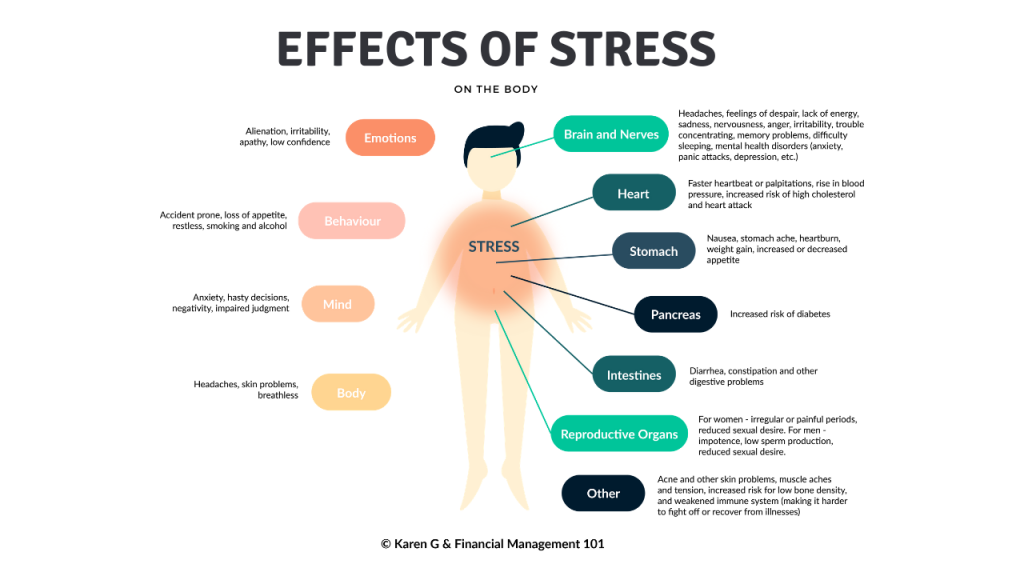
If you take a look at this illustration you’ll see that it’s affecting many areas within your body, some are obvious while others may surprise you.
I want you to look at the left hand side of this diagram to see how first hand it’s affecting your emotions.
When your emotions are overloaded by stress, you become irritable, you may alienate yourself from others and your confidence drops.
When you’re under stress, your behaviour changes and you may become accident-prone, lose appetite, take up recreational drugs or alcohol, and/or start smoking.
And no surprise here that stress greatly affects your mind and mental well-being, where you may experience more anxiety, become negative or make impaired decisions and judgments where you otherwise wouldn’t have done.
The area that I see common with stressed out people is when they experience headaches, skin problems and become breathless.
But did you know that stress can have a detrimental affect on other areas within your body like, complaints either in the form of diarrhoea or heartburn.
In more severe cases, stress can also affect your heart. You may experience heart palpitations or even worse, a heart attack.
In some cases stress has know to be the start of more serious issues like cancer and diabetes.
So you can see it’s more important than ever to take care of yourself and look at what’s stressing you out.
For a lot of people money is the biggest stress as I’ve outlined early in findings by the Australian Psychology Well Being Survey.
While I don’t have a cure for how stress affects the body – I do have a solution that anyone can adopt where financial issues are part of their stress and that’s getting more information and knowledge about how money works.
Obtaining financial education to improve your money position is critical to living a healthy stress free life.
Getting the right financial education, support and coaching will alleviate financial stress if you are serious about improving the quality of your life.
What I offer is a full coaching service that’s affordable while you get the support, knowledge and help you require to make better and healthy financial decisions.
So if money stress is causing you problems then check out how you can work with me in the resources below.
If you’ve recently lost your job or you feel you’re about to, here are some things you can do right now to make sure you survive during the uncertain weeks or months ahead.
Okay so you need cash and you need to earn it fast.
There are 3 basic things you need to make sure you have secured during this rough uncertain and unpredictable time and that is:
Make sure you have food on the table for you and your family.
You have shelter. A roof over your head to weather out this nasty health disaster.
Protect your mental health and wellbeing.
Listen to this podcast as I share with you 5 ways to make sure you’re going to survive;
For more support and help in during this uncertain time join my private FB GROUP where you will be supported and receive more financial and mindset education to help get you through this.
If you’ve recently lost your job or you feel you’re about to, here are some things you can do right now to make sure you survive during the uncertain weeks or months ahead.
Okay so you need cash and you need to earn it fast.
There are 3 basic things you need to make sure you have secured during this rough uncertain and unpredictable time and that is:
Make sure you have food on the table for you and your family.
You have shelter. A roof over your head to weather out this nasty health disaster.
Protect your mental health and wellbeing.
Here are 5 ways to make sure you’re going to survive;
1If you have a mortgage broker now is the time to make contact with them if they haven’t already got in touch with you to discuss your home loan options.
If you feel you don’t have someone who you can trust in this area then I’ll drop you the name of a broker who is loyal, trustworthy and has the homeowner’s best interests at the forefront.
A point to note is that I don’t have any affiliation with this company, nor do I receive any kickbacks. I’ve just known them for a very long time and they’ve shared many tips with me to help my clients pay down their home loan debt as fast as possible, all without any strings attached.
2 If you’re not comfortable talking with a mortgage broker then get on the phone with your bank or lending institution and negotiate a deal that sees you freezing your monthly mortgage payments for the next couple of months.
What the bank will do in most cases is hold of taking payments for a short period of time, or they may even negotiate with you just paying interest-only payments.
Once this storm has passed, they will get you making small additional payments on top of your regular mortgage payments, once things go back to the “new normal” and you’re earning an income again.
3 Get in touch with your credit card provider and see what they can do for you to hold off making any monthly credit card payments. There may be something they can do to stop the cash bleed going towards paying your debts while your cash is in short supply.
4 If you’re renting then get on the phone and talk to your landlord to see what they will do to help take the strain of worrying about how you can afford to keep the roof over your head.
Most cases they are going to be in the same situation, worried that if you move out how will they afford to keep up their ongoing mortgage commitments on the property you’re living in. It’ll be up to them to negotiate with the bank to see what they can do on the other side to hold off future mortgage payments until things become a little more financial.
5 Now you’ve made contact with your bank or lending institution, next you have to see where you can find some cash or get some part-time work to make sure you survive during this traumatic time.
With the coronavirus pandemic impacting almost every business, some entrepreneurs are thriving and looking at ways to support their employees during this difficult time.
There are some industries that are still hiring and in fact looking to increase their staffing requirements because they’re in areas where they are in high demand during this time.
Supermarkets are one example as soon as they stack the shelves they are empty again. Some of the areas they are hiring and looking for are packers, bakers, customer service staff – check your supermarket’s website to see what they need.
Fast food deliveries have seen an increase in demand due to self isolation requirements and companies like Uber eats have seen an increase where they are looking for more drivers.
There’s a job board I discovered this week called Jora which is an Australian based search engine for jobs. Unlike traditional job boards, individuals can search through thousands of career opportunities, all sourced from many job sites from around Australia.
They list updates every 24 hours with new job opportunities. The site even breaks it down into job type, salary, location and job titles. Go check out it.
Here’s the link to Jora Australia just click on it and see if there’s something for you.
Other ways to get extra cash is;
You could look around the house to see what’s cluttering your home that you could sell online.
Or if you’re crafty and creative, how about sell your stuff online at sites like Etsy.
What about if you’re a cafe owner who a person who can bake. Why not teach someone how to decorate cupcakes, or another favourite baking item of yours and get paid for it by setting up a class online. People are basically in isolation looking for new creative ways to fill in their time.
You could also look to partaking in online surveys or focus groups and get paid to give your opinion.
Another is to sell your expertise online, whether you’re a tutor, teacher or have an expertise that you could share or teach online and get paid for it.
Why not look at some freelance work at sites like Fiverr, Upwork, Craigslist to name a few. Check out these sites as there may be something you’re good at and get paid for.
Affiliate marketing is another way, if you have a blog or website, you could get paid for advertising someone’s business on your site.
6 Okay next look to see where you can cut all unnecessary costs.
Go through your bank statement and see what you’re spending your money on.
What subscriptions do you have that you can go without for a while that will save you any money big or small?
I recently did this exercise as I often have things I’ve subscribed to that I don’t use any more. So because I hate giving good money away, I cut about 4 subscriptions and put $80 back in my pocket per month.
One of these was to suspend my audible account for the next 90 days as I have enough books in my library to keep me going for a year.
It may not sound like much but saving $50 or $100 will make the difference when you need to put food on the table or keep the roof over your head.
If you’ve got an iPhone go through the settings tab on your phone and check out your apple account to see what subscriptions have slipped through the cracks.
Gym membership is a big one at the moment because you can’t go out so why not suspend or cancel it if you can.
What streaming providers do you need? Do you need everyone that’s on offer at the moment like Foxtel, Netflix, Stan, Disney or even Amazon Prime to name the ones off the top of my head?
Maybe decide on one or two and cancel the rest. Wherever you can save a few dollars do it.
You’ve got to be ruthless and tough. Just as I am sitting here writing this our daughter came in wanting to buy an online game for her iPad.
It may have been only $5 and she said I’ll use my own money. That’s fine but as I said to her do you really need it right now and why not see if you can save that money for a bit longer to can go without for the next month before you decide to shell out your pocket money.
If we can teach our kids now the importance of saving, when a time like this comes up in THEIR working life, they’ll have the skills to knuckle down and not spend on non-essentials.
Now is the time to teach your kids about the value of money and how looking after the cents will amount to huge amounts of dollars later in life.
Look at what you’re spending your money on and see where you can cut down on things.
Sadly, most don’t have 6 – 8 months worth of emergency money so look at ways to get some dollars in the door fast.
You’ll need to make sure you have about 90 days worth of money to see you through.
Your job right now is to get a job if you’re not working and bring in some money to take the pressure off.
This will help keep your spirits high and look after your mental well being and health.
There is nothing more stressful than financial worry and pressure, so do what you can and see if any one of the suggestions I’ve offered above helps you out.
If you need emotional support or looking for more information on how to take the financial pressure off, then join my FB Group where I will be here for anyone needing an ear, as well as, sharing more tips and information.
I look forward to hearing from you.
In the meantime stay safe and healthy.
Reference: Mortgage Broker – Harry Bozin CLICK HERE for more info.
I talk a lot about building financial muscle and for good reason.
Why? Because some people today still don’t have their money working for them and they’re making dumb decisions when it comes to managing it effectively.
My concern is that when these people decide around 65 – 70 years of age that they would like to retire – they’re going to struggle!
Why, because they’re going to have nothing to enjoy their retirement years with, as they’ve spent everything they’ve earned along the way.
Financial muscle as I bang on about constantly, is making sure firstly that you’re hard earned money is working for you and not your bank’s.
And secondly, it’s about having something put away for “just in case” which “just in case” comes up a fair bit during our lifetime.
So how nice would it be to know that you’ve got money and it’s working to your advantage when you need it.
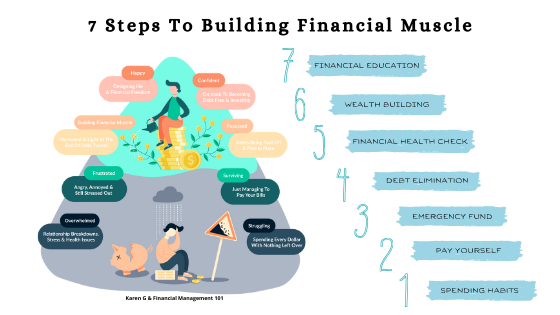
Here are 7 steps you need to know when it comes to building financial muscle and they are:
1 Looking at your spending habits. What are you spending your money on each and every payday? Are you spending it on things that are worthless and while short term makes you feel good initially but then when it comes to paying your bills you haven’t anything left to pay for them?
My guess is, this is when you start to feel stressed out and your life becomes very overwhelming.
The quickest and easiest way to get a handle on what you’re spending is to look at doing a budget. For the first month, you write down everything you spend and then deduct what you earn by what you’ve spent for the month.
More often than not, you’ve used credit to help get you out of a bind, but it’s not working and you’re getting further and further into debt.
2 Next, once you’ve worked out if there’s any surplus, you’ll want to make some adjustments in your spending to put away a small percentage around 10% of what you earn into a savings account.
Now 10% is not a lot of money, but you’ll need to do this first at payday before you pay any bills or use some of your income on other expenditure.
Once you’ve put away 10% or even $20 or $30 into a savings account then put on autopilot, where every payday money goes from your pay into this account. I guarantee you’ll start to think about your money a little differently.
Something magical happens when you know you have some money saved and you start to feel a little more confident and less stressed and it gives you a greater sense of security.
3 Ok the third area where you’ve got to be strict with yourself is to open another savings account, one that is too hard to get access to and start building on your emergency fund.
You’ll need to get your emergency fund up to at least $2000 as quickly as possible.
There are many ways to get this account up to $2000 and the first is to look around your home. What could you sell online that’s sitting around in your garage or shed that’s gathering dust?
The emergency fund is the 3rd most critical aspect to building financial muscle because it takes the pressure off you and your money when those unexpected things arise like your hot water goes on the blink or your fridge packs up.
The emergency fund is for exactly that emergencies that make life very difficult if they’re not fixed or replaced.
Ideally, the emergency fund needs to be at a balance where if you lost your job or you couldn’t work for 6 months, you would have enough money to be able to pay your bills until you get back to working again.
4 The major stress for most people is their ever-increasing debt, whether it be from overspending on credit or the mortgage on your home.
I can’t stress enough that when you finally become debt-free life is going to be a whole lot more fun. Things that used to stress you out are suddenly gone and all the pressure of working at a job that you probably don’t like now gives you the power and choice to look at whether you continue working there.
If you’re not working to pay down all your debts as fast as you can – you’re just throwing away good money to the banking institutions that are funding your poor money habits and making them richer while you become poorer.
Map out who you owe, how much you owe and then start with one debt at a time and pay that down until it’s gone. Once the first debt has been eliminated, then use the money that you paid the debt down with to double up on the next debt.
5 Ok, so the next step in building financial muscle is to stop and do a quick financial health check.
A financial health check will look at quite simply if there are any areas within your money that you need to work on, or get more information on, to get you back on track and retiring comfortably.
I have a 5 min financial health check that you can download HERE to get you started.
6 Now you’ve got money being saved, your debts are being paid off, it’s now time to look at your wealth-building strategies.
Your wealth-building will consist of two parts:
Investing and
Protecting
Let’s talk about investing first.
Investing is about growing your money through facilities like superannuation and other investment options.
Superannuation is a way of saving for retirement.
Essentially your employer in Australia is putting away a percentage of your salary into a fund of your choice that invests the money until you retire.
It’s a forced type of saving but brilliant to help those in particular that are not good at saving and will see you have some money at the end of your working life.
This is a big topic that’s too big to cover off in this post, so I will write a post on this and explain in more detail shortly, so keep an eye out for it.
Other investment options for wealth building during your working years could consist of investing in shares, managed funds or property to name a few.
I would encourage anyone looking into wealth building to seek a financial adviser who is qualified to provide advice on what assets or which investment vehicle is best for you and your personal circumstances.
There are many out there so be careful and take the time to ensure they have your best interest at the forefront of their advice giving.
Next, I want to talk about protecting your money. This is a very important topic. Today, I’ll give you a brief summary but like the topic on superannuation, I’ll be writing more about this in another post.
But for now, let me explain why it’s important to have a Will or good Estate Plan.
A Will and Estate Plan are there to make sure your wishes at the end of your life are carried out and distributed properly.
A Will is a legal document that states what you would like to happen with your assets when you die and forms part of your Estate Plan.
An Estate Plan, on the other hand, records exactly what you would like to happen with your assets upon death and includes documents such as your Will, a testamentary trust, superannuation assets and may contain powers of attorney or other such documents that in the event of you being unable to make decisions, someone appointed by you will act on your behalf.
So as you can see from the brief descriptions above it is extremely important to make sure you are protecting what you’ve worked long and hard to build.
If you die without making a Will it means you die intestate and this causes a lot of heartache and headache for your loved ones left behind.
What actually happens here is that your estate is left to deal with either from the Supreme or Highest Court, depending on which state you live in Australia, who will appoint an administrator.
The administrator’s job is to arrange the funeral and distribute any leftover assets after paying any debts and taxes. Sometimes there are fees associated with an administrator taking care of your details which means your loved ones may not receive the full inheritance you had planned on leaving them.
So make sure you have a current Will your priority today because nobody knows when our time is up.
7 And lastly, the 7th step to building financial muscle is to get yourself ongoing financial education and support.
Just like a sporting team, they all use coaches to help them and guide them to their sporting greatness.
Financial coaching is much the same, an experienced coach who knows sound financial education can make the difference between living with financial stress or living your life the way you’ve always desired – happy and stress-free.
If you’ve read to the bottom of this and you’ve followed the steps outlined above then congratulations as you are one who is committed to living a financially comfortable life.
Why not continue with your financial education by working with me on a monthly basis.
I offer several options, but the first is the most preferred as it’s inexpensive and extremely supportive towards you achieving awesome financial health.