
Cash Flow is King: Why Every Small Business Owner  Needs a Financial Plan (Not Just More Work)

Cash Flow is King: Why Every Small Business Owner  Needs a Financial Plan (Not Just More Work)

If you’re a tradie, Franchisee or small business owner, chances are you’ve said this before:

“I just need more work.”
“If I can land that next big job, I’ll be sweet.”
“Once I get through this month, I’ll finally get on top of things.”

Sound familiar?

We’ve been sold this idea that working more hours or taking on more jobs is the key to financial stability.

But here’s the truth…

More work won’t fix your money problems if your financial plan is broken.

Let me say that again: More work won’t fix broken cash flow.

In fact, working harder without a system can actually worsen your money stress – leading to burnout, resentment, and a business that runs you, instead of the other way around.

In this blog, I’ll break down why cash flow is king, how small business owners end up in the trap of “more jobs = more chaos”, and what you can do to take control of your money (without working yourself into the ground).

The Myth of “More Work = More Money”

Let’s say you take on 3 new clients this month as a tradie. Awesome, right?
But then:

  • You buy more materials
  • You spend more hours on-site
  • You hire a subbie to help out
  • You juggle more admin
  • You forget to invoice someone
  • And suddenly – you’re busier than ever… but your bank account doesn’t show it

That’s because revenue doesn’t equal profit, and being busy doesn’t equal being financially fit.
You can be flat-out all month and still feel broke.

That’s the trap, and I see it every week with tradies, franchisees and business owners who are absolutely brilliant at what they do… but never learned how to manage the money side of things.

So What’s the Real Problem?

It comes down to one powerful truth:

Cash flow – not just income – is what makes or breaks your business.

Cash flow is the movement of money in and out of your business.

Not just how much you make, but:

  • When you get paid
  • How consistently money comes in
  • What goes out each week
  • Whether you’re left with a profit (or just scraping by)

If you don’t have control over your cash flow, you’re always reacting. You’re playing catch-up. And that stress leaks into everything – your health, your relationships, and even the quality of your work.

Here’s What Cash Flow Chaos Looks Like

If you’ve ever experienced any of these, you’re in a cash flow crunch:

  • You avoid checking your account because you’re afraid of what you’ll see
  • You wait until BAS is due to realise you owe thousands
  • You struggle to pay your own wage regularly
  • You’re always chasing late invoices
  • You can’t take time off because you’re constantly hustling to “keep up”
  • You’ve had to dip into your personal savings more than once

Sound familiar? You’re not alone. But the good news is – it’s fixable.

The Solution: A Simple, Small Business – Friendly Financial Plan

You don’t need a finance degree or a fancy accountant to get this sorted. You just need a clear plan for how money flows through your business. Here’s how to start building one.

1. KNOW YOUR BREAK-EVEN POINT

This is the minimum amount of money you need to earn each month to cover:

  • Business expenses (tools, fuel, phone, materials, subs, etc.)
  • Your personal wage
  • Tax and super
  • Any loan or debt repayments

Without knowing your break-even, you’re guessing. You’re flying blind. Once you’ve nailed this number, everything becomes clearer.

Now, you can set targets based on facts – not hope.

2. PAY YOURSELF A WAGE – YES, YOU!

This is the game changer. Every time income hits your account, it should be split into different buckets. That way, you’re not tempted to spend what should’ve gone to tax, bills, or your own pay.

Here’s a simple version that works great for small business owners:

✅ Income Account
Where all your payments land. This is your holding zone.

✅ Owner’s Pay Account
Your regular wage. Non-negotiable. You work hard, you deserve to be paid consistently.

✅ Expenses Account
Materials, suppliers, fuel, subscriptions, etc.

✅ Tax & BAS Account
Put aside 25 – 30% of every payment for Tax plus the GST portion. No more panic come BAS time.

✅ Profit Account
Even just 5% of each job. This is for rainy days, growth, or peace of mind.

You can set this up in 30 minutes through online banking. Once you do? You’ll sleep better knowing your money is finally working for you.

3. TRACK YOUR MONEY CASH FLOW

Once a week, check in on your numbers. This doesn’t need to be a 2-hour admin marathon. I’m talking 20–30 minutes to:

  • See what came in
  • Check what went out
  • Update your numbers
  • Chase unpaid invoices
  • Move money into your buckets

Make this a weekly ritual (I call it a Money Date) and watch your confidence skyrocket. Because the more you look at your money, the less power it holds over you.

4. TRACK YOUR MONEY CASH FLOW

You can have all the work in the world, but if your prices don’t reflect the true cost of running your business – you’ll never get ahead.

Too many small business owners undercharge because they’re afraid of losing the work.

But if you’re not charging for:

  • Admin time
  • Quote prep
  • Travel
  • Time off tools
  • Overheads
  • Profit margin

…then you’re not building a business. You’re building a time bomb.

You should be pricing with confidence, knowing that it covers everything – not hoping for the best.
Inside The Edge, I teach you a simple pricing calculator so you know exactly what to charge and why.

5. BUILD A BUFFER FUND

We all know some work can be seasonal or unpredictable.

A job gets delayed. A client pays late. You get sick. And suddenly your cash flow takes a hit. That’s why a buffer fund is crucial.

Aim to build up 1–3 months’ worth of business expenses in a separate account. This gives you breathing space and avoids making panic-driven decisions like slashing prices or taking on crappy jobs just for quick cash.

Start small – $50 a week adds up. Automate it. Make it part of your money system. 

Build a Buffer Fund

The Truth? You Don’t Need More Work. You Need a Better Money Plan.

You don’t need to hustle harder. You don’t need to take every job that comes your way. You need to manage your money better so the work you’re already doing actually pays off. Imagine this:

  • Getting paid consistently – even in quiet months
  • No more panicked BAS seasons
  • Knowing exactly what your business needs to earn each week
  • Saying YES to time off without financial stress
  • Watching your bank account grow, not shrink

That’s what happens when cash flow becomes your king, and your systems support you, not sabotage you.

And That’s Exactly What We Do Inside THE EDGE

THE EDGE is a 6-week coaching program for tradies, franchisees and small business owners who are ready to stop guessing and start owning their business money. We’ll help you:

✅ Set up a cash flow system
✅ Price for profit
✅ Get your BAS and tax sorted
✅ Pay yourself consistently
✅ Build a buffer
✅ Plan for growth (without working more hours)

It’s simple, structured, and built for people who are great at their trade, not spreadsheets.

Final Thoughts: Work Smarter. Get Paid Properly. Stress Less.

You didn’t go into business to work 24/7 and still worry about money.

You started your business for freedom, flexibility, and a better life. And the path to that life isn’t more work. It’s better cash flow.

So if you’re ready to take the pressure off and finally feel in control of your business money…

Join THE EDGE: 6-Week Coaching Program

Your business doesn’t need to change, it just needs a plan. Let’s build it together.

THE EDGE - 6-WEEK PROGRAM
Are You Working Hard But Still Broke? Here’s What Tradies and Small Business Owners Need to Know About Money

Are You Working Hard But Still Broke? Here’s What Tradies and Small Business Owners Need to Know About Money

Let’s talk straight.

You’re working your guts out. The tools are always in your hands, you’re answering calls at all hours, quoting jobs, managing clients, juggling suppliers, and doing all the behind-the-scenes stuff nobody sees. From the outside, you look successful – people assume you’re rolling in it.

But you’re not.

Behind the scenes, you’re quietly stressing about money. There never seems to be enough to get ahead. You’re chasing late invoices, dipping into your personal savings, and wondering why you feel broke when you’re working harder than ever.

Sound familiar?

If you’re a tradie or small business owner stuck in this cycle, let me be the one to tell you: you are not alone – and it’s not your fault. But it is time to do something different.

Let’s unpack what’s really going on, and what you can do right now to change the game for good.

Why Hard Work Alone Isn’t Paying Off

There’s this old-school mindset that says: “If you just work hard enough, the money will come.”

But here’s the truth: working harder doesn’t guarantee financial success.

You can work 60+ hour weeks and still be broke if:

  • Your pricing isn’t profitable
  • You don’t have a money system in place
  • You’re not managing cash flow properly
  • You don’t have a plan for your income
  • You’re guessing instead of tracking

Hard work is important – but smart money management is where the real financial freedom begins.


Why Hard Work Alone Isn’t Paying Off

The Trap Most Business Owners Fall Into

When you’re running your own business, you wear all the hats – operator, bookkeeper, marketer, customer service rep… and somehow, you’re supposed to be a financial expert too?

It’s a lot. And most people end up winging it.

Here’s what that often looks like:

  • All your income goes into one account (usually the same one you use to buy groceries).
  • You pay bills as they come up, hope there’s enough left over for tax, and pay yourself last (if there’s anything left).
  • You do jobs, get paid, then start from scratch trying to get more work.
  • BAS time? Cue panic.

That kind of financial chaos leads to one thing: burnout.

Because let’s face it – there’s nothing more frustrating than working your butt off and still feeling like you’re just scraping by.

Let’s Fix This: Money Tips Every Tradie & Small Biz Owner Needs

You don’t need an accounting degree or a finance background to turn your money situation around. You just need a few smart systems, a clear plan, and a coach who gets where you’re at.

Here’s where to start:

1. KNOW YOUR REAL NUMBERS

Let’s start with a basic but powerful truth: If you don’t know your numbers, you don’t know your business.

You need to get crystal clear on:

  • What it costs to run your business monthly
  • What you need to earn to break even
  • How much you need to pay yourself regularly
  • What profit you’re actually making

Many tradies and small business owners confuse revenue with profit – but just because you billed $10k this month doesn’t mean you earned $10k.

Once you see the real numbers, you’ll understand why the money keeps vanishing, and what needs to change.

2. PAY YOURSELF A WAGE – YES, YOU!

Here’s a wild idea: You deserve to be paid like an employee in your business.

Too many business owners pay themselves last – if at all. That ends today.

Start setting a weekly or fortnightly wage for yourself, even if it’s small at first. The goal is consistency. It helps you budget your personal life and builds a healthier relationship with your business finances.

You’ll be amazed at how this one habit shifts your mindset from chaos to control.

3. CREATE A MONEY FLOW SYSTEM THAT WORKS FOR YOU

This is a non-negotiable. If you’re running everything through one account, your finances are a mess (even if it looks like it’s working).

Set up a dedicated business account and keep your personal expenses out of it.

From there, set up these buckets:

  • Income Account – where all client payments go
  • Owner’s Pay Account – your personal wage
  • Expenses Account – materials, tools, fuel, etc.
  • Tax & GST Account – set aside 25 – 30% as you go
  • Profit Account – yes, you should be making profit!

This keeps everything cleaner, easier to manage, and stress-free come tax time.

4. DON’T JUST HUSTLE – PRICE PROPERLY

Undercharging is one of the biggest reasons business owners stay broke.

You’re not just getting paid for your time – you’re charging for your expertise, overheads, insurance, fuel, time off tools, admin, and the value you bring to the job.

If your pricing doesn’t factor in all of that (plus a margin for profit), you’ll always be playing catch-up. In THE EDGE, we teach a powerful pricing formula to help you know your numbers and charge with confidence – without feeling guilty about it.

Don’t Just Hustle - Price Properly

5. BUILD A BUFFER, NOT JUST A BUSINESS

You know what’s worse than a quiet month? A quiet month with no savings.

A simple business buffer – 3 months’ worth of expenses, is your safety net. It turns a slow season from a disaster into a non-event.

Start small. Set aside a small percentage of every job into a savings account. Over time, you’ll build a cushion that gives you breathing room when you need it.

And trust me – you will need it.

6. PAY YOURSELF A WAGE – YES, YOU!

Most business owners don’t fail because they’re lazy. They fail because they didn’t plan ahead.
That’s why a big part of The Edge coaching program is helping you build your Money Game Plan:

  • How much do you want to earn?
  • How many jobs or clients do you need?
  • What are your monthly expenses?
  • What’s your profit target?
  • What’s your 6-month and 12-month plan?

When you have a clear plan, everything becomes easier. You know what you need to do, when you need to do it, and how to stay on track.

7. GET SUPPORT – DON’T GO IT ALONE

One of the biggest mistakes I see? Trying to do it all yourself.

Running a business is hard enough. Trying to fix your money struggles without guidance? That’s like trying to build a house with no blueprint and one arm tied behind your back.

That’s where THE EDGE 6-Week Coaching Program comes in.

It’s designed specifically for tradies, solo operators, franchisees and small business owners who are great at their trade but tired of being stressed about money.

You’ll learn:

  • How to manage cash flow like a boss
  • How to set up your business money system
  • How to price your services properly
  • How to plan for BAS, tax, and quiet seasons
  • How to pay yourself consistently and profitably

And most importantly – you’ll have support, accountability, and a step-by-step plan to follow.

Final Thoughts: It’s Time to Take Your Power Back

Being broke while working hard isn’t a badge of honour – it’s a signal that something needs to change.
You deserve to enjoy the rewards of your effort. You deserve to have money in the bank. You deserve a business that supports your life, not one that drains it.

If you’re ready to ditch the stress, sort out your money once and for all, and build a business that truly pays off, then THE EDGE is your next move.

Join THE EDGE: Your 6-Week Business Money Makeover

 ✅ Designed for tradies, franchisees and small business owners
✅ 6 weeks of step-by-step financial coaching
✅ Simple systems that work (even if you hate spreadsheets)
✅ Learn how to price right, manage cash flow, and finally pay yourself
✅ Personalised support and no-fluff accountability

Let’s stop surviving and start thriving.
? Join The Edge now and take control of your business money.

THE EDGE - 6-WEEK PROGRAM
The Big Picture: Why Net Position Matters More Than Budgeting

The Big Picture: Why Net Position Matters More Than Budgeting

When people think about managing their finances, budgeting is often the first thing that comes to mind. While budgeting is an essential tool, it’s only one piece of the puzzle. To truly take control of your financial life, you need to understand your net position. This bigger-picture view is the cornerstone of long-term financial success. In this blog, we’ll dive into what net position is, why it matters, and how it can transform your approach to money management.

What is Net Position?

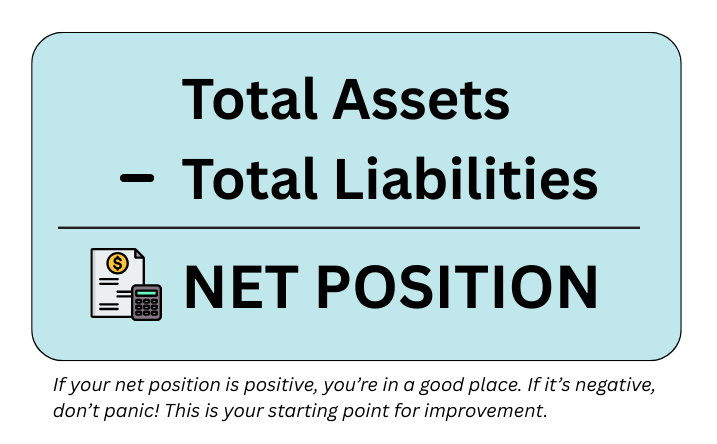
Your net position is the difference between what you own (your assets) and what you owe (your liabilities). It’s essentially your financial scorecard, giving you a snapshot of your overall financial health. Here’s a simple formula:

Net Position

Assets include things like your home, car, savings, and investments. Liabilities include mortgages, credit card debt, personal loans, and other financial obligations. Knowing your net position helps you understand whether you’re building wealth or accumulating debt.

Why Net Position Matters More Than Budgeting

Budgeting is about managing your monthly cash flow, how much money comes in and goes out. While this is important, it doesn’t give you a complete picture of your financial health. Here’s why focusing on your net position is a game-changer:

1. PROVIDES A HOLISTIC VIEW

      • Budgeting focuses on short-term goals, like paying bills or saving for a vacation. Net position shows your long-term financial standing, including the value of your assets and the weight of your debts.

2. HELPS SET REALISTIC GOALS

      • Understanding your net position allows you to set achievable financial goals, whether it’s buying a home, retiring early, or becoming debt-free.

3. REVEALS FINANCIAL TRENDS

      • Tracking your net position over time helps you see whether your financial health is improving or deteriorating.

4. GUIDES BETTER DECISION-MAKING

      • Knowing your net position helps you make informed decisions about spending, saving, and investing.

Common Misconceptions About Net Position

Budgeting is about managing your monthly cash flow, how much money comes in and goes out. While this is important, it doesn’t give you a complete picture of your financial health. Here’s why focusing on your net position is a game-changer:

1. “Only Wealthy People Need to Track Their Net Position”

      • False! Everyone, regardless of income level, can benefit from understanding their net position. It’s about knowing where you stand and where you’re headed.

2. “Budgeting Alone is Enough”

      • While budgeting is crucial for managing day-to-day expenses, it doesn’t address your overall financial health.

3. “It’s Too Complicated”

      • Tracking your net position can be as simple as listing your assets and liabilities in a spreadsheet or using a financial app.

Steps to Improve Your Net Position

1. ELIMINATE HIGH-INTEREST DEBT

      • Focus on paying off credit cards and personal loans first. These often carry the highest interest rates and can significantly impact your financial health.

2. INCREASE YOUR SAVINGS

      • Build an emergency fund with at least three to six months’ worth of living expenses. This provides a financial safety net and reduces the need for high-interest debt during emergencies.

3. INVEST WISELY

      • Grow your assets by investing in a diversified portfolio. Consider long-term investments like retirement accounts or real estate.

4. REDUCE LIABILITIES

      • Pay down loans and avoid taking on new debt unless it’s for a strategic purpose, like buying a home.

5. TRACK YOUR PROGRESS

      • Revisit your net position quarterly or annually to measure your progress and adjust your financial plan as needed.

How Our “Know Your Numbers” Course Can Help

Our “Know Your Numbers” course is designed to take the guesswork out of understanding your net position. Here’s what you’ll learn:

1. HOW TO CALCULATE YOUR NET POSITION 

      • Step-by-step guidance on listing your assets and liabilities.

2. TOOLS AND TEMPLATES

      • Access user-friendly calculators and spreadsheets to track your progress.

3. STRATEGIES FOR IMPROVEMENT

      • Learn actionable steps to grow your assets, reduce your liabilities, and increase your net worth.

4. REAL-LIFE EXAMPLES 

      • See how others have transformed their financial health by focusing on their net position.

Success Stories

1. JOAN’S TRANSFORMATION

Joan discovered her net position was negative due to high credit card debt. Using strategies from the course, she paid off her debt in two years and now has a positive net worth of $20,000.

2. PETER’S JOURNEY

Peter thought he was doing well because he had a high income. After calculating his net position, he realised his debt outweighed his assets. He’s since restructured his finances and is on track to achieve financial independence.

Know Your Numbers

Conclusion

Understanding your net position is the key to unlocking financial freedom. It’s not just about how much you earn or spend; it’s about the bigger picture of what you own versus what you owe. By focusing on your net position, you can make smarter financial decisions, set realistic goals, and build a secure future. Ready to take control? Join our “Know Your Numbers” course today and start your journey toward financial clarity and success.

The Vault