
How to Price Your Products or Services Properly (Without Undervaluing Yourself)

How to Price Your Products or Services Properly (Without Undervaluing Yourself)

Pricing your products or services can feel like one of the most uncomfortable parts of running a business.

You sit there staring at a number, wondering:

Is this too high?
Is this too low?
Will people actually pay this?
What if I lose customers?

So instead of making a clear, strategic decision, you do what most small business owners do…

You guess.

Maybe you look at what competitors are charging and land somewhere in the middle. Maybe you choose a number that “feels reasonable”. Or maybe you go lower than you’d like, just to be safe.

And while that might feel like the least risky option, it’s actually one of the biggest reasons businesses struggle to grow.

Because pricing isn’t just about making a sale, it’s about building a business that actually works.

If your pricing is off, everything feels harder. You work more, earn less, and constantly feel like you’re chasing your tail. But when your pricing is right, things start to click. You attract better clients, your workload becomes more manageable, and your business becomes far more sustainable.

So let’s break this down properly and give you a clear, practical approach to pricing your products or services, without the guesswork.

The first thing to understand is that pricing is not just a financial decision. It’s also a positioning decision.

The price you set tells your customers something about your business before you even speak to them.

A lower price often signals affordability and accessibility, but it can also suggest lower value. A higher price can position you as premium, but only if the experience and results match.

Neither approach is right or wrong, but it has to be intentional.

The problem is that many business owners don’t choose a position. They end up somewhere in the middle, without a clear strategy, trying to appeal to everyone, and ultimately attracting the wrong customers.

And this is where pricing starts to create stress.

Because when your pricing doesn’t align with your costs, your value, and your positioning, you feel it every single day in your business.

Because when your pricing doesn’t align with your costs, your value, and your positioning, you feel it every single day in your business.<br />

One of the most common mistakes is relying too heavily on competitor pricing.

It seems like the logical place to start. After all, if everyone else is charging a certain amount, it must be the “right” price… right?

Not necessarily.

You don’t know their financial situation. You don’t know their cost structure. You don’t know their profit margins. And you definitely don’t know whether they’re actually making money.

There are plenty of businesses out there that look successful on the surface but are barely breaking even behind the scenes.

So when you base your pricing on competitors, you’re not creating a strategy – you’re copying someone else’s guess.

And that’s a risky way to run a business.

Instead, your pricing needs to start with your numbers.

At its simplest level, pricing comes down to one core idea: Your price must cover your costs and generate a profit.

Sounds straightforward, but this is where most business owners get it wrong. Because they don’t fully understand their costs.

When people think about costs, they often focus on the obvious ones; materials, stock, or direct expenses tied to delivering a product or service.

But there are so many hidden costs that get overlooked.

Your time is a cost. Admin work is a cost. Emails, phone calls, quoting, planning, travel—it all adds up. Even things like software subscriptions, marketing tools, insurance, and professional services need to be factored in.

If you’re not accounting for all of these, you’re underpricing – whether you realise it or not. And that’s where the frustration begins. You’re busy. You’re making sales. But at the end of the month, there’s not much left over.

Not because your business isn’t working, but because your pricing isn’t supporting it.

Then there’s the topic of profit.

This is where things get a little uncomfortable for many business owners. Because profit can feel… optional. Something extra. Something you’ll get to “eventually”.

But here’s the reality: Profit is not a bonus. It’s a requirement. Profit is what allows you to:

  • Pay yourself properly
  • Reinvest in your business
  • Handle unexpected expenses
  • Grow sustainably

Without profit, your business becomes a job and often not a very well-paid one. So instead of hoping there’s money left at the end, you need to build profit into your pricing from the start.

Even if it’s small to begin with, it needs to be intentional.

Now, once you understand your costs and include a profit margin, the next step is thinking about value. Because pricing isn’t just about covering costs – it’s also about what your customer is receiving.

This is where value-based pricing comes into play

Let’s say you’re offering a service that helps a client increase their revenue, save time, or reduce stress. The value of that outcome is often far greater than the time it takes you to deliver it.

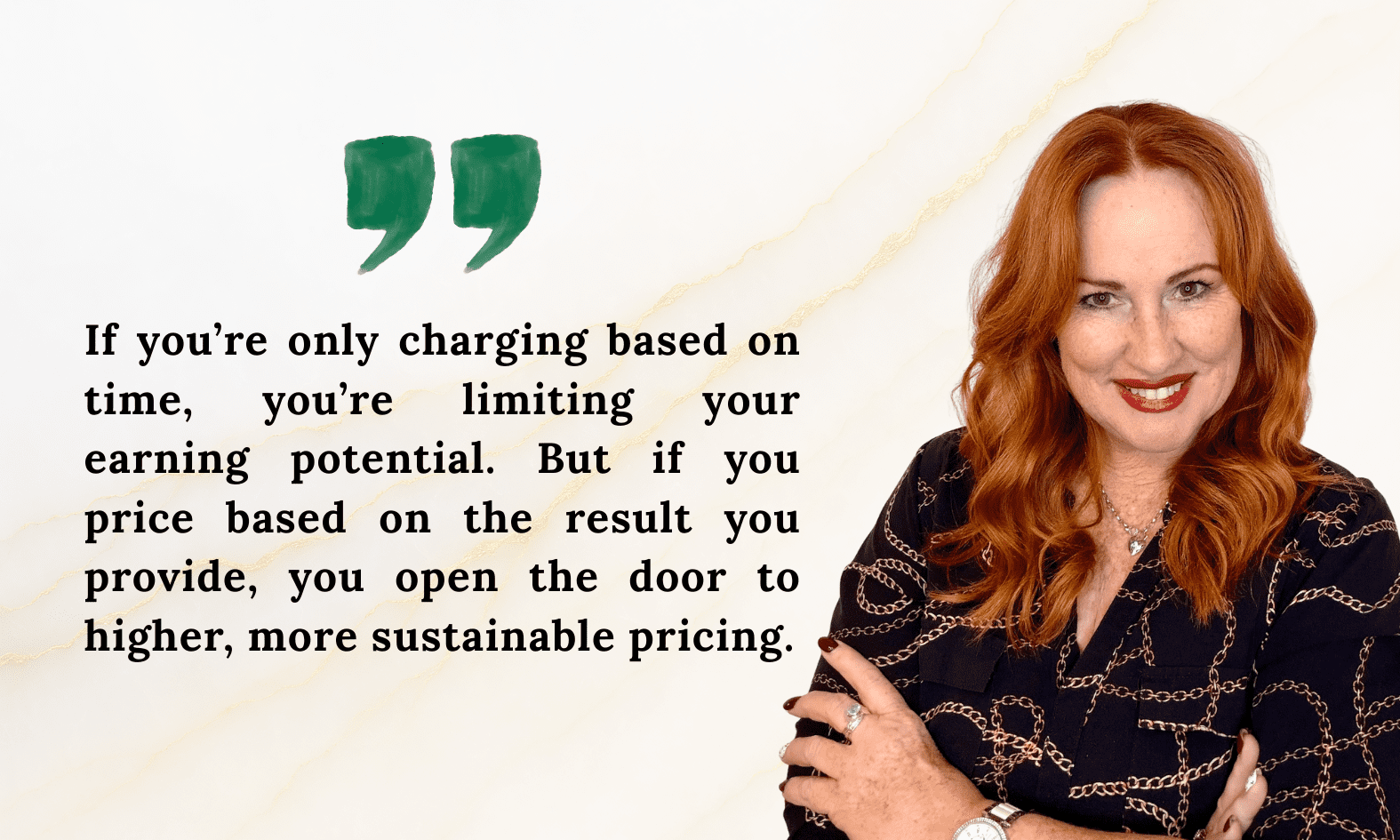
If you’re only charging based on time, you’re limiting your earning potential. But if you price based on the result you provide, you open the door to higher, more sustainable pricing.

This doesn’t mean ignoring your costs; it means combining both approaches.

Know your baseline (your costs and required profit), then position your pricing based on the value you deliver.

Of course, even when you understand all of this, there are still a few traps that can quietly pull your pricing down.
One of the biggest is underpricing to win customers

It feels like a smart move to make your offer more attractive, get more sales, and build momentum.

But what often happens is that you attract price-sensitive customers who are always looking for the cheapest option. They’re harder to please, quicker to leave, and less loyal overall. And because your margins are lower, you need more of them just to stay afloat.

That’s not a recipe for a healthy business.

Another common trap is discounting too quickly. A customer hesitates, and before they even ask, you offer a lower price. It might help close the sale in the moment, but it also reduces your perceived value and sets a precedent.

Over time, it trains customers to expect discounts and makes it harder to charge your full price.

Then there’s the habit of avoiding price increases altogether.

Costs go up. Expenses rise. But your prices stay the same.

This slowly erodes your profitability, often without you noticing until things feel tight.

Raising your prices doesn’t have to be dramatic. Even small, regular adjustments can make a big difference over time.

And in most cases, customers expect it, especially if you’re continuing to deliver value.

If the idea of increasing your prices feels uncomfortable, you’re not alone.

But here’s a helpful way to think about it.

When you raise your prices, you’re not just charging more – you’re creating space.

Space to:

  • Deliver a better experience
  • Reduce stress and burnout
  • Focus on quality over quantity
  • Build a more sustainable business

And while you might lose a small number of customers, you often gain better ones.

Clients who value what you do, respect your time, and are willing to pay for quality.

Confidence in pricing doesn’t come from mindset alone – it comes from clarity.

When you understand your numbers, your costs, and your value, pricing becomes less emotional and more strategic.

You stop second-guessing yourself. You stop apologising for your prices. And you start making decisions that support the business you actually want to build.

So where should you start?

Keep it simple. Choose one product or service and break it down properly.

Work out what it truly costs you to deliver. Include your time. Add a profit margin. Then compare that to what you’re currently charging.

If there’s a gap, adjust. Not perfectly. Not all at once. Just intentionally. Because small improvements in pricing can have a huge impact over time.

At the end of the day, pricing properly isn’t about being the most expensive or the cheapest.

It’s about building a business that works for you.

A business that pays you properly.
A business that supports your lifestyle.
A business that gives you room to grow.

And that starts with one decision, stopping the guesswork and taking control of your pricing.

Ready to Get Started?

If you’re serious about changing your money…

Not just thinking about it…

Join the membership and let’s build this together!

Membership - FM101

#HowToResetMyMoneyMindset #WhyDoIFeelOutOfControlWithMoney #HowToFeelInControlOfFinances #ResetMoneyMindset2025 #NewYearFinancialMindset #HowToStartFreshWithMoney  emergency fund australia, money management, family savings 
 

Busy Is Not Profitable: 7 Financial Foundations Every Business Owner Needs

Busy Is Not Profitable: 7 Financial Foundations Every Business Owner Needs

There’s a big myth in small business that if you just work hard enough, everything will eventually click into place.

Spoiler alert: hard work matters, but hard work without financial foundations can leave you exhausted, underpaid, and wondering why your business still feels so heavy.

I see this all the time with small business owners, tradies, franchisees, coaches, and self-employed professionals.

They are flat out. Clients are coming in. Invoices are going out. The calendar is packed.

And yet… There is still stress. Still pressure. Still that sinking feeling of, “Why does it feel like I’m doing all this work and not getting ahead?”

Here’s why:

Because busy is not profitable. And being great at your trade or profession is not the same as having strong money systems.

The good news? You do not need a finance degree to fix this. You just need the right foundations.

Here are seven of the most important ones.

1. A cashflow system that tells the truth

Cashflow is not something you check when you are already in trouble.
It is something you build so you can stay out of trouble.

A good cashflow system shows you:

  • what is coming in
  • what is going out
  • what bills are approaching
  • what is available to spend
  • what needs to be set aside for tax, super, wages, and future costs

Cashflow gives you visibility. Visibility gives you control.

2. Clear separation between personal and business money

Using your personal account like a business overdraft creates confusion fast.

It becomes harder to track spending, harder to know what the business is really earning, and harder to make clean decisions.

Separating business and personal finances is one of the fastest ways to reduce chaos.
It is not about being fancy. It is about being clear.

3. Pricing that actually protects your profit

So many business owners price from fear.

Fear of losing the sale.
Fear of seeming too expensive.
Fear of being judged.

But underpricing does not make you more professional. It makes your business more fragile.

Your pricing needs to cover more than the job in front of you. It needs to reflect overheads, admin time, tax obligations, profit goals, and the actual value you deliver.

Pricing with confidence is not greedy.
It is responsible.

4. A plan to pay yourself properly

Using your personal account like a business overdraft creates confusion fast.

It becomes harder to track spending, harder to know what the business is really earning, and harder to make clean decisions.

Separating business and personal finances is one of the fastest ways to reduce chaos.
It is not about being fancy. It is about being clear.

5. Weekly and monthly money rhythms

You do not need to stare at your numbers every day.
But you do need a rhythm.

That might include:

  • checking cashflow weekly
  • reviewing key reports monthly
  • monitoring expenses and margins
  • tracking unpaid invoices
  • spotting small issues before they turn into big ones

Confidence with numbers is built through repetition, not perfection.

6. Knowing your numbers without drowning in them

You do not need to obsess over every metric.
You do need to know the numbers that matter.

Think:

  • revenue
  • gross profit
  • operating expenses
  • net profit
  • cash position
  • debt levels
  • wage costs
  • tax set-asides

The goal is not more complexity.
The goal is better decisions.

When you know what your numbers are saying, you stop making emotional decisions and start making strategic ones.

7. A business structure that can handle growth

Growth is exciting, but if your systems are messy, it can magnify every weakness.

That is why foundations matter before scaling.

You want business systems that support:

  • clear accounts setup
  • simple automations
  • better reporting
  • cleaner budgeting
  • stronger decision-making
  • less burnout

Strong structure makes growth feel possible instead of painful.

Business foundations create freedom

Why this matters right now

The business landscape is not getting easier.
Costs are rising. Margins can be tight. Pressure builds quickly when you do not have clarity.

That is exactly why now is the time to stop relying on memory, hope, and hustle alone.

The strongest business owners are not always the loudest or busiest.
They are the ones who know their numbers, trust their systems, and make decisions early.

Foundations Create freedom

Let’s make this simple. When your financial foundations are solid, you get:

  • less panic
  • less avoidance
  • less confusion
  • better decisions
  • stronger profit
  • more confidence
  • more breathing room

And honestly? More enjoyment.

Because business should not feel like one long financial mystery.

    A business structure will help you handle growth

    Your invitation to stop winging it

    If you know your foundations need work, you are not alone.
    And you do not have to figure it all out the hard way.

    That is exactly what The Edge Bootcamp is designed to help you do.

    Over two practical, high-impact days, we dig into the real foundations of profitable business: money systems, CEO mindset, cashflow, paying yourself, pricing, budgets, business setup, reading your numbers, leadership, growth stages, and more.

    This is for business owners who want results, not just motivation.

    Join The Edge Bootcamp in May and give your business the foundations it needs to make money, keep money, and enjoy the ride.

    Because being flat out is not the goal.
    Building a business that works for you is.

    Join The Edge Bootcamp

    #HowToResetMyMoneyMindset #WhyDoIFeelOutOfControlWithMoney #HowToFeelInControlOfFinances #ResetMoneyMindset2025 #NewYearFinancialMindset #HowToStartFreshWithMoney  emergency fund australia, money management, family savings 

     

    How Can I Reset My Money Mindset This Year and Finally Feel in Control of My Finances?

    How Can I Reset My Money Mindset This Year and Finally Feel in Control of My Finances?

    It’s Not Just About the Numbers – It’s About Your Mindset

    Look, you can have the best spreadsheet in the world…

    You can download all the budget apps, cut back on coffee, and cancel every subscription.

    But if your money mindset hasn’t shifted? You’ll still feel stuck, overwhelmed, or like “you’re just not good with money.”

    Let’s fix that because 2026 is the year we stop dragging last year’s money baggage into our future.

    This blog is your ultimate guide to resetting your mindset, clearing out old financial beliefs, and building a powerful, positive relationship with money.

    And yes – it’s fun, it’s doable, and it’s way more effective than another boring budget.

    Let’s go.

    What Even Is a Money Mindset?

    Your money mindset is the collection of beliefs, emotions, and thoughts you have about money. It’s your personal “money story” – the internal script you repeat (often subconsciously) about earning, saving, spending, and wealth.

    Some of it comes from your childhood, your past experiences, or society’s weird money rules. And here’s the wild part: It influences every single money decision you make.

    Your mindset determines whether you:

    • Save confidently or hoard out of fear
    • Ask for more money or shrink your value
    • Budget with ease or avoid your bank balance like it’s haunted

    Signs You Might Need a Money Mindset Reset

    ?‍♀️ You feel anxious or guilty every time you spend money
    ? You avoid looking at your bank account or credit card
    ?‍♂️ You say things like “I’m just bad with money” or “I’ll never get ahead”
    ?‍♀️ You feel stuck in a paycheck-to-paycheck cycle, even when your income grows

    If that sounds like you, it doesn’t mean you’re broken – it means it’s time to reprogram your financial brain.

    Step 1: Identify the Old Money Stories Holding You Back

    Before you can shift your mindset, you need to see what you’re working with.

    Ask yourself:

    • What did I learn about money growing up?
    • What do I believe about wealthy people?
    • When I think about money, do I feel free or fearful?

    Some common limiting beliefs:

    • “There’s never enough money.”
    • “Money is hard to manage.”
    • “I’m not good with numbers.”
    • “More money means more stress.”

    ? None of these are facts. They’re just beliefs. And beliefs can change.

    Step 2: Choose Empowering New Money Beliefs

    You get to write a new story this year. Start by replacing the old thoughts with intentional, positive ones:

    Instead of: “I’m bad with money” → Say: “I’m learning how to manage my money powerfully.”
    Instead of: “I’ll never get ahead” → Say: “Every dollar I manage well moves me forward.”
    Instead of: “Money is stressful” → Say: “Money is a tool I’m learning to use with confidence.”

    ✨ Tip: Write your new beliefs down. Post them on your mirror. Make them your phone wallpaper. Say them out loud. Train your brain to believe better.

    Step 3: Connect Your Money to What You Actually Value

    Ask yourself:

    • What do I want money to do for me this year?
    • What do I value most – freedom? stability? generosity? joy?
    • How can I align my spending and saving with those values?

    Example: 

    If you value peace of mind, create a savings plan.
    If you value freedom, reduce debt.
    If you value fun, build in guilt-free spending money.

    Money doesn’t just serve numbers – it should serve your life.

    Money doesn’t just serve numbers - it should serve your life.

    Step 4: Make Mindset Work Part of Your Routine

    You don’t go to the gym once and expect abs, right?
    Same with your mindset. It takes repetition.

    Here’s a weekly reset routine you can follow:

    ? Money Mindset Reset (10 Minutes):

    • Review your thoughts from the week – what came up around money?
    • Journal one thing you’re proud of financially
    • Write or say one new belief out loud
    • Visualise yourself succeeding with money

    ? Do this every Sunday before your weekly budget check-in and you’ll be unstoppable.

    Step 5: Surround Yourself With New Financial Energy

    If you want to upgrade your mindset, you need to upgrade your environment.

    That might look like:

    • Listening to empowering money podcasts
    • Following financial educators who speak your language (hello ? yes me ?)
    • Talking about money with friends who are also growing
    • Hiring a coach who helps you reframe, reset, and rise (hello ? yes me again ?)

    You can’t change your money mindset in isolation. That’s why I created my Financial Muscle Coaching Membership.  It’s where financial growth meets real community and support.

    Listen to empowering money podcasts like Managing Money Made Easy

    Step 6: Replace Shame With Curiosity

    When things go “wrong”  you overspend, forget a bill, or avoid a budget – don’t spiral into shame. Instead, ask:

    • What triggered this?
    • What do I need right now – support, structure, or space?
    • What can I do differently next time?

    Every financial hiccup is just data. Don’t let one moment of messiness define your entire money story.

    You’re allowed to be a work in progress and a success story at the same time.

    Step 7: Set Mindset-Based Goals for the Year

    Let’s skip the boring “save more, spend less” vibe.

    Try these instead:

    • “This year, I’m building my financial self-trust.”
    • “This year, I’m proving I can stick to one habit consistently.”
    • “This year, I’m learning to enjoy managing my money.”

    Then break that into monthly goals:
    ✅ January: Track every dollar
    ✅ February: Create a spending plan aligned to my values
    ✅ March: Build an emergency fund of $300

    Momentum creates confidence and mindset fuels momentum.

    Final Thoughts: You Can’t Budget Your Way Out of a Scarcity Mindset

    If you’re stuck in fear, guilt, or shame around money, no spreadsheet will save you. You have to go deeper. And you have to believe that a new relationship with money is possible for you.

    Because it is.

    You are not bad with money.
    You are not too far behind.
    You are not stuck – you’re just getting started.

    And when you build a strong, positive money mindset? Everything else gets easier.

    Let’s build that mindset muscle together.

    ? Join Financial Muscle Coaching

    If you’re ready to change your money mindset, build real financial confidence, and create a life that feels good – not just looks good on paper – I’ve got you.

    Join Financial Muscle Coaching – my coaching community where we:
    ✅ Rewrite limiting money stories
    ✅ Build strong, sustainable habits
    ✅ Create aligned goals you actually want to follow

    This isn’t just budgeting. This is mindset, motivation, and muscle – built week by week, with me in your corner.

    Your money mindset reset starts here. Let’s go. ?

    Join Financial Muscle Coaching Now

    #HowToResetMyMoneyMindset #WhyDoIFeelOutOfControlWithMoney #HowToFeelInControlOfFinances #ResetMoneyMindset2025 #NewYearFinancialMindset #HowToStartFreshWithMoney #MindsetShiftForMoney #RebuildMoneyConfidence #WhatIsMoneyMindset #MoneyMindsetTransformation #MoneyMindset #MoneyConfidence #FinancialReset #MoneyHealing #FinancialEmpowerment #AbundanceMindset #WealthMindset #MoneyCoach #MoneyGoals2025 #FinancialMuscle

    Why Do Most People Fail at Their New Year’s Resolutions and How Can I Actually Stick to My Financial Goals This Year?

    Why Do Most People Fail at Their New Year’s Resolutions and How Can I Actually Stick to My Financial Goals This Year?

    New Year, Same Resolutions? Let’s Talk About It.

    Ahhh January the month of green smoothies, gym selfies, and freshly purchased planners that are definitely going to change your life this time, right?

    If you’re like most people, you’ve probably made a few New Year’s resolutions that sounded amazing on January 1st… but by February? They’re long forgotten, buried under Uber Eats receipts and good intentions.

    And when it comes to money goals? Ohhh, this is where the guilt hits hard.

    So let’s break it down: Why do New Year’s resolutions fail and what can you do instead to actually stick to your financial goals this year?

    Spoiler: It’s not about willpower. It’s about building financial muscle and that’s what I help people do every day.

    The Stats Don’t Lie – Most Resolutions Don’t Last

    According to research:

    • 43% of people expect to fail their resolutions by February
    • Only 9% actually feel successful by the end of the year
    • The most common failed resolutions? Diet, fitness… and yes — money

    Why? Because most resolutions are made in the heat of a moment – not rooted in a system, a strategy, or support.

    We say things like:

    • “I’m going to save $5,000 this year!”
    • “I’m cutting up ALL my credit cards!”
    • “I’ll never spend money on takeout again!”

    …but we don’t have a real plan behind it. Just hope, hype, and maybe a pretty notebook.

    New Year’s Resolutions

    Why Financial Resolutions Fail: The Real Talk

    Here’s what I’ve seen in my coaching practice over and over:

    1. The goal is too vague.
      “Get better with money” isn’t a goal – it’s a wish. Your brain doesn’t know what to do with that.
    2. There’s no timeline.
      Saving “someday” or “this year” doesn’t create urgency or clarity.
    3. You try to do too much, too fast.
      Going from zero to “never spending a dollar unless it’s pre-budgeted” is like deciding to run a marathon when you haven’t walked around the block in months.
    4. No accountability.
      When you’re the only one who knows your goals… it’s easy to quit. Life gets busy, bills pile up, and suddenly, your “big resolution” is a tab you closed weeks ago.
    5. Shame gets in the way.
      One slip-up, and your inner critic screams, “See?! You always mess this up!” And so you give up again.

    Sound familiar?

    So What Actually Works? (This Is Where It Gets Fun)

    Instead of setting rigid resolutions, try this instead:

    ✅ Set Clear Financial Intentions – Not Punishments

    Financial intentions focus on who you want to become and how you want to feel – not just what you want to do.

    For example:

    • “I want to feel peaceful when I check my bank account.”
    • “I want to be someone who saves consistently.”
    • “I want to feel proud of my money decisions.”

    From there, we build small, tangible goals that align with that intention. That’s the sweet spot.

    ✅ Build Micro Goals That Stack Into Momentum

    Instead of “Save $5,000 this year,” try:

    • “Transfer $100 every payday to my savings account.”
    • “Do 1 no-spend weekend per month.”
    • “Track my spending daily for 30 days.”

    These small actions feel doable and when done consistently, they change everything.

    ✅ Have a System – Not Just a Goal

    Anyone can write a goal. But what’s your system to get there?

    Here’s a basic system I teach inside my Financial Muscle Coaching:

    1. Weekly money check-ins (10 minutes)
    2. Monthly budget reviews
    3. Track 1 habit at a time (like spending or debt payments)
    4. Celebrate progress every month.

    Have a Money Budgeting System

    Systems create structure and structure creates success. Don’t wait – join the membership now and start living your best life from today.

    Join Financial Muscle Coaching Now

    #WhyDoResolutionsFail #HowToStickToFinancialGoals #WhyCantIKeepNewYearGoals #NewYearMoneyResolutionHelp #HowToMakeMoneyGoalsThatLast #MoneyGoalsNotResolutions #HowToStayMotivatedWithMoney #BreakTheCycleWithMoney #SmartFinancialGoals2025 #BuildBetterMoneyHabits #NewYearsResolutionFail #MoneyGoals2025 #FinancialGoalsThatStick #BudgetGoals #MoneyHabits #ResolutionReset #MoneyCoaching #FinancialMuscle #GoalSettingTips #SmartMoneyMoves 

    Money Isn’t the Problem – Your Brain Might Be!

    Money Isn’t the Problem – Your Brain Might Be!

    Feeling Stuck with Money? You’re Not Alone

    Ever feel like no matter how hard you work, money keeps slipping through your fingers?

    You track your spending, download another budgeting app, maybe even try a no-spend challenge (ugh)…
    But nothing sticks. You’re still stressed, still overspending, and still wondering why money feels so hard.

    Here’s a radical idea that might blow your mind:

    Your financial struggle isn’t just about money. It’s about your mindset.

    If you’ve ever told yourself:

    • “I’m just not good with money.”


    • “I’ll never get ahead.”


    • “I’m terrible with numbers.”


    • “There’s never enough to go around.”

    …then guess what? You’re not bad with money.
    You’re just running an outdated mental program and it’s time to upgrade your system.

    ? Your Mindset Is the Missing Link in Money Management

    Let’s get one thing straight: You weren’t born with your current money habits.

    They were learned, shaped, and reinforced over years often by:

    • What you saw growing up
    • What society tells you about money
    • Your past financial “mistakes”
    • Deep, often unconscious beliefs about what’s possible for you

    Most of us were never taught how to actually think about money in a healthy, empowering way.

    Instead, we internalise things like:

    • “Money doesn’t grow on trees.”
    • “Rich people are greedy.”
    • “You have to work hard to make money.”

    These beliefs shape our thoughts.
    Our thoughts drive our behaviours.
    Our behaviours determine our results.

    “Change your thoughts, and you change your world.” – Norman Vincent Peale

    ? Meet the RAS: The Tiny Brain Filter That Shapes Your Reality

    One of the most powerful (yet overlooked) players in your financial journey is your Reticular Activating System (RAS).

    It’s a tiny bundle of nerves in your brainstem that acts like a filter, allowing in information that matches your beliefs and blocking out everything else.

    In short:

    • If you believe money is hard to come by, your RAS will filter out opportunities and highlight obstacles.
    • If you believe you’ll never get ahead, your RAS will literally make it harder to see paths to progress.

    It’s not woo-woo. It’s neuroscience. ?⚡

    But here’s the good news: You can train your RAS to focus on abundance, opportunity, and growth. That’s the work we do in my Master Your Money program – and it works.

    Create a monthly payment plan that includes money for fun and savings.

    ? 5 Limiting Beliefs That Keep You Financially Stuck

    Let’s get real for a moment. Most people are walking around with a money mindset full of invisible roadblocks.

    Here are 5 common ones that might be running in the background of your brain:

    1. “I’m just not good with money.”
      → Translation: I’ve made mistakes, and now I believe they define me.


    2. “There’s never enough.”
      → Leads to hoarding, fear-based spending, or total avoidance.


    3. “I always mess it up.”
      → Creates shame, procrastination, and financial self-sabotage.


    4. “If I make more, I’ll lose it anyway.”
      → Keeps you stuck at your current income level (or worse).


    5. “Wanting wealth is greedy or selfish.”
      → Prevents you from receiving more, even when you’ve earned it.

    Sound familiar?

    The first step to changing your results is changing these beliefs. But how? Let’s walk through a simple reframe technique that works fast.

    ? Flip the Script: How to Rewire a Limiting Money Belief

    Step 1: Identify the belief

    Example: “I’ll never be debt-free.”

    Step 2: Ask yourself, “Where did I learn this?”

    Maybe from watching your parents struggle, or after repeated financial setbacks.

    Step 3: Write the empowering opposite

    ✅ “I am taking steps every day toward financial freedom.”
    ✅ “My past doesn’t define my financial future.”
    ✅ “I am capable, committed, and in control.”

    Now, speak that new belief out loud every morning.
    Yes – out loud. You’re rewiring your brain. It needs to hear the new code.

    ?‍♀️ Practice Mindful Money: A Daily 5-Minute Ritual

    You don’t need hours of meditation or 12-tab spreadsheets to take control of your finances.
    You just need five intentional minutes a day.

    Here’s a powerful money mindfulness ritual to try:

    ? Each morning or evening:

    1. Check in with your emotions around money.
      • Am I feeling anxious? Grateful? Avoidant?
    2. Review your spending from the past 24 hours.
      • One win + one lesson.
    3. Name your money goal for the week.
      • Keep it small and actionable: “Track all spending” or “Bring lunch from home 3x.”
    4. Say your top 3 affirmations out loud.
      • Examples: “I am aligned with abundance.” “Money flows to me with ease.” “I am in control of my financial future.”

        Repeat for 30 days and watch how much more confident, clear, and calm you feel around money.

    Create a monthly payment plan that includes money for fun and savings.

    ? Why This Work Matters More Than Spreadsheets

    I’ve been in the financial industry since 1986.
    I’ve seen people transform their finances not because they suddenly won the lotto or got a huge raise…
    …but because they shifted how they think about money.

    They rewired their brains for:

    • Financial confidence
    • Resilience
    • Peace of mind
    • And yes – wealtH

    And that’s why I created the Master Your Money program.

    It’s not just another budgeting course. It’s a 30-day, mindset-first reset that helps you finally stop the cycle of stress, sabotage, and shame around money and start creating real momentum towards financial freedom.

    ? What Happens When You Rewire Your Money Mindset?

    ✨ You stop panic-spending and start making calm, intentional choices.
    ✨ You forgive your past mistakes and take empowered action today.
    ✨ You feel in control – even if your income hasn’t changed yet.
    ✨ You start attracting new opportunities, support, and even more money.

    This is the magic of mindset.
    It works. It’s real. And it’s within your reach.

    ? Try This: Your 7-Day Money Mindset Challenge

    Want to get a taste of what mindset work can do for you?

    Here’s a simple challenge to try this week:

    Day 1: Write your 3 biggest money fears

    Day 2: Flip each into an empowering belief

    Day 3: Create a 5-minute money ritual

    Day 4: Track one spending habit with curiosity (not judgment)

    Day 5: Visualise your ideal financial future

    Day 6: Celebrate one money win

    Day 7: Journal what’s shifted emotionally, mentally, or financially

    You’ll be amazed what starts to change in just one week.

    ? Ready to Go Deeper? Join Master Your Money!

    If you’re tired of feeling:

    • Confused about where your money goes
    • Anxious every time a bill lands
    • Guilty when you spend (or don’t)
    • Stuck in a financial Groundhog Day…

    Then you’re ready for a reset.
    Not just in your bank account – but in your brain.

    My Master Your Money 30-day program walks you step-by-step through:
    ✅ Rewiring limiting beliefs
    ✅ Creating daily habits that stick
    ✅ Building emotional clarity around money
    ✅ Using mindset tools like visualisation, affirmations, and gratitude
    ✅ Becoming the CEO of your financial life (finally)

    No judgment. No jargon. Just powerful, practical transformation.

    ? Final Thought: It Was Never About the Money

    It was always about:

    • The story you believed.
    • The patterns you repeated.
    • The mindset you inherited.

    But here’s the best part:

    You have the power to rewrite the story.

    Let today be the day you stop blaming money and start mastering your mindset.

    Because once your brain gets on board? Your bank account will follow.

    Your Financial Freedom Breakthrough™