Financial Stress at Work Is Real: How Employers Can Support Staff Through Uncertain Times

Financial Stress at Work Is Real: How Employers Can Support Staff Through Uncertain Times

Let’s talk about the thing many workplaces feel but few talk about openly.

Financial stress.

Right now, many employees are carrying a heavy mental load. Rising living costs, debt pressure, interest rate worries, and the emotional weight of trying to “hold it all together” can quietly affect how people show up at work.

The tricky part?
A lot of struggling employees do not look like they are struggling.

They still show up.
They still smile in meetings.
They still get the work done.

But underneath the surface, they may be losing sleep, feeling distracted, or wondering how they are going to stay on top of everyday life.

This is not just a personal issue. It is a workplace issue too.

The hidden impact of financial pressure

When an employee is stressed about money, it rarely stays neatly at home.
It follows them into the workday.

Financial stress can affect:

  • concentration
  • confidence
  • energy levels
  • productivity
  • decision-making
  • mental wellbeing
  • workplace engagement

And when it goes unaddressed for too long, people often do not just want more money.
They want relief.
They want stability.
They want support.

Sometimes, that means they leave.

When an employee is stressed about money, it rarely stays neatly at home.
It follows them into the workday.

Why a pay rise is not always the answer

This is where many employers get caught off guard.

They assume financial stress is only about income, so they respond with a pay rise when possible. While higher income can help, it does not automatically solve poor money habits, lack of structure, debt overwhelm, or financial anxiety.

Because financial wellbeing is not just about how much people earn.
It is also about how confidently they manage what they have.

That is why some employees can get a raise and still feel overwhelmed.
And why some workplaces offer perks, rewards, and recognition but still experience turnover, burnout, or disengagement.

People do not always leave for a bigger paycheck.
Sometimes they leave because they are chasing less stress.

What employees really need

In uncertain times, employees need more than surface-level support.
They need practical help that builds real confidence.

That can look like:

  • education that makes money feel less overwhelming
  • simple systems to manage spending and bills
  • tools to reduce financial chaos
  • strategies to tackle debt with a plan
  • guidance that helps them feel more in control
  • a safe, shame-free space to get support

When people feel financially stronger, they often feel emotionally stronger too.
And that changes how they show up in every area of life, including work.
The role employers can play

The role employers can play

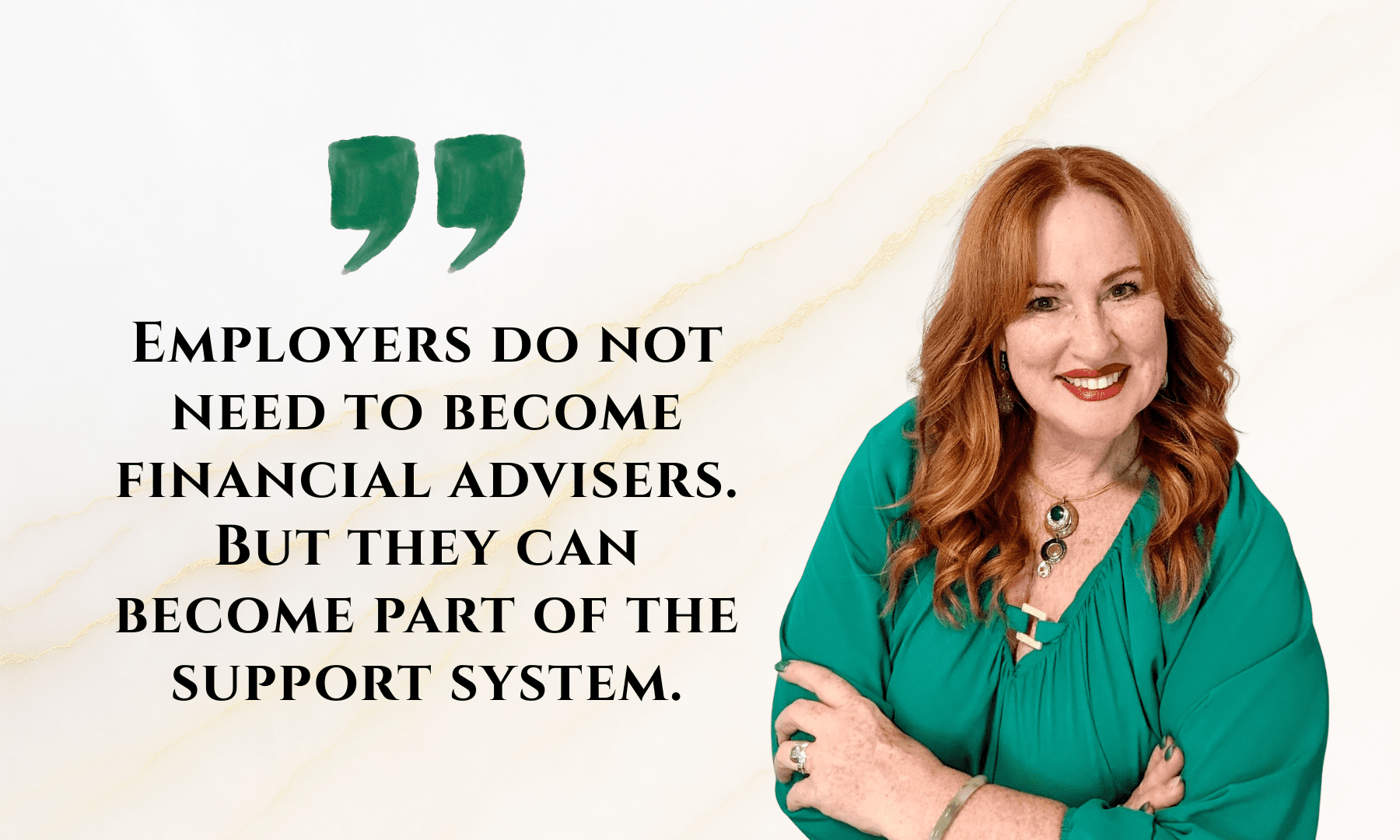
Employers do not need to become financial advisers.
But they can become part of the support system.

A workplace that genuinely cares about financial wellbeing sends a powerful message:

“We see the pressure. We care about the person, not just the performance.”

That kind of support builds trust.
It strengthens loyalty.
And it helps create a workplace culture where people feel valued in a real way.

Simple ways employers can help include:

  • offering financial wellbeing education
  • normalising money conversations without stigma
  • providing access to coaching or structured support
  • recognising the connection between financial stress and performance
  • focusing on prevention, not just crisis response

Why this matters for business outcomes too

Supporting employee financial wellbeing is not just kind. It is smart.

When employees feel less stressed about money, businesses often benefit from:

  • improved focus
  • better productivity
  • lower turnover
  • stronger morale
  • healthier workplace culture
  • more trust between staff and leadership

When employees feel less stressed about money, businesses often benefit

In other words, supporting financial wellbeing is not a “soft” benefit.
It is a practical one.

And in times of uncertainty, practical support is exactly what people remember.

Comfort matters too

There is one more piece that deserves attention.

People do not just need solutions. They need reassurance.

Many employees are currently feeling shame about money. They may feel embarrassed that they are stressed. They may think they “should” have it sorted. They may stay silent because they would rather not look incapable.

That is why comfort matters.

It helps to remind people:

  • they are not alone
  • financial pressure is affecting many households
  • struggling does not mean failing
  • support is available
  • change is possible with the right tools and guidance

Sometimes the most powerful first step is simply helping someone feel seen.

Creating a more supportive workplace

If you are an employer, leader, or HR decision-maker, this is your opportunity to think bigger about what support really means.

Financial wellbeing is no longer a “nice to have”.
It is one of the most practical and human ways to support your team.

And it does not require overcomplicating things. It starts with awareness.

Then it moves into education, tools, and support that help people take back a sense of control.

A better path forward

The world feels heavy for many people right now. That is real. But so is the opportunity to respond differently.

Instead of waiting for burnout, disengagement, or unexpected resignations, employers can choose to act earlier.


They can offer support that helps employees feel steadier, calmer, and more capable. And when that happens, everybody wins.

If you want to support your team in a practical, meaningful way, my Financial Wellbeing Program helps employees build confidence, reduce money stress, and create healthier financial habits with real tools and support.

Because sometimes the best staff benefit is not another perk.
It is helping your people feel safer, stronger, and more in control of their lives.
Financial Wellbeing Program

#HowToResetMyMoneyMindset #WhyDoIFeelOutOfControlWithMoney #HowToFeelInControlOfFinances #ResetMoneyMindset2025 #NewYearFinancialMindset #HowToStartFreshWithMoney  emergency fund australia, money management, family savings 
 

Budgeting Without the Boring: The Money Map Method That Actually Works

Budgeting Without the Boring: The Money Map Method That Actually Works

Let’s be honest for a second. The word “budget” has the same vibe as:

  • “We need to talk…”
  • “Your call is being transferred…”
  • “Please see the attached invoice…”

It makes people tense. Defensive. Slightly sweaty. 😅

And here’s the irony: most people don’t hate having a plan. They hate the way budgeting has been sold to them – like it’s punishment for daring to enjoy life.

So today, I’m giving you a different approach.

Not a strict budget.
Not a spreadsheet that needs a PhD to operate.
Not a system that makes you feel like you have to track every piece of gum you’ve ever purchased.

This is Money Mapping – the method I use with clients who want to feel in control, not controlled.

Because your money doesn’t need a prison.

It needs a plan. A plan that fits your actual life. Not the version of you who meal preps on Sundays and never impulse buys at Kmart.

(If that version of you exists, I’d like to meet her. She sounds organised and slightly intimidating.)

Why Traditional Budgets Fail (and why it’s not your fault)

Most budgets fail for three reasons:

1) They’re too restrictive

People try to cut everything at once: coffees, fun, birthdays, little treats, takeaway, holidays… and then wonder why they rebound like a rubber band.

If a budget feels like suffering, you won’t stick to it.
Your brain will treat it like a threat.
And humans don’t do “threat” long-term.

2) They’re too complicated

Forty-seven categories. Daily tracking. Constant adjustments.
You miss one thing and suddenly you feel like you’ve “failed.”

A budget that requires constant maintenance becomes another job.
And nobody needs a second job that doesn’t pay.

3) They’re built on guilt, not goals

Many budgets are basically: “Stop spending money on things that make you happy.”

No thanks.

Money mapping works because it’s:

  • simple
  • flexible
  • based on priorities
  • designed for consistency, not perfection

What is a Money Map?

A Money Map is a simple plan that tells your money where to go before life grabs it.

It answers these questions:

  1. What must be paid? (essentials + bills)
  2. What matters to you? (your priorities)
  3. What are we building? (savings, emergency fund, investing, debt reduction)
  4. How do we keep your life enjoyable while still making progress? (yes, fun stays)

A money map is not about tracking every dollar.
It’s about creating a flow.

And when your money flows with intention, financial stress drops fast

A Money Map is a simple plan that tells your money where to go before life grabs it.

The Big Mindset Shift: A Budget Isn’t Restriction – It’s Permission

I want you to reframe this:

A budget isn’t a list of things you can’t do.
It’s a permission slip that says:

✅ “Yes, you can spend money on what you love.”
✅ “Yes, you can have fun.”
✅ “Yes, you can enjoy your life.”
and also
✅ “Yes, you can build wealth and feel safe.”

That’s the goal: enjoying today while protecting tomorrow.

The Money Map Framework (Simple, Powerful, Real-Life Friendly)

Here’s the structure I recommend. It’s clean and easy:

Category 1: Essentials (Must Pays)

These are the costs of keeping your life running:

  • mortgage/rent
  • utilities
  • groceries
  • fuel/transport
  • insurance
  • minimum debt repayments
  • childcare/school essentials
  • basic medical

These are your “keep the lights on” expenses.

Category 2: Future You (Your Financial Muscle)

This is where you build safety and wealth:

  • emergency fund
  • sinking funds (car rego, Christmas, school costs, rates, holidays)
  • extra debt repayments
  • investing/super top-ups (where appropriate)

Future You deserves funding. Not “whatever’s left.”

Rainy Day Fund or Emergency Fund

Category 3: Fun & Freedom (Guilt-Free Spending)

This is the category that keeps you sane:

  • coffees
  • dinners out
  • entertainment
  • hobbies
  • shopping (within reason, Karen… within reason 😄)
  • little treats

The reason most budgets fail is because this category is either missing or unrealistically small.

We’re not doing that here.

Step-by-Step: How to Build Your Money Map in Under an Hour

Grab a pen, notes app, or whatever you use when you’re feeling productive for five minutes.

Step 1: Find your baseline numbers

Look at the last 4–8 weeks of spending (not because we love pain, but because data helps).

Write down:

  • total income (after tax)
  • total essentials
  • average weekly spending (groceries, fuel, eating out, shopping)
  • debt minimums
  • any annual bills that sneak up (rego, insurance, school, rates)

You’re not judging. You’re observing.

Step 2: Choose your “Money Map style”

There are two main styles:

  1. A) Weekly Flow Map (best for people paid weekly/fortnightly)
  • Allocate money each pay into Essentials / Future You / Fun
  1. B) Monthly Map (best for salaried monthly pay)
  • Set amounts for each category and automate them

If you’ve tried budgeting before and it didn’t stick, weekly is usually easier because it gives faster feedback.

Step 3: Set up separate accounts (this is where the magic happens)

I’m going to say this lovingly:

If all your money sits in one account, your brain will treat it like it’s all available.
That’s not a discipline problem. That’s a human brain problem.

A simple setup is:

  1. Bills account (Essentials)
  2. Spending account (groceries/fuel/fun)
  3. Future You account (emergency + sinking funds)

Automation is your best friend. Because you’re busy.
And your money system should run even when you’re tired.

Step 4: Decide your “non-negotiables”

These are your priorities — the things you want your money to reflect.

Examples:

  • “I want to stop feeling anxious about bills.”
  • “I want an emergency fund.”
  • “I want to pay off this debt.”
  • “I want to travel without putting it on a credit card.”
  • “I want to stop fighting with my partner about money.”

Your money map should support your real goals — not someone else’s idea of financial success.

Step 5: Allocate your numbers (start simple)

Here’s a starting point many people can relate to:

  • Essentials: 60–75%
  • Future You: 10–20% (even 5% is a start if money is tight)
  • Fun & Freedom: 10–20%

If your essentials are currently higher than 75% — you’re not alone. Cost of living has been doing the most.

This is where strategy matters: we might need to reduce leaks, renegotiate bills, or adjust the debt plan to create breathing room.

Step 6: Create one weekly “Money Date” (10 minutes)

Once a week:

  • check what’s coming out
  • check what’s coming in
  • make sure bills are covered
  • adjust your spending category if needed

No drama. No self-lectures. Just a quick check-in.

Think of it like brushing your teeth. You don’t do it once and call it done forever.

The “I Hate Tracking” Version: The 3-Number Method

If you’re someone who rebels against tracking (I see you), do this instead:

Pick three numbers each week:

  1. Your weekly spending limit (food + fuel + fun)
  2. Your weekly Future You transfer
  3. Your “buffer amount” you want to keep in your spending account

Then the rule is simple:
When spending hits the limit… you stop spending until next week.
No guilt. Just boundaries.

This is the system many of my clients love because it’s:

  • quick
  • clear
  • low-maintenance
  • effective

Money Map in Real Life: What This Looks Like (Example)

Let’s say your household brings in $2,500 a week after tax.

You might map it like this:

  • $1,700 Essentials (bills, groceries, fuel, minimum debt)
  • $400 Future You (emergency fund + sinking funds + extra debt)
  • $400 Fun & Freedom (eating out, treats, spending money)

Then you automate:

  • $1,700 goes straight into Bills account
  • $400 into Future You account
  • $400 stays in Spending account

Now you’re not trying to “budget” daily.
You’re simply spending from the right place.

And when your Spending account runs low, it gives you a clear signal:
“That’s it for this week.”

No spreadsheet required.

What If There’s Not Enough Money to Map?

This is the part where I get very real with you:

If you feel like there’s never enough, it doesn’t mean you’re failing.
It means your map needs to include leak-plugging and breathing space first.

Here’s what I do with clients when money is tight:

  1. tighten obvious leaks (subscriptions, lazy renewals, bank fees)
  2. build a tiny emergency buffer (even $500 can change your stress levels)
  3. stabilise bills and reduce panic spending
  4. create sinking funds for predictable expenses
  5. then build momentum

You don’t jump from stressed to thriving in one week.
But you can absolutely move from chaos to calm with the right steps.

The Most Important Part: Your Money Map Must Match Your Personality

Some people need structure.
Some need flexibility.
Some need boundaries.
Some need permission.

So here are a few personality-based tweaks:

If you’re an overspender:

  • reduce “available money” in your spending account
  • use separate “fun” cash or a dedicated card
  • increase automation

If you’re an underspender/anxious saver:

  • allocate guilt-free fun money and actually spend it
  • focus on safety targets (emergency fund)
  • build confidence with small consistent steps

If you’re a “set and forget” person:

  • automate everything
  • schedule the weekly money check-in
  • keep categories very simple

If you’re a couple/family:

  • do a shared Money Map + personal spending allowances
  • agree on the weekly “household number”
  • remove judgement from the conversation

Money mapping isn’t one-size-fits-all.
It’s “your life, your values, your plan.”

If You Want This to Stick, Join the Membership

Now, if you’re reading this thinking:

“Okay… this makes sense. But I need help setting it up properly.” or “I’ve tried before and I fall off the wagon.” or “I want a system that actually fits my life.”

That’s exactly what my Membership is for.

Because here’s the truth:

Most people don’t need more information. They need support, structure, and someone to keep them consistent.

Inside the Membership, we don’t just talk about budgeting. We:
✅ build your personal Money Map (based on your real numbers)
✅ set up accounts and automation so it runs without willpower
✅ create sinking funds so life stops surprising you
✅ learn how to manage spending without guilt
✅ build financial muscle with ongoing guidance and community

You’re not meant to do this alone.

If you’re ready to stop winging it and start feeling calm and in control, join the Membership.
Let’s build your Money Map together — and get your financial house in order the smart way.

budgeting without spreadsheets, simple budget method, cash flow planning, how to budget in Australia, reduce financial stress, personal finance tips, money management system, budgeting for beginners, weekly money check-in, sinking funds, financial management 101, Karen G Adams, financial coaching


Money Isn’t the Problem – Your Brain Might Be!

Money Isn’t the Problem – Your Brain Might Be!

Feeling Stuck with Money? You’re Not Alone

Ever feel like no matter how hard you work, money keeps slipping through your fingers?

You track your spending, download another budgeting app, maybe even try a no-spend challenge (ugh)…
But nothing sticks. You’re still stressed, still overspending, and still wondering why money feels so hard.

Here’s a radical idea that might blow your mind:

Your financial struggle isn’t just about money. It’s about your mindset.

If you’ve ever told yourself:

  • “I’m just not good with money.”


  • “I’ll never get ahead.”


  • “I’m terrible with numbers.”


  • “There’s never enough to go around.”

…then guess what? You’re not bad with money.
You’re just running an outdated mental program and it’s time to upgrade your system.

? Your Mindset Is the Missing Link in Money Management

Let’s get one thing straight: You weren’t born with your current money habits.

They were learned, shaped, and reinforced over years often by:

  • What you saw growing up
  • What society tells you about money
  • Your past financial “mistakes”
  • Deep, often unconscious beliefs about what’s possible for you

Most of us were never taught how to actually think about money in a healthy, empowering way.

Instead, we internalise things like:

  • “Money doesn’t grow on trees.”
  • “Rich people are greedy.”
  • “You have to work hard to make money.”

These beliefs shape our thoughts.
Our thoughts drive our behaviours.
Our behaviours determine our results.

“Change your thoughts, and you change your world.” – Norman Vincent Peale

? Meet the RAS: The Tiny Brain Filter That Shapes Your Reality

One of the most powerful (yet overlooked) players in your financial journey is your Reticular Activating System (RAS).

It’s a tiny bundle of nerves in your brainstem that acts like a filter, allowing in information that matches your beliefs and blocking out everything else.

In short:

  • If you believe money is hard to come by, your RAS will filter out opportunities and highlight obstacles.
  • If you believe you’ll never get ahead, your RAS will literally make it harder to see paths to progress.

It’s not woo-woo. It’s neuroscience. ?⚡

But here’s the good news: You can train your RAS to focus on abundance, opportunity, and growth. That’s the work we do in my Master Your Money program – and it works.

Create a monthly payment plan that includes money for fun and savings.

? 5 Limiting Beliefs That Keep You Financially Stuck

Let’s get real for a moment. Most people are walking around with a money mindset full of invisible roadblocks.

Here are 5 common ones that might be running in the background of your brain:

  1. “I’m just not good with money.”
    → Translation: I’ve made mistakes, and now I believe they define me.


  2. “There’s never enough.”
    → Leads to hoarding, fear-based spending, or total avoidance.


  3. “I always mess it up.”
    → Creates shame, procrastination, and financial self-sabotage.


  4. “If I make more, I’ll lose it anyway.”
    → Keeps you stuck at your current income level (or worse).


  5. “Wanting wealth is greedy or selfish.”
    → Prevents you from receiving more, even when you’ve earned it.

Sound familiar?

The first step to changing your results is changing these beliefs. But how? Let’s walk through a simple reframe technique that works fast.

? Flip the Script: How to Rewire a Limiting Money Belief

Step 1: Identify the belief

Example: “I’ll never be debt-free.”

Step 2: Ask yourself, “Where did I learn this?”

Maybe from watching your parents struggle, or after repeated financial setbacks.

Step 3: Write the empowering opposite

✅ “I am taking steps every day toward financial freedom.”
✅ “My past doesn’t define my financial future.”
✅ “I am capable, committed, and in control.”

Now, speak that new belief out loud every morning.
Yes – out loud. You’re rewiring your brain. It needs to hear the new code.

?‍♀️ Practice Mindful Money: A Daily 5-Minute Ritual

You don’t need hours of meditation or 12-tab spreadsheets to take control of your finances.
You just need five intentional minutes a day.

Here’s a powerful money mindfulness ritual to try:

? Each morning or evening:

  1. Check in with your emotions around money.
    • Am I feeling anxious? Grateful? Avoidant?
  2. Review your spending from the past 24 hours.
    • One win + one lesson.
  3. Name your money goal for the week.
    • Keep it small and actionable: “Track all spending” or “Bring lunch from home 3x.”
  4. Say your top 3 affirmations out loud.
    • Examples: “I am aligned with abundance.” “Money flows to me with ease.” “I am in control of my financial future.”

      Repeat for 30 days and watch how much more confident, clear, and calm you feel around money.

Create a monthly payment plan that includes money for fun and savings.

? Why This Work Matters More Than Spreadsheets

I’ve been in the financial industry since 1986.
I’ve seen people transform their finances not because they suddenly won the lotto or got a huge raise…
…but because they shifted how they think about money.

They rewired their brains for:

  • Financial confidence
  • Resilience
  • Peace of mind
  • And yes – wealtH

And that’s why I created the Master Your Money program.

It’s not just another budgeting course. It’s a 30-day, mindset-first reset that helps you finally stop the cycle of stress, sabotage, and shame around money and start creating real momentum towards financial freedom.

? What Happens When You Rewire Your Money Mindset?

✨ You stop panic-spending and start making calm, intentional choices.
✨ You forgive your past mistakes and take empowered action today.
✨ You feel in control – even if your income hasn’t changed yet.
✨ You start attracting new opportunities, support, and even more money.

This is the magic of mindset.
It works. It’s real. And it’s within your reach.

? Try This: Your 7-Day Money Mindset Challenge

Want to get a taste of what mindset work can do for you?

Here’s a simple challenge to try this week:

Day 1: Write your 3 biggest money fears

Day 2: Flip each into an empowering belief

Day 3: Create a 5-minute money ritual

Day 4: Track one spending habit with curiosity (not judgment)

Day 5: Visualise your ideal financial future

Day 6: Celebrate one money win

Day 7: Journal what’s shifted emotionally, mentally, or financially

You’ll be amazed what starts to change in just one week.

? Ready to Go Deeper? Join Master Your Money!

If you’re tired of feeling:

  • Confused about where your money goes
  • Anxious every time a bill lands
  • Guilty when you spend (or don’t)
  • Stuck in a financial Groundhog Day…

Then you’re ready for a reset.
Not just in your bank account – but in your brain.

My Master Your Money 30-day program walks you step-by-step through:
✅ Rewiring limiting beliefs
✅ Creating daily habits that stick
✅ Building emotional clarity around money
✅ Using mindset tools like visualisation, affirmations, and gratitude
✅ Becoming the CEO of your financial life (finally)

No judgment. No jargon. Just powerful, practical transformation.

? Final Thought: It Was Never About the Money

It was always about:

  • The story you believed.
  • The patterns you repeated.
  • The mindset you inherited.

But here’s the best part:

You have the power to rewrite the story.

Let today be the day you stop blaming money and start mastering your mindset.

Because once your brain gets on board? Your bank account will follow.

Your Financial Freedom Breakthrough™
Breaking the Chains: How to Escape the Cycle of Living Paycheck to Paycheck

Breaking the Chains: How to Escape the Cycle of Living Paycheck to Paycheck

Do you feel like your money disappears as soon as you get paid? Are you constantly counting the days until your next paycheck? If so, you’re not alone – millions of people find themselves trapped in the cycle of living paycheck to paycheck. But here’s the good news: escaping this cycle isn’t just possible, it’s within your control.

Let’s break the chains and create a life where money works for you, not the other way around.

Step 1: Shift from Survival Mode to Financial Strategy

Most people stuck in the paycheck-to-paycheck cycle don’t have a spending problem, they have a strategy problem. Instead of reacting to financial emergencies, it’s time to start planning proactively.

Ask yourself:

  • What would financial stability look like for me?
  • How much money do I need to feel secure between paychecks?
  • What’s stopping me from breaking free?

By shifting your focus from surviving to strategising, you take back control of your finances.

Shift from Survival Mode to Financial Strategy

Step 2: Find Your Financial Leaks (and Plug Them!)

Ever wonder where all your money goes? It’s time to find out. Track your spending for a month and identify the small, sneaky expenses draining your bank account. These could be:

  • Subscription services you forgot about
  • Daily coffee runs that add up to hundreds a month
  • Unused gym memberships
  • Frequent food delivery orders

Plugging these leaks doesn’t mean cutting out all enjoyment – it means being intentional about where your money goes.

Small, sneaky expenses might be draining your bank account

Step 3: Pay Yourself First – Even If It’s Just $10

The key to breaking the cycle is creating a buffer between you and financial stress. Start by setting aside a small amount from every paycheck – yes, even if it’s just $10. The act of saving builds momentum and rewires your brain for financial growth.

Open a separate savings account and automate deposits. Over time, you’ll build a financial cushion that prevents you from relying on the next paycheck.

Step 4: Increase Your Income Without Working More Hours

If your expenses leave you with nothing to save, it’s time to boost your income. But before you assume that means working more hours, consider these options:

  • Ask for a raise – most employees don’t, and employers often have room to negotiate.
  • Sell unused items – your clutter could be someone else’s treasure.
  • Offer freelance or side gigs – platforms like Fiverr, Upwork, and Etsy offer ways to monetise your skills.
  • Rent out assets – if you have an extra room, parking space, or equipment, consider renting it out.

Small income boosts can create big shifts in your financial freedom.

Step 5: Use Your Credit Wisely (Not Recklessly)

Credit can be a tool or a trap – it all depends on how you use it. Instead of relying on credit cards to cover gaps, use them strategically:

  • Pay off balances in full to avoid high-interest debt.
  • Use credit card rewards for cash back or travel perks.
  • Build your credit score to access lower rates on future loans.

Mastering your credit is key to long-term wealth-building.

Step 6: Create a 3-Month Escape Plan

Breaking free isn’t about overnight miracles, it’s about consistent steps in the right direction. Create a 3-month plan with small, achievable goals:

  • Month 1: Cut financial leaks and save at least $50.
  • Month 2: Increase income by $200 through side gigs or negotiations.
  • Month 3: Use extra income to build a financial cushion and pay off high-interest debt.

By the end of 90 days, you’ll have proof that escaping the paycheck-to-paycheck cycle is possible.

FINAL THOUGHTS

Financial freedom isn’t just for the lucky, it’s for those who take action. You have the power to rewrite your financial story and create a life where money works for you.

If you’re ready for a deeper transformation and a complete guide to managing your money, my Master Your Money Program will provide the step-by-step tools to take control once and for all.

You deserve financial peace – start your escape plan today!