
How to Price Your Products or Services Properly (Without Undervaluing Yourself)

How to Price Your Products or Services Properly (Without Undervaluing Yourself)

Pricing your products or services can feel like one of the most uncomfortable parts of running a business.

You sit there staring at a number, wondering:

Is this too high?
Is this too low?
Will people actually pay this?
What if I lose customers?

So instead of making a clear, strategic decision, you do what most small business owners do…

You guess.

Maybe you look at what competitors are charging and land somewhere in the middle. Maybe you choose a number that “feels reasonable”. Or maybe you go lower than you’d like, just to be safe.

And while that might feel like the least risky option, it’s actually one of the biggest reasons businesses struggle to grow.

Because pricing isn’t just about making a sale, it’s about building a business that actually works.

If your pricing is off, everything feels harder. You work more, earn less, and constantly feel like you’re chasing your tail. But when your pricing is right, things start to click. You attract better clients, your workload becomes more manageable, and your business becomes far more sustainable.

So let’s break this down properly and give you a clear, practical approach to pricing your products or services, without the guesswork.

The first thing to understand is that pricing is not just a financial decision. It’s also a positioning decision.

The price you set tells your customers something about your business before you even speak to them.

A lower price often signals affordability and accessibility, but it can also suggest lower value. A higher price can position you as premium, but only if the experience and results match.

Neither approach is right or wrong, but it has to be intentional.

The problem is that many business owners don’t choose a position. They end up somewhere in the middle, without a clear strategy, trying to appeal to everyone, and ultimately attracting the wrong customers.

And this is where pricing starts to create stress.

Because when your pricing doesn’t align with your costs, your value, and your positioning, you feel it every single day in your business.

Because when your pricing doesn’t align with your costs, your value, and your positioning, you feel it every single day in your business.<br />

One of the most common mistakes is relying too heavily on competitor pricing.

It seems like the logical place to start. After all, if everyone else is charging a certain amount, it must be the “right” price… right?

Not necessarily.

You don’t know their financial situation. You don’t know their cost structure. You don’t know their profit margins. And you definitely don’t know whether they’re actually making money.

There are plenty of businesses out there that look successful on the surface but are barely breaking even behind the scenes.

So when you base your pricing on competitors, you’re not creating a strategy – you’re copying someone else’s guess.

And that’s a risky way to run a business.

Instead, your pricing needs to start with your numbers.

At its simplest level, pricing comes down to one core idea: Your price must cover your costs and generate a profit.

Sounds straightforward, but this is where most business owners get it wrong. Because they don’t fully understand their costs.

When people think about costs, they often focus on the obvious ones; materials, stock, or direct expenses tied to delivering a product or service.

But there are so many hidden costs that get overlooked.

Your time is a cost. Admin work is a cost. Emails, phone calls, quoting, planning, travel—it all adds up. Even things like software subscriptions, marketing tools, insurance, and professional services need to be factored in.

If you’re not accounting for all of these, you’re underpricing – whether you realise it or not. And that’s where the frustration begins. You’re busy. You’re making sales. But at the end of the month, there’s not much left over.

Not because your business isn’t working, but because your pricing isn’t supporting it.

Then there’s the topic of profit.

This is where things get a little uncomfortable for many business owners. Because profit can feel… optional. Something extra. Something you’ll get to “eventually”.

But here’s the reality: Profit is not a bonus. It’s a requirement. Profit is what allows you to:

  • Pay yourself properly
  • Reinvest in your business
  • Handle unexpected expenses
  • Grow sustainably

Without profit, your business becomes a job and often not a very well-paid one. So instead of hoping there’s money left at the end, you need to build profit into your pricing from the start.

Even if it’s small to begin with, it needs to be intentional.

Now, once you understand your costs and include a profit margin, the next step is thinking about value. Because pricing isn’t just about covering costs – it’s also about what your customer is receiving.

This is where value-based pricing comes into play

Let’s say you’re offering a service that helps a client increase their revenue, save time, or reduce stress. The value of that outcome is often far greater than the time it takes you to deliver it.

If you’re only charging based on time, you’re limiting your earning potential. But if you price based on the result you provide, you open the door to higher, more sustainable pricing.

This doesn’t mean ignoring your costs; it means combining both approaches.

Know your baseline (your costs and required profit), then position your pricing based on the value you deliver.

Of course, even when you understand all of this, there are still a few traps that can quietly pull your pricing down.
One of the biggest is underpricing to win customers

It feels like a smart move to make your offer more attractive, get more sales, and build momentum.

But what often happens is that you attract price-sensitive customers who are always looking for the cheapest option. They’re harder to please, quicker to leave, and less loyal overall. And because your margins are lower, you need more of them just to stay afloat.

That’s not a recipe for a healthy business.

Another common trap is discounting too quickly. A customer hesitates, and before they even ask, you offer a lower price. It might help close the sale in the moment, but it also reduces your perceived value and sets a precedent.

Over time, it trains customers to expect discounts and makes it harder to charge your full price.

Then there’s the habit of avoiding price increases altogether.

Costs go up. Expenses rise. But your prices stay the same.

This slowly erodes your profitability, often without you noticing until things feel tight.

Raising your prices doesn’t have to be dramatic. Even small, regular adjustments can make a big difference over time.

And in most cases, customers expect it, especially if you’re continuing to deliver value.

If the idea of increasing your prices feels uncomfortable, you’re not alone.

But here’s a helpful way to think about it.

When you raise your prices, you’re not just charging more – you’re creating space.

Space to:

  • Deliver a better experience
  • Reduce stress and burnout
  • Focus on quality over quantity
  • Build a more sustainable business

And while you might lose a small number of customers, you often gain better ones.

Clients who value what you do, respect your time, and are willing to pay for quality.

Confidence in pricing doesn’t come from mindset alone – it comes from clarity.

When you understand your numbers, your costs, and your value, pricing becomes less emotional and more strategic.

You stop second-guessing yourself. You stop apologising for your prices. And you start making decisions that support the business you actually want to build.

So where should you start?

Keep it simple. Choose one product or service and break it down properly.

Work out what it truly costs you to deliver. Include your time. Add a profit margin. Then compare that to what you’re currently charging.

If there’s a gap, adjust. Not perfectly. Not all at once. Just intentionally. Because small improvements in pricing can have a huge impact over time.

At the end of the day, pricing properly isn’t about being the most expensive or the cheapest.

It’s about building a business that works for you.

A business that pays you properly.
A business that supports your lifestyle.
A business that gives you room to grow.

And that starts with one decision, stopping the guesswork and taking control of your pricing.

Ready to Get Started?

If you’re serious about changing your money…

Not just thinking about it…

Join the membership and let’s build this together!

Membership - FM101

#HowToResetMyMoneyMindset #WhyDoIFeelOutOfControlWithMoney #HowToFeelInControlOfFinances #ResetMoneyMindset2025 #NewYearFinancialMindset #HowToStartFreshWithMoney  emergency fund australia, money management, family savings 

 

The Financial House Inspection: 10 Sneaky Money Leaks (And How to Plug Them Fast)

The Financial House Inspection: 10 Sneaky Money Leaks (And How to Plug Them Fast)

Let me ask you something… if your financial house was a real house, would you invite guests over right now?

Or would you do that frantic pre-visit panic clean where you shove everything into the laundry or the spare room and pray nobody opens that door?

Because that’s what most people are doing financially.
Not because they’re “bad with money” (you’re not), but because life is busy, expensive, and full of sneaky little costs that quietly set up camp in your bank account like they pay rent.

And the truth is… you don’t always need a bigger income to feel more in control.
Sometimes you just need to find the leaks.

Today, we’re doing a Financial House Inspection – warm cuppa in hand, no shame, no judgement, and definitely no stiff “financial coach voice.”  You’ll walk away with practical fixes, a clearer head, and probably a few “WAIT… WHAT?!” moments.

Let’s inspect your money house.

Why “Money Leaks” Matter (Even If You Earn Good Money)

A money leak is not a big, dramatic purchase you remember forever (like buying a car or going on a holiday).

A money leak is the “small stuff” you don’t notice… until you look at your bank statement and think:

“Excuse me, where did my money go?”

Leaks are dangerous because they:

  • feel harmless in the moment
  • happen repeatedly
  • add up faster than you think
  • make you feel like you’re always behind even when you’re trying

And here’s the kicker: leaks are often emotionally driven, not logically driven. They’re convenience, comfort, habit, exhaustion, reward, stress, or just not having a system in place.

So let’s find them and plug them like the financially strong legend you are.

The Financial House Inspection Checklist: 10 Common Money Leaks

1) The Subscription Graveyard

This one is so common it deserves its own memorial plaque.

Streaming services, apps, software, gym memberships, delivery memberships, random “productivity tools,” audiobooks, meditation apps, cloud storage…

And you know what makes subscriptions sneaky?
They don’t hurt enough to notice. It’s just $9.99 here… $14.99 there… $24.99 for something you “might use.”

Until suddenly you’re donating $300 a month to the Subscription Graveyard.

Quick Fix:

  • Go through your bank statements and highlight every recurring payment.
  • Ask: “Would I buy this again today?”
  • Cancel anything that isn’t a HELL YES.

Pro tip:
If cancelling makes you panic (“but what if I need it one day?”), that’s not logic, that’s fear. And fear is expensive.

2) Lazy Renewals (Insurance, Utilities, Phone Plans)

Lazy renewals are like leaving a tap dripping for years and being shocked your water bill is high.

Insurance companies love loyal customers… because loyal customers often don’t check the price.

Phone plans creep up. Internet deals expire. Electricity rates change. Suddenly you’re paying premium pricing for basic service.

Quick Fix:

  1. Put a recurring reminder in your calendar every 6–12 months:
    • car/home insurance
    • health insurance
    • electricity/gas
    • phone/internet
  2. Compare and renegotiate.

Money mindset note:
Being financially responsible is not being “cheap.” It’s being strategic.

3) Bank Fees and “Oops” Charges

Account keeping fees. International transaction fees. ATM fees. Late payment fees. Overdraft fees.

These aren’t “just the cost of banking.” They’re often the cost of not having the right account setup or system.

Quick Fix:

  • Review your bank accounts and credit cards.
  • Ask your bank: “Is there a fee-free option?”
  • Set up alerts for low balances and bill due dates.
  • Automate minimum payments to avoid late fees.

You don’t need to pay $10 – $30 a month in fees just to have a bank account. Your money deserves better.

4) Convenience Spending (AKA “I’m Too Tired” Tax)

This is the one people don’t want to admit because it’s so relatable.

Convenience spending is:

  • takeaway because you’re exhausted
  • Uber because parking feels like emotional warfare
  • delivery apps because “I’ll just get one thing”
  • pre-made meals because you can’t face thinking

And honestly? Sometimes it’s worth it. Life is busy. You’re human. But if it’s happening on autopilot, it becomes a leak.

Quick Fix:

  • Create a weekly “convenience budget”  –  guilt-free, planned.
  • Have one or two “emergency meals” at home (freezer meals, eggs, wraps, anything easy).
  • Decide your rules before you’re tired.

This isn’t about perfection. It’s about awareness + boundaries.

Convenience Spending includes food delivery services.

5) Supermarket Drift (The “Just One More Thing” Trap)

You go in for milk and bread. You come out with:

  • fancy dips
  • a plant you didn’t need
  • snacks for “school lunches” (even though you don’t have kids)
  • and a candle because self-care.

The supermarket is designed to separate you from your money with maximum efficiency.

Quick Fix:

  • Shop with a list (yes, like a grown-up, annoying but effective).
  • Eat before you shop.
  • Do click-and-collect if you’re an impulse buyer.
  • Track your weekly grocery spend for 4 weeks and be honest about what’s happening.

Groceries are one of the easiest leaks to tighten without feeling deprived.

6) The Servo Snack & Coffee Leak

The little daily habits: coffee, snacks, “just grabbing something,” the quick drink on the way home, the “treat” because the day was hard.

And let me be clear: you’re allowed joy. But when joy is unplanned and daily, it becomes a leak.

Quick Fix:

  • Choose what’s worth it.
  • If café coffee is your thing, keep it, but make it intentional.
  • Set a weekly allowance for treats and stick to it.

The goal isn’t to become a finance robot. The goal is to stop accidentally overspending.

7) Lifestyle Inflation (The “I Deserve It” Spiral)

This one is sneaky because it feels like progress. You earn more… so you spend more. New car. Nicer clothes. More dinners out. Better holidays. Upgraded everything.

And you might still feel broke. Lifestyle inflation isn’t about being irresponsible. It’s about missing the moment where you lock in your future before upgrading your present.

Quick Fix:

  1. When income increases, decide in advance:
    • what percentage goes to lifestyle
    • what percentage goes to savings/investing
    • what percentage goes to debt reduction
  2. Automate “Future You” first.

Future You is not asking for everything.
Future You is asking for something.

8) “Buy Now Pay Later” (BNPL) and Payment Splitting

BNPL is basically like inviting little debts into your house and then being shocked they’re eating all your groceries.

It doesn’t feel like debt because it’s broken up into payments.
But it still reduces your future cash flow and adds mental load.

Quick Fix:

  • List every BNPL account and total outstanding.
  • Pause new purchases until the balances are cleared.
  • Rebuild a sinking fund for things you commonly use BNPL for (clothes, gifts, school costs, etc.

BNPL is not evil. But it is dangerous if it becomes your normal.

9) Unused Memberships and “Aspirational Spending”

This is spending money on the version of you who:

  • goes to the gym 5 days a week
  • does yoga at sunrise
  • reads 2 business books a week
  • meal preps like a wellness influencer
  • uses that online course “soon”

We’re funding our aspirational selves while our current selves are just trying to get through Tuesday.

Quick Fix:

  • Keep one “growth” commitment at a time.
  • If you’re not using it, pause it.
  • Choose what actually fits your life right now.

The goal is to build financial muscle, not financial guilt.

10) The “No System” Leak (The Biggest One)

This is the mother of all leaks. Because even if you fix everything above, if you don’t have a system, the leaks come back.

A system is what creates calm. It tells your money where to go before life grabs it first.

Quick Fix:
Start with these basics:

  • a separate bills account
  • automatic transfers on pay day
  • a weekly money check-in (10 minutes)
  • clear spending categories (not 47 categories… just the ones that matter)

Most people don’t have a money problem. They have a money flow problem.

And that is fixable.

Your Mini Action Plan: Plug Leaks in 30 Minutes This Week

If you want to feel immediate relief, do this:

  1. Print your last 30 days of transactions (or pull them up on your banking app).
  2. Highlight anything that surprised you.
  3. Circle:
    • subscriptions
    • takeaway/coffee
    • shopping
    • fees
  4. Choose 3 leaks to plug this week.
  5. Move the money you save into a separate “Future Me” account.

That last step matters. If you don’t redirect the savings, it disappears into new spending. Money is like that. It loves momentum.

Print your last 30 days of transactions (or pull them up on your banking app). Then, highlight anything that surprised you.

The Real Truth: You Don’t Need More Willpower – You Need Support + Structure

I want to say something kindly but clearly:

If you’ve tried to “get on top of money” before and it didn’t stick, it’s not because you’re hopeless. It’s because you’ve been trying to do it alone, in between work, kids, stress, bills, and exhaustion… with zero structure and a lot of pressure.

And that’s not a character flaw. That’s a strategy gap.

Come Into the Membership (Because This Is What We Do Together)

If reading this has you thinking, “Okay… I can see the leaks, but I need help making this a real system,” then babe – this is exactly why I created my Membership.

Inside the Membership, we don’t just talk about money. We build financial muscle.

✅ We identify your personal leaks (not generic ones).
✅ We set up a simple money system that actually fits your life.
✅ We make progress without shame, overwhelm, or perfection.
✅ You get guidance, structure, education, and support – so you’re not constantly starting over.

Because getting your financial house in order isn’t about a one-time clean-up.
It’s about building habits and systems that keep it running smoothly long-term.

If you’re ready to stop guessing and start feeling in control, join the Membership.
Let’s plug the leaks, create a plan, and turn your financial house into a place you feel proud to live in.

#HowToResetMyMoneyMindset #WhyDoIFeelOutOfControlWithMoney #HowToFeelInControlOfFinances #ResetMoneyMindset2025 #NewYearFinancialMindset #HowToStartFreshWithMoney Discover 10 sneaky money leaks draining your bank account and simple fixes to plug them fast. Get your financial house in order without the guilt. financial house in order, stop overspending, budgeting without stress, cash flow tips reduce financial stress, personal finance Australia spending habits save money fast, subscriptions costing me money, how to manage money better


How Can I Rebuild My Confidence After Making a Financial Mistake or Falling Behind on My Budget?

How Can I Rebuild My Confidence After Making a Financial Mistake or Falling Behind on My Budget?

We’ve all had that moment.

You check your bank account… and it’s lower than you thought.
You open your credit card bill… and it’s higher than you expected.
You look at your budget… and realse you haven’t followed it for two weeks.

Cue the shame spiral.

If you’ve recently made a money mistake – or you just feel behind – I want you to know this:

You are not alone.
You are not a failure.
And you are absolutely capable of bouncing back stronger.

This blog will walk you through how to move from guilt to growth, and rebuild your confidence one step at a time.

1. Separate Your Self-Worth from Your Net Worth

First and foremost: you are not your bank balance.

Your financial missteps don’t make you “bad with money.” They make you human.

Whether you overspent, ignored your budget, or slipped back into old habits, it doesn’t define who you are. It’s a moment – not a life sentence.

Start here:

  • Remind yourself: “I am capable of change.”
  • Reflect on a past financial win, no matter how small

Say out loud: “I forgive myself. I’m ready to move forward.”

2. Get Honest (Without the Shame)

Let’s name what happened – not to beat yourself up, but to take your power back.

Ask yourself:

  • What did I spend that I hadn’t planned for?
  • Did I avoid tracking or checking in with my money?
  • Did I say “yes” to things I couldn’t afford?

Write it all down. You’re not here to judge yourself – just to gain clarity so you can move forward with purpose.

3. Understand What Triggered the Slip-Up

There’s always a “why” behind every money misstep mand understanding it is key to change.

Common triggers:

  • Emotional spending (boredom, stress, celebration)
  • People-pleasing (saying yes to things out of guilt)
  • Lack of planning (unexpected expenses you didn’t prep for)
  • Old money stories (like “I’ll never get ahead anyway”)

Identifying the trigger gives you a new layer of awareness and that’s when real change begins.

4. Reset with a Micro-Goal

When your confidence is shaken, the best thing you can do is create a tiny win that rebuilds momentum.

Here are some examples:

  • Track your spending for the next 3 days
  • Create a mini budget just for this week
  • Make one extra payment toward your credit card
  • Pause one subscription and save the money instead

Success is a series of small, intentional steps. Start with one.

Create a mini budget for this week

5. Watch Your Words (They Matter More Than You Think)

Your internal dialogue becomes your financial reality.

Let’s flip the script:

❌ “I’m terrible with money.”
✅ “I’m learning how to manage my money better every day.”
❌ “I’ll never get out of debt.”
✅ “Every payment I make moves me closer to freedom.”
❌ “I can’t stick to a budget.”
✅ “I’m figuring out a system that works for me.”

Language matters. Speak like someone who’s growing because you are.

6. Track Progress, Not Perfection

You don’t have to get everything right to be making progress. Celebrate the fact that:

  • You noticed the slip-up
  • You chose to stop and reflect
  • You’re taking action now

That’s what winning with money actually looks like.

Make a habit of reflecting each month:

  • What went well?
  • Where did I struggle?

  • What can I adjust?

And remember: even showing up for your finances when it’s hard is worth celebrating.

7. Lean Into Support – Don’t Do This Alone

Shame thrives in isolation. Confidence grows in community.

Find a space where:

  • You can ask questions without feeling judged
  • You can share your wins and struggles
  • You can be held accountable to your goals

That’s exactly what Financial Muscle Coaching is a coaching and accountability space, where we normalise setbacks and celebrate bounce-backs.

Inside the membership, you’ll find structure, strategy, and support – all in one place.

8. Build Your Financial Muscle, One Rep at a Time

Rebuilding financial confidence is like building physical strength – it happens one rep at a time.

One decision to check your balance.
One habit of tracking your spending.
One conversation where you ask for help instead of hiding.
One payment that moves you forward.

You don’t need to leap – you just need to lift. And every lift makes you stronger.

Final Thoughts

Mistakes are part of the journey – not the end of it.

You are not behind. You are not bad with money. And you don’t have to do this perfectly to make progress.

Every time you choose to come back – to review, reflect, and reset – you’re rebuilding your confidence.

You’re showing yourself what you’re made of.
And you’re writing a new money story that’s rooted in self-trust, resilience, and growth.

You’ve got this. And I’m right here cheering you on.

? Join Financial Muscle Coaching

If you’re tired of navigating your money alone – or beating yourself up every time you slip – Financial Muscle Coaching is the place for you.

In this weekly coaching space, you’ll get:
✅ Encouragement instead of criticism
✅ Clear, doable action plans that meet you where you are
✅ Real accountability to build habits and confidence that last

No more shame. No more silence. Just strength, strategy, and steady growth.

Join Financial Muscle Coaching Now

#HowToChangeMoneyMindset #ResetMyMoneyBeliefs #BuildFinancialConfidence #MoneyMindsetHelp #FinancialMindsetCoaching #HowToFeelBetterAboutMoney #WhyDoIFeelStressedAboutMoney #NewYearMoneyMindset #MoneyMindsetReset2025 #PositiveMoneyBeliefs #MoneyMindset #FinancialFreedomJourney #MoneyCoach #BudgetMindset #AbundanceMindset

The Big Picture: Why Net Position Matters More Than Budgeting

The Big Picture: Why Net Position Matters More Than Budgeting

When people think about managing their finances, budgeting is often the first thing that comes to mind. While budgeting is an essential tool, it’s only one piece of the puzzle. To truly take control of your financial life, you need to understand your net position. This bigger-picture view is the cornerstone of long-term financial success. In this blog, we’ll dive into what net position is, why it matters, and how it can transform your approach to money management.

What is Net Position?

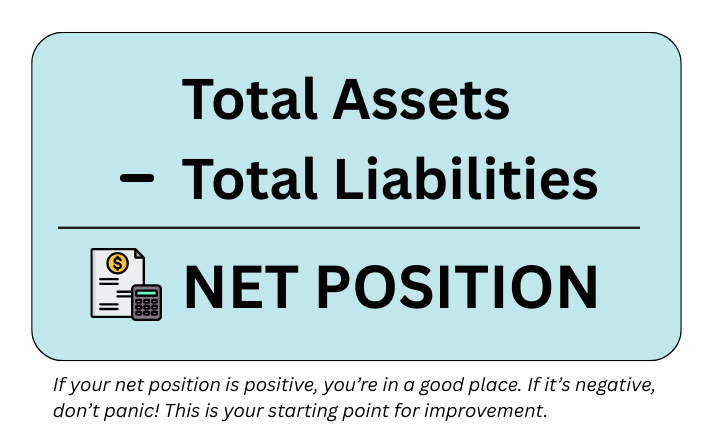
Your net position is the difference between what you own (your assets) and what you owe (your liabilities). It’s essentially your financial scorecard, giving you a snapshot of your overall financial health. Here’s a simple formula:

Net Position

Assets include things like your home, car, savings, and investments. Liabilities include mortgages, credit card debt, personal loans, and other financial obligations. Knowing your net position helps you understand whether you’re building wealth or accumulating debt.

Why Net Position Matters More Than Budgeting

Budgeting is about managing your monthly cash flow, how much money comes in and goes out. While this is important, it doesn’t give you a complete picture of your financial health. Here’s why focusing on your net position is a game-changer:

1. PROVIDES A HOLISTIC VIEW

      • Budgeting focuses on short-term goals, like paying bills or saving for a vacation. Net position shows your long-term financial standing, including the value of your assets and the weight of your debts.

2. HELPS SET REALISTIC GOALS

      • Understanding your net position allows you to set achievable financial goals, whether it’s buying a home, retiring early, or becoming debt-free.

3. REVEALS FINANCIAL TRENDS

      • Tracking your net position over time helps you see whether your financial health is improving or deteriorating.

4. GUIDES BETTER DECISION-MAKING

      • Knowing your net position helps you make informed decisions about spending, saving, and investing.

Common Misconceptions About Net Position

Budgeting is about managing your monthly cash flow, how much money comes in and goes out. While this is important, it doesn’t give you a complete picture of your financial health. Here’s why focusing on your net position is a game-changer:

1. “Only Wealthy People Need to Track Their Net Position”

      • False! Everyone, regardless of income level, can benefit from understanding their net position. It’s about knowing where you stand and where you’re headed.

2. “Budgeting Alone is Enough”

      • While budgeting is crucial for managing day-to-day expenses, it doesn’t address your overall financial health.

3. “It’s Too Complicated”

      • Tracking your net position can be as simple as listing your assets and liabilities in a spreadsheet or using a financial app.

Steps to Improve Your Net Position

1. ELIMINATE HIGH-INTEREST DEBT

      • Focus on paying off credit cards and personal loans first. These often carry the highest interest rates and can significantly impact your financial health.

2. INCREASE YOUR SAVINGS

      • Build an emergency fund with at least three to six months’ worth of living expenses. This provides a financial safety net and reduces the need for high-interest debt during emergencies.

3. INVEST WISELY

      • Grow your assets by investing in a diversified portfolio. Consider long-term investments like retirement accounts or real estate.

4. REDUCE LIABILITIES

      • Pay down loans and avoid taking on new debt unless it’s for a strategic purpose, like buying a home.

5. TRACK YOUR PROGRESS

      • Revisit your net position quarterly or annually to measure your progress and adjust your financial plan as needed.

How Our “Know Your Numbers” Course Can Help

Our “Know Your Numbers” course is designed to take the guesswork out of understanding your net position. Here’s what you’ll learn:

1. HOW TO CALCULATE YOUR NET POSITION 

      • Step-by-step guidance on listing your assets and liabilities.

2. TOOLS AND TEMPLATES

      • Access user-friendly calculators and spreadsheets to track your progress.

3. STRATEGIES FOR IMPROVEMENT

      • Learn actionable steps to grow your assets, reduce your liabilities, and increase your net worth.

4. REAL-LIFE EXAMPLES 

      • See how others have transformed their financial health by focusing on their net position.

Success Stories

1. JOAN’S TRANSFORMATION

Joan discovered her net position was negative due to high credit card debt. Using strategies from the course, she paid off her debt in two years and now has a positive net worth of $20,000.

2. PETER’S JOURNEY

Peter thought he was doing well because he had a high income. After calculating his net position, he realised his debt outweighed his assets. He’s since restructured his finances and is on track to achieve financial independence.

Know Your Numbers

Conclusion

Understanding your net position is the key to unlocking financial freedom. It’s not just about how much you earn or spend; it’s about the bigger picture of what you own versus what you owe. By focusing on your net position, you can make smarter financial decisions, set realistic goals, and build a secure future. Ready to take control? Join our “Know Your Numbers” course today and start your journey toward financial clarity and success.

The Vault