Busy Doesn’t Pay the Bills

Busy Doesn’t Pay the Bills

You worked sixty hours last week. So why does the bank account look like you worked twenty?

This is the one nobody wants to say out loud at the barbecue – being busy and being profitable are two completely different things, and most small business owners have spent years chasing the wrong one without realising it, because busy is the one everyone can see and profit is the one hardly anyone talks about.

We wear “flat out” like a badge of honour around here. Full calendar, full inbox, full plate, barely time for lunch, home late again. It’s practically a competitive sport among business owners, whoever’s had the wildest week wins some invisible prize. But a full calendar doesn’t automatically mean a full bank account, and that gap is exactly where the frustration lives, working harder than you ever have and still not seeing it show up where it counts, still lying awake doing mental maths that never quite adds up the way it should.
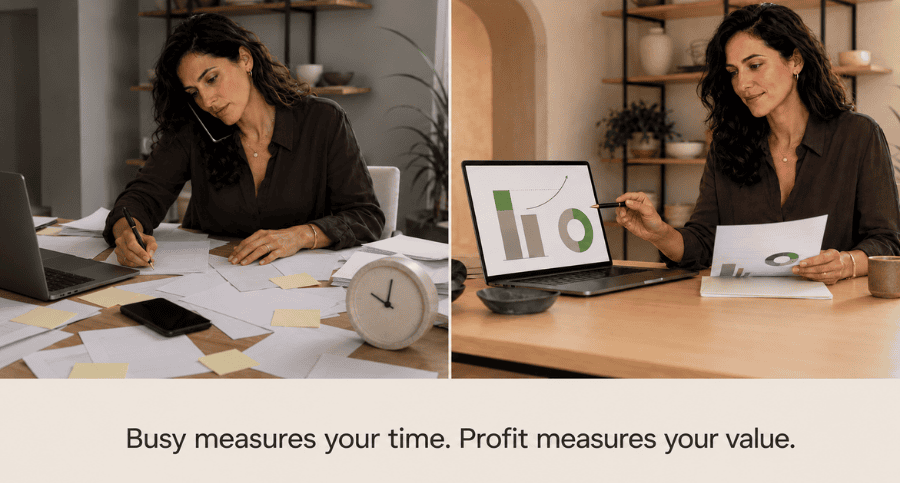
Busy measures your time. Profit measures your value.

Busy measures your time. Profit measures your value.

You can be fully booked out doing work that barely covers what it costs you to deliver it. Being busy tells you the calendar’s full. It tells you nothing about whether the business is actually working for you, or just working you into the ground while quietly running on thin margins nobody’s checked in a while.

I’ve sat across from business owners who were, by any outside measure, wildly successful booked out months in advance, a great reputation, more work than they could handle. And they were barely paying themselves properly, because nobody had ever sat down and worked out what each job actually needed to cost to make the whole thing worthwhile. Busy had completely disguised the real story, right up until it couldn’t any more.

Why busy feels so convincing

Part of the problem is that being busy comes with all the physical evidence of hard work; the tired legs, the full diary, the late nights. It feels like proof that things are going well, because it’s the same feeling we’ve always associated with success. Profit, on the other hand, is quiet. It doesn’t announce itself the same way. You don’t feel a profitable decision the moment you make it, the way you feel a long day in your bones. So busy wins the argument for attention, even when it’s not actually the one that matters most.

The trap of “just get more clients”

There’s a piece of advice that gets handed around a lot in small business circles – “just get more clients, that’ll fix it.” I’ll be straight with you, it’s tired advice, and it’s rarely true. More clients on top of an unprofitable structure just means more busy, at the same thin margin, with a lot more stress bolted on top. You’ve simply built a bigger version of the same leaky bucket. Fix the structure first. Scale it after, not before, otherwise you’re just working harder to stand still, faster, and wondering why the extra effort never seems to catch up.

What actually moves the needle

It’s rarely one big dramatic change. More often it’s a handful of smaller, unglamorous ones done properly knowing what a job genuinely costs before you quote it, building in a bit of buffer instead of pricing to the bone, saying no occasionally, following up on the money you’re owed without embarrassment. None of these make for an exciting headline. All of them, done consistently, add up to a business that reflects the effort going into it.

A small shift that changes a lot

Before you say yes to the next job, the next client, the next “quick favour” that somehow always turns into three hours of your Saturday, check what it’s actually worth once the real costs are factored in. Time, materials, the admin it drags behind it, the toll it takes on the rest of your week. Sometimes the most profitable move you can make is saying no to something that is busy without adding a cent of real profit, and saying yes instead to fewer things, done properly, priced properly.

You’re not behind, and you’re certainly not lazy. You’ve just never had proper visibility on which parts of the business are working for you and which parts are quietly working against you while you’re too busy to look. Once that becomes clear, the decisions get so much easier genuinely, not in a “just think positive” way, but in a very practical, this-is-what-the-numbers-actually-show kind of way.

The uncomfortable question worth asking

Here’s one worth sitting with for a minute; if your business stayed exactly this busy for the next twelve months, with nothing else changing, would you actually be better off this time next year? Not busier. Better off. More profit in the bank, more breathing room, more choice in what you say yes to.

For a lot of business owners, the honest answer is “not really,” and that’s an uncomfortable thing to admit after all the hours that have gone in. But it’s also the most useful question you can ask, because it points you toward the actual fix, which is almost never “do more of the same, just harder.”
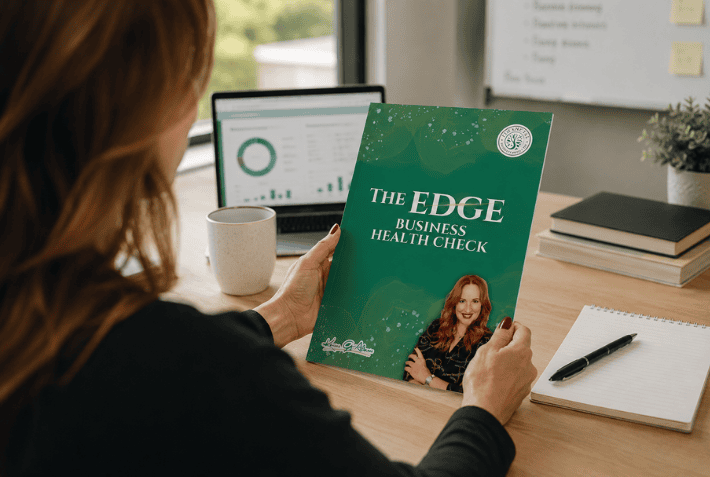
The Edge Business Health Check

Redefining what a good week looks like

We’ve been taught, somewhere along the way, that a good week in business is a full one. Every hour booked, every day accounted for, home late most nights because that’s what commitment apparently looks like. It’s worth challenging that definition, because a genuinely good week isn’t the one with the most hours in it – it’s the one that moved the business forward the most, profitably, without costing you your evenings and your patience along the way.

That might mean fewer hours worked, not more. It might mean turning down the client who’s more trouble than they’re worth, even though saying yes would have made the calendar look fuller. A full calendar looks impressive from the outside. A profitable, sustainable one is the one that actually serves you.

That visibility is exactly what The Edge Business Health Check gives you, in about fifteen minutes flat.

#HowToResetMyMoneyMindset #NewYearFinancialMindset #HowToStartFreshWithMoney  emergency fund australia, money management, family savings #SmallBusinessOwner #BusinessGrowth #CashflowManagement #BusinessSuccess
#EntrepreneurMindset

 

Why Small Business Owners Are Working Harder Than Ever — But Making Less Profit

Why Small Business Owners Are Working Harder Than Ever — But Making Less Profit

The Shift Every Business Owner Must Understand to Survive and Thrive in Today’s Economy

There was a time when hard work almost guaranteed success in business.

If you stayed committed, put in the hours, sacrificed weekends, pushed through exhaustion, and gave your business everything you had, eventually the rewards would come.

At least that’s what many small business owners were taught to believe.

But today?

Things feel very different.

Across Australia, many small business owners are working harder than ever before, yet they’re feeling more stressed, overwhelmed, and financially stretched than they did years ago.

They’re putting in longer hours.

Taking fewer breaks.

Carrying more responsibility.

Worrying more about cashflow.

And despite all the effort
 many still feel like they’re not truly getting ahead.

If that sounds familiar, you’re not alone.

Right now, thousands of business owners are quietly asking themselves the same question:

“Why does it feel like I’m working harder than ever
 but making less profit?”

The answer is confronting but important.

The old way of doing business no longer works in today’s economy.

And the businesses that will thrive over the next decade will not necessarily be the businesses working the hardest.

They’ll be the businesses operating the smartest.

That’s a massive shift.

Because many business owners were conditioned to believe that success comes purely from hustle.

Work harder.
Push harder.
Do more.
Sacrifice more.

But in today’s world, hard work without systems, visibility, strategy, and leadership often leads straight to burnout.

And burnout is becoming one of the biggest silent killers of small business success.

The Hidden Trap Many Business Owners Fall Into

One of the biggest issues I see with small business owners is that they unknowingly create businesses that rely entirely on them to survive.

They become:

  • the salesperson
  • the marketer
  • the customer service team
  • the accounts department
  • the operations manager
  • the problem solver
  • the social media manager
  • the decision maker

Every problem flows through them.

Every question lands on their desk.

Every fire becomes theirs to put out.

At first, this level of involvement feels normal.

In the early stages of business, most owners wear multiple hats because they have to.

But the problem is many businesses never evolve beyond this stage.

Instead of building scalable businesses, owners end up creating stressful jobs for themselves.

And over time, the pressure becomes exhausting.

The scary part?

Many business owners start believing this level of stress is simply “part of business.”

But it shouldn’t be.

Because while hustle may build a business initially, hustle alone rarely sustains long-term success.

Across Australia, many small business owners are working harder than ever before, yet they’re feeling more stressed, overwhelmed, and financially stretched than they did years ago.

Exhaustion Is Not a Business Strategy

Somewhere along the way, burnout became glorified in business culture.

Working 12-hour days became something to brag about.

Skipping holidays became normal.

Being “busy” became a badge of honour.

But exhausted people do not make powerful business decisions.

When business owners are constantly stressed and overwhelmed, they often begin operating emotionally instead of strategically.

They react instead of lead.

They focus on urgent problems instead of important ones.

They become trapped inside the daily chaos of the business instead of building a business designed for growth.

And eventually, the cracks begin to show.

Relationships suffer.
Health suffers.
Energy drops.
Decision-making weakens.
Creativity disappears.
And often
 profitability suffers too.

Because here’s the truth many people don’t want to admit:

You cannot scale chaos.

Revenue Does Not Equal Profit

One of the biggest misconceptions in business is believing that high turnover automatically means success.

It doesn’t.

There are businesses turning over hundreds of thousands, even millions, of dollars that are still struggling financially behind the scenes.

Why?

Because revenue and profit are two very different things.

Turnover is not profit.

Profit is not cashflow.

And cashflow is not personal wealth.

This is where many business owners get caught.

From the outside, the business may appear successful.

The branding looks great.
Customers are coming through the door.
Sales are happening.

But internally, the owner is stressed, overwhelmed, and wondering where all the money keeps disappearing to.

And honestly?

This creates enormous emotional pressure for business owners.

Because when the numbers don’t make sense, uncertainty grows.

And uncertainty creates stress.

Why Financial Visibility Changes Everything

One of the most powerful things a business owner can have is visibility.

Not complicated spreadsheets.

Not confusing accounting jargon.

Real visibility.

Understanding:

  • where your money is going
  • what’s actually profitable
  • what products or services are underperforming
  • where cashflow leaks are happening
  • what your numbers are really telling you

Because numbers tell stories.

They reveal habits.
Patterns.
Blind spots.
Strengths.
Weaknesses.
Opportunities.

And when business owners truly understand their numbers, something powerful happens.

Confidence returns.

Decision-making improves.

Stress reduces.

Growth becomes more strategic instead of reactive.

But many owners avoid looking deeply at their numbers because they feel confronting.

So instead, they rely on gut instinct.

They check the bank account balance instead of understanding the bigger financial picture.

And while instinct matters in business, instinct without data can become dangerous.

The businesses thriving right now are the ones combining intuition with visibility.

Because when you can clearly see what’s happening in your business, you stop operating from fear.

You start operating from clarity.

The Business World Has Changed

Another reason hard work alone is no longer enough is because business itself has changed dramatically.

Consumers have changed.

Technology has changed.

Marketing has changed.

Attention spans have changed.

And artificial intelligence is now reshaping industries faster than many business owners realise.

Yet many businesses are still operating using outdated systems and outdated models.

This creates a dangerous gap between effort and results.

Some owners are working incredibly hard
 but inefficiently.

They’re manually doing tasks technology could streamline.

They’re overwhelmed by admin.

They’re spending hours creating content.

They’re reacting to problems all day instead of building systems that reduce problems.

And as a result, they stay trapped in operational overwhelm.

The future belongs to business owners who learn how to combine human leadership with smart systems and modern technology.

This doesn’t mean removing the personal side of business.

In fact, human connection matters more than ever.

But it does mean removing unnecessary friction.

It means creating efficiency.

It means building businesses that don’t completely rely on the owner being “on” 24/7.

The Shift From Operator to CEO

This is one of the most important transformations a business owner can make.

The shift from operator to CEO.

Operators stay trapped in the daily chaos.

CEOs create systems.

Operators react emotionally.

CEOs make strategic decisions.

Operators focus purely on revenue.

CEOs focus on profitability and sustainability.

Operators stay busy.

CEOs stay intentional.

This shift changes everything.

Because the goal of business ownership should not be constant exhaustion.

The goal should be building a business that creates freedom, opportunity, and long-term sustainability.

But that requires leadership.

It requires visibility.

And it requires the willingness to evolve.

The Businesses That Will Thrive in the Future

The businesses that will thrive over the next decade are not necessarily the biggest businesses.

They are the businesses willing to adapt.

The businesses are willing to modernise.

The businesses willing to embrace:

  • financial clarity
  • leadership
  • systems
  • automation
  • smarter decision-making
  • visibility
  • sustainable growth

The future small business owner needs more than technical skills.

They need:

  • emotional resilience
  • financial intelligence
  • strategic thinking
  • leadership capability
  • adaptability
  • communication skills
  • modern business systems

Because business growth is no longer just about effort.

It’s about alignment.

Alignment between:

  • strategy
  • systems
  • leadership
  • financial visibility
  • personal wellbeing
  • and sustainable growth

Success is building a business that supports your life.

Your Business Should Support Your Life – Not Consume It

This is the conversation more business owners need to start having.

Because too many owners are trapped inside businesses that are draining them emotionally, mentally, physically, and financially.

And that’s not success.

Success is building a business that supports your life.

A business that creates opportunity.

A business that allows you to grow financially without destroying your health or relationships in the process.

A business that gives you freedom instead of constant anxiety.

And perhaps the biggest shift of all is this:

The goal was never just to work harder.

The goal was always to build better.

To build smarter.

To build more intentionally.

To create stronger systems.

To understand your numbers properly.

To lead with clarity instead of chaos.

And to create a business that actually works for you – instead of one that constantly burns you out.

Because the businesses that thrive in this new era will not be the businesses grinding themselves into the ground.

They’ll be the businesses willing to evolve.

The businesses willing to simplify.

The businesses willing to lead differently.

And the business owners who understand that shift will create something far more powerful than just revenue.

They’ll create sustainability.

Freedom.

Profitability.

And a business and life – they genuinely enjoy.

Ready to Stop Surviving and Start Leading?

If you’re tired of feeling overwhelmed, financially stretched, or stuck working harder without seeing the results you deserve, maybe it’s time to stop asking:

“How can I work harder?”

And start asking:

“How can I build smarter?”

Because sometimes the biggest breakthrough in business doesn’t come from doing more.

It comes from finally doing things differently.

Take the FREE Business Performance Auditℱ and uncover what’s really slowing your business down.

Membership - FM101

#HowToResetMyMoneyMindset #NewYearFinancialMindset #HowToStartFreshWithMoney  emergency fund australia, money management, family savings #SmallBusinessOwner #BusinessGrowth #CashflowManagement #BusinessSuccess
#EntrepreneurMindset

 

Busy Is Not Profitable: 7 Financial Foundations Every Business Owner Needs

Busy Is Not Profitable: 7 Financial Foundations Every Business Owner Needs

There’s a big myth in small business that if you just work hard enough, everything will eventually click into place.

Spoiler alert: hard work matters, but hard work without financial foundations can leave you exhausted, underpaid, and wondering why your business still feels so heavy.

I see this all the time with small business owners, tradies, franchisees, coaches, and self-employed professionals.

They are flat out. Clients are coming in. Invoices are going out. The calendar is packed.

And yet
 There is still stress. Still pressure. Still that sinking feeling of, “Why does it feel like I’m doing all this work and not getting ahead?”

Here’s why:

Because busy is not profitable. And being great at your trade or profession is not the same as having strong money systems.

The good news? You do not need a finance degree to fix this. You just need the right foundations.

Here are seven of the most important ones.

1. A cashflow system that tells the truth

Cashflow is not something you check when you are already in trouble.
It is something you build so you can stay out of trouble.

A good cashflow system shows you:

  • what is coming in
  • what is going out
  • what bills are approaching
  • what is available to spend
  • what needs to be set aside for tax, super, wages, and future costs

Cashflow gives you visibility. Visibility gives you control.

2. Clear separation between personal and business money

Using your personal account like a business overdraft creates confusion fast.

It becomes harder to track spending, harder to know what the business is really earning, and harder to make clean decisions.

Separating business and personal finances is one of the fastest ways to reduce chaos.
It is not about being fancy. It is about being clear.

3. Pricing that actually protects your profit

So many business owners price from fear.

Fear of losing the sale.
Fear of seeming too expensive.
Fear of being judged.

But underpricing does not make you more professional. It makes your business more fragile.

Your pricing needs to cover more than the job in front of you. It needs to reflect overheads, admin time, tax obligations, profit goals, and the actual value you deliver.

Pricing with confidence is not greedy.
It is responsible.

4. A plan to pay yourself properly

Using your personal account like a business overdraft creates confusion fast.

It becomes harder to track spending, harder to know what the business is really earning, and harder to make clean decisions.

Separating business and personal finances is one of the fastest ways to reduce chaos.
It is not about being fancy. It is about being clear.

5. Weekly and monthly money rhythms

You do not need to stare at your numbers every day.
But you do need a rhythm.

That might include:

  • checking cashflow weekly
  • reviewing key reports monthly
  • monitoring expenses and margins
  • tracking unpaid invoices
  • spotting small issues before they turn into big ones

Confidence with numbers is built through repetition, not perfection.

6. Knowing your numbers without drowning in them

You do not need to obsess over every metric.
You do need to know the numbers that matter.

Think:

  • revenue
  • gross profit
  • operating expenses
  • net profit
  • cash position
  • debt levels
  • wage costs
  • tax set-asides

The goal is not more complexity.
The goal is better decisions.

When you know what your numbers are saying, you stop making emotional decisions and start making strategic ones.

7. A business structure that can handle growth

Growth is exciting, but if your systems are messy, it can magnify every weakness.

That is why foundations matter before scaling.

You want business systems that support:

  • clear accounts setup
  • simple automations
  • better reporting
  • cleaner budgeting
  • stronger decision-making
  • less burnout

Strong structure makes growth feel possible instead of painful.

Business foundations create freedom

Why this matters right now

The business landscape is not getting easier.
Costs are rising. Margins can be tight. Pressure builds quickly when you do not have clarity.

That is exactly why now is the time to stop relying on memory, hope, and hustle alone.

The strongest business owners are not always the loudest or busiest.
They are the ones who know their numbers, trust their systems, and make decisions early.

Foundations Create freedom

Let’s make this simple. When your financial foundations are solid, you get:

  • less panic
  • less avoidance
  • less confusion
  • better decisions
  • stronger profit
  • more confidence
  • more breathing room

And honestly? More enjoyment.

Because business should not feel like one long financial mystery.

    A business structure will help you handle growth

    Your invitation to stop winging it

    If you know your foundations need work, you are not alone.
    And you do not have to figure it all out the hard way.

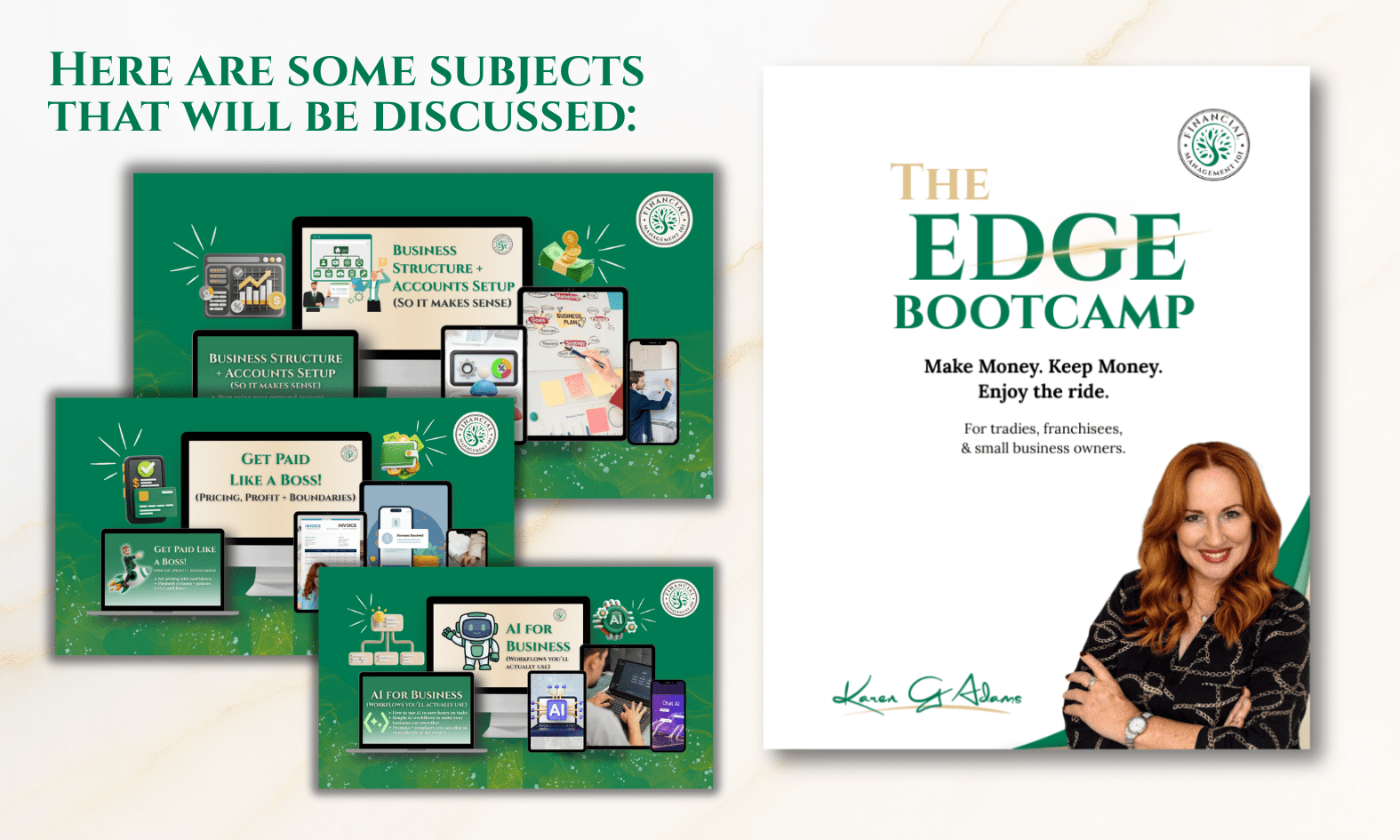
    That is exactly what The Edge Bootcamp is designed to help you do.

    Over two practical, high-impact days, we dig into the real foundations of profitable business: money systems, CEO mindset, cashflow, paying yourself, pricing, budgets, business setup, reading your numbers, leadership, growth stages, and more.

    This is for business owners who want results, not just motivation.

    Join The Edge Bootcamp in May and give your business the foundations it needs to make money, keep money, and enjoy the ride.

    Because being flat out is not the goal.
    Building a business that works for you is.

    Join The Edge Bootcamp

    #HowToResetMyMoneyMindset #WhyDoIFeelOutOfControlWithMoney #HowToFeelInControlOfFinances #ResetMoneyMindset2025 #NewYearFinancialMindset #HowToStartFreshWithMoney  emergency fund australia, money management, family savings 


    Tax Time Without the Panic – The Simple Systems That Keep More of Your Hard-Earned Money

    Tax Time Without the Panic – The Simple Systems That Keep More of Your Hard-Earned Money

    Tax Time Shouldn’t Feel Like a Horror Movie

    If “BAS” makes your eye twitch or tax time feels like a jump scare, you’re not alone.

    For many business owners, tax time looks like:

    • digging through email for receipts
    • trying to remember what that transaction was
    • realising GST money has been accidentally spent
    • asking your accountant, “Is this bad?” 😅
    • promising yourself (again) that you’ll get organised next year

    Whether you’re a tradie, franchisee, coach, consultant, or self-employed professional, it’s easy for tax to become the thing you avoid
 until you can’t.

    But here’s the thing:
    Tax panic isn’t a personality trait. It’s a system issue.

    And the solution isn’t “try harder.”
    It’s: build foundations that make tax time boring.

    Boring is the goal.
    Boring means organised.
    Boring means you’re in control.

    The Real Reason Tax Time Feels So Stressful

    Most tax stress comes from one (or more) of these:

    1) You’re spending money that isn’t actually yours

    If GST/tax isn’t separated, the bank balance lies.

    It looks like there’s cash available
 but a chunk of that cash belongs to the ATO (or will soon). So when BAS hits, it feels like a crisis.

    2) Your numbers aren’t clean

    Mixed transactions, personal spending from business accounts, inconsistent invoicing, missing receipts – these all make reporting harder.

    And when reporting is hard, you avoid it.

    3) You don’t have a simple routine

    If you only look at your money when something is due, you’ll always be reacting.

    4) You’re not clear on what’s “normal”

    Many owners don’t know what to expect from their obligations (GST, PAYG, super, income tax, etc.). That uncertainty turns into anxiety.

    The fix is not complicated, but it does require a shift from reactive to proactive.

    Owner Pay Is the Cornerstone of a Healthy Business

    The “Tax Calm” Blueprint (Simple, Practical, Repeatable)

    Let’s build tax calm from the ground up.

    Step 1: Separate business and personal (because clarity = calm)

    This is the first domino.

    When business and personal are mixed:

    • profit looks different than it really is
    • expenses get miscategorised
    •  your accountant has to untangle it (costly + time-consuming)

    •  BAS reporting becomes messy

    • tax estimates become unreliable

    When you separate them, your numbers get clearer fast. Even if you’re not ready to overhaul everything, start with this:

    • separate bank accounts (or at least strict allocation “buckets”)
    • a clear rule: business expenses only from business, personal only from personal
    • owner pay transferred as owner pay (not random withdrawals)

    This one change reduces stress massively.

    Step 2: Quarantine GST/tax weekly (so it never surprises you again)

    If you do nothing else after reading this blog, do this one thing.

    When GST and tax are quarantined weekly:

    • you stop “accidentally spending” future obligations
    • BAS becomes a planned payment
    • your cash flow becomes more reliable
    • you feel calm because you know the money is there

    A simple habit: Each week (or each time income lands), transfer a percentage into a tax/GST bucket

    The right percentage depends on your structure and circumstances (and this is where your accountant or qualified adviser can guide you). But the foundation is non-negotiable:

    Set aside first. Spend second.

    Step 3: Create a weekly money routine (30 minutes that changes everything)

    You don’t need a full day of admin.

    You need a repeatable routine.

    Pick one day per week – your “money check-in.”

    On that day, you:

    1. review what came in
    2. allocate GST/tax set-aside
    3. check bills due in the next 7 – 14 days
    4. confirm owner pay
    5. quickly check that transactions are being categorised correctly
    6. look at ONE key number (margin, break-even, or cash runway)

    That’s it.

    This is how tax time becomes boring, because you’ve been managing it in small pieces all year.

    Step 4: Keep records simple (no one’s trying to win an admin award)

    Receipts and records are one of the biggest stress points, so let’s make it easy.

    Your goal is not “perfect bookkeeping.”
    Your goal is “good enough that nothing becomes a disaster.”

    Simple record habits that help:

    • snap receipts immediately (or forward them to a dedicated email)
    • keep a consistent filing approach (even if it’s just “by month”)
    • reconcile regularly (weekly or fortnightly)
    • don’t leave it until BAS is due

    Future you will thank you.

    Step 5: Understand the 3 reports that remove the fear

    You don’t need to become an accountant, but you do need to feel confident in the basics.

    These three reports reduce stress instantly:

    1. Profit & Loss (P&L): tells you if the business is making money
    2. Balance Sheet (basic understanding): tells you what the business owns/owes
    3. Cash Flow position: tells you what’s actually available and what’s coming

    You’ll build confidence understanding key reports, including Xero if you use it (and the principles still apply if you use other systems).

    Confidence with these reports is what stops tax time feeling like a mystery.

    The Hidden Cost of Tax Panic (It’s Not Just the Bill)

    Tax panic doesn’t only cost you money. It costs you:

    • time (scrambling, chasing receipts, fixing mistakes)
    • stress (constant background anxiety)
    •  decision fatigue (avoiding choices because you don’t trust your numbers)

    • opportunity (hesitating to invest, hire, grow, or take time off)


    When your numbers are clean and your system is simple:

    • you price more confidently
    • you choose better clients 
    • you stop discounting out of fear
    • you plan ahead instead of catching up 
    • you keep more of what you earn (because you stop leaking money through chaos)

    Common “Tax Time Traps” (and how to avoid them)

    Here are the patterns I see all the time:

    Trap #1: “I’ll sort it out when it’s quieter”

    If you’re a tradie or franchisee, it might never get quieter.
    If you’re a coach/consultant, the quiet seasons are often when you’re building the next offer.

    Solution: a weekly rhythm. It’s small enough to do even when busy.

    Trap #2: “My accountant will handle it”

    Your accountant is essential, but they shouldn’t be your emergency clean-up crew.

    Solution: you handle the foundation; they handle the strategy and compliance.

    Trap #3: “I’m scared to look”

    Avoidance creates bigger problems.

    Solution: start with one number, one routine, one week at a time.

    Trap #4: “I don’t use Xero so I can’t get organised”

    Tools help, but tools aren’t the solution.

    Solution: the system works regardless of platform. (Xero is just a tool; your habits are the strategy.

    What “Tax Calm” Looks Like in Real Life

    When you’ve built foundations, tax time becomes:

    • “Yep, that’s due – money’s already set aside.”
    • “My reports make sense.”
    • “My accountant has what they need.”
    • “I’m not guessing.”
    • “I’m not panicking.” 

    And here’s the best part: When tax becomes calm, you stop running your business from stress. You start running it from strategy.


    When tax becomes calm, you stop running your business from stress.
You start running it from strategy.

    How The Edge Bootcamp Supports This (and why it’s perfect before EOFY planning)

    The Edge Bootcamp is designed for business owners who want more profit, better systems, cleaner numbers, and less overwhelm.

    You’ll walk away with:

    • a simple money system
    • clearer separation between business and personal finances
    • confidence understanding Xero and key reports
    • and a clear 90-day implementation plan so you know what to do first, next, and next

    Tickets include:

    • the 2-day live bootcamp
    • digital resources
    • templates
    • 90-day action plan tools

    And yes, recordings are provided after the event for ticket holders.

    If you’re thinking, “I’m behind and embarrassed,” this is a practical and judgement-free event – designed to help you build confidence step-by-step.

    You can attend:

    So whether you’re based in Perth, Fremantle, East Fremantle, regional WA, interstate, or juggling a packed schedule, you can still get the foundations in place.

    Want Tax Time to Be Boring (In the Best Way)?

    If you’re ready to stop the stress spiral and build a simple system that makes tax time calm, cash flow predictable, and owner pay consistent


    ✅ Join The Edge Bootcamp (2-day live event)
    ✅ Attend in person at East Fremantle Yacht Club or live online
    ✅ Get templates + digital resources + your 90-day action plan tools included
    ✅ Receive recordings after the event so you can rewatch while you implement

    CTA: Book your spot for The Edge Bootcamp and walk away with the foundations to manage your business and finances with clarity, confidence, and a plan.

    Note: This is general education only, not personalised financial, tax, accounting, legal, health, or investment advice. Please seek advice from qualified professionals for your specific circumstances.

    Join The Membership at Financial Management 101

    #HowToResetMyMoneyMindset #WhyDoIFeelOutOfControlWithMoney #HowToFeelInControlOfFinances #ResetMoneyMindset2025 #NewYearFinancialMindset #HowToStartFreshWithMoney  emergency fund australia, money management, family savings 


    The Emergency Fund Isn’t Optional – How to Build One Without Feeling Broke (and why it changes everything)

    The Emergency Fund Isn’t Optional – How to Build One Without Feeling Broke (and why it changes everything)

    Let’s talk about the one money habit that turns chaos into calm faster than almost anything else:

    An emergency fund.

    Now before you roll your eyes and think, “Karen, I knowww
 but I can barely afford groceries,” stay with me.

    Because I’m not about to tell you to magically save three months of expenses overnight, live on rice and sadness, and stop enjoying life.

    That’s not financial education – that’s financial punishment. 😅

    What I am going to do is show you how to build an emergency fund in a way that feels doable, realistic, and actually sticks
 even if money is tight.

    And here’s why this matters:

    An emergency fund isn’t just “money in an account.”
    It’s peace, options, and less stress when life does what life does best
 surprise you at the worst possible time.

    So let’s get your financial house in order by building the foundation that stops everything from wobbling.

    Why the Emergency Fund Is Non-Negotiable (Even If You Have Debt)

    I want you to imagine your finances like a house.

    If your foundation is cracked, everything else feels unstable:

    • you can’t plan properly
    • you can’t relax
    • you’re constantly bracing for impact
    • and one unexpected bill can knock you sideways

    An emergency fund is the foundation.

    It stops you from:

    • using credit cards “just this once”
    • grabbing BNPL for essentials
    • borrowing from family
    • draining your savings every time something happens
    • feeling like you’re always behind

    Even if you’re paying down debt, you still need a buffer.
    Because without one, every emergency becomes more debt
 and that cycle is exhausting.

    An Emergency Fund Is Non-Negotiable Even If You Have Debt

    The Biggest Myth: “I’ll Start When I Have More Money”

    This is the #1 reason people delay emergency savings.

    They think:

    • “I’ll start when I get a pay rise.”

    • “I’ll start when the kids are older.”

    • “I’ll start when the cost of living calms down.” (lol
 remember calm?)

    • “I’ll start when things settle.”

    But here’s the truth:

    Things don’t settle.
    You just get stronger and more organised.

    And you don’t get stronger by waiting.
    You get stronger by starting small and building consistency.

    You don’t need a massive emergency fund to change your life.
    You need the habit of saving, the system that supports it, and the confidence that you can handle surprises.

    What Counts as an “Emergency”? (Let’s Be Clear)

    If we don’t define “emergency,” your emergency fund gets eaten by:

    • sales

    • convenience spending

    • spontaneous “self-care” shopping

    • and that “it’s been a week” moment at Target 😄

    An emergency is:
    ✅ urgent
    ✅ necessary
    ✅ unexpected
    ✅ not in the budget

    Examples:

    • car repairs

    • urgent medical/dental

    • last-minute travel for family reasons

    • job loss or reduced income

    • essential home repairs

    • unexpected vet bills (pets are adorable little financial liabilities)

    Not emergencies:
    ❌ a holiday
    ❌ Christmas (it’s predictable, we plan for it)
    ❌ a new phone because your current one is “annoying”
    ❌ a birthday gift (also predictable)
    ❌ a sale (I don’t care how good the sale is)

    For those predictable costs, we use sinking funds (we’ll talk about that shortly).

    Emergency Fund vs Sinking Funds (The Difference That Changes Everything)

    This is a game-changer for getting your financial house in order.

    Emergency fund:

    For true, unexpected emergencies.

    Sinking funds:

    For expected expenses that don’t happen weekly or monthly but absolutely happen:

    • car rego and insurance
    • school expenses
    • rates
    • Christmas
    • birthdays
    • holidays
    • annual subscriptions
    • car servicing

    When people don’t have sinking funds, they call predictable bills an “emergency”
 and then their emergency fund never grows.

    So yes, we want both. But we start with a buffer first.

    Step One: Build a “Stress Buffer” (The First Goal)

    Forget “3 months of expenses” for a second.

    Your first goal is what I call a Stress Buffer:

    • $500 if you’re starting from scratch
    • $1,000 if you have a bit more breathing room

    This amount won’t solve everything, but it will stop the small stuff from turning into drama.

    And you know what? When you see that balance grow, something shifts.

    You start trusting yourself. You feel less panicked. You stop living on the edge of your bank balance.

    That’s financial muscle building in real time.

    “But I Can’t Save” – Yes You Can (Here’s How)

    I’m going to say this kindly:

    Most people can save something.
    They just haven’t had a system that makes it automatic and non-negotiable.

    Here are practical ways to start, even if you’re on a tight budget.

    1) The Micro-Save Method

    Start with:

    • $10 a week

    • or $25 a fortnight

    • or $2 a day

    Yes, it feels small. But small done consistently becomes powerful.

    The goal is not the amount at the start.
    The goal is building the identity of: “I’m someone who saves.”

    2) The “Pay Yourself First” Transfer

    This is the most important strategy of all:

    Set up an automatic transfer on payday into a separate account called:

    • “Emergency Fund”

    • “Stress Buffer”

    • “Do Not Touch” 😄

    • “Future Me’s Peace”

    When it’s automatic, you don’t have to think about it.

    And thinking less about money is the dream, isn’t it?

    3) The Round-Up Hack

    Many banks let you round up purchases and move the difference into savings.

    It’s not life-changing on its own, but combined with automation?
    It’s a lovely little boost.

    4) The “Found Money” Rule

    Any unexpected money goes to the emergency fund until you hit your first goal:

    • tax returns

    • bonuses

    • cashback

    • refunds

    • gifts

    • overtime

    You can still enjoy some of it – I’m not a monster – but Future You gets first dibs until your foundation is built.

    Where to Put Your Emergency Fund (So You Don’t Accidentally Spend It)

    This part matters because if your emergency fund is sitting next to your spending money
 it will be treated like spending money.

    Human brains do not like temptation.

    Here’s the rule:
    ✅ separate account
    ✅ not linked to your everyday card
    ✅ easy enough to access in an emergency, but not instant-grab easy

    A high-interest savings account is often a good option for many people, but the key isn’t the interest rate – it’s the separation.

    If you have to take one extra step to access it, you’ll be less likely to raid it for non-emergencies.

    How Much Should Your Emergency Fund Be?

    Once you’ve built the Stress Buffer, you can level up.

    Here are the common tiers:

    Tier 1: $500–$1,000 Stress Buffer

    Stops small emergencies becoming debt.

    Tier 2: 1 month of essential expenses

    Covers short-term hiccups.

    Tier 3: 3 months of essential expenses

    A solid safety net for most households.

    Tier 4: 6 months of essential expenses

    Great if you’re self-employed, commission-based, or in an industry with variable work.

    Important: You don’t have to build this in a week. You build it steadily and that’s what makes it sustainable.

    The “Life Is Lifey” List: Why Emergencies Keep Happening

    Here are just a few things I see all the time:

    • the car decides it’s done with life
    • unexpected house repair
    • the hot water system taps out
    • the dog eats something it shouldn’t (again)
    • a dentist visit becomes a “how is this $800?” moment
    • your kid needs something for school tomorrow
    • your income changes unexpectedly


    These aren’t rare events. They’re predictable unpredictables.

    And when you have an emergency fund, you stop being shocked and start being prepared. That is the point.

    Life Emergencies Keep Happening

    What If You’re Paying Off Debt?

    Here’s my professional but real-life approach: If you have debt, you still build a Stress Buffer first.

    Why? Because without it, you’ll keep going back into debt every time something happens.

    A simple strategy is:

    1. Build $500 – $1,000 buffer
    2. Focus on debt payoff
    3. Build 1 month expenses
    4. Continue debt payoff + build sinking funds
    5. Build to 3 months expenses

    This is balanced. Realistic. And it reduces stress.

    How to Make Saving Feel Less Painful (Because Yes, It Can)

    Saving can feel like deprivation when your brain believes money is scarce.

    So we make it feel lighter by doing two things:

    1) Make it automatic

    If you’re relying on motivation, you’ll save only when you feel inspired.

    And motivation is
 inconsistent. Automation builds wealth quietly.

    2) Give your savings a purpose

    Calling it “Savings” is boring. Calling it “Freedom Fund” or “Peace Buffer” hits differently.

    Name it like it matters, because it does.

    The Secret to Getting Your Financial House in Order: One System That Runs Without You

    Here’s the truth:

    Most people don’t fail at money because they don’t care.
    They fail because they don’t have a system, they’re doing everything manually, with willpower, while stressed.

    And that’s like trying to carry groceries without bags. Possible
 but messy and exhausting.

    A system looks like:

    • separate accounts
    • automatic transfers
    • sinking funds for predictable costs
    • a weekly 10-minute money check-in
    • clear rules for what is/isn’t an emergency

    This is what creates calm.

    Want Help Building This (So It Actually Sticks)? Join the Membership.

    If you’ve read this and thought:

    “I want this, but I need help setting it up.” or “I’ve tried to save before and it disappears.” or “I need a plan that’s realistic for my life.”

    That’s exactly why I created my Membership.

    Inside the Membership we don’t just talk about emergency funds – we build the whole system:
    ✅  Your Stress Buffer plan (based on your income and expenses)
    ✅  Automated transfers so saving happens without willpower
    ✅  Sinking funds so predictable expenses stop feeling like emergencies
    ✅  Amoney map so your cash flow has structure
    ✅  Support and guidance so you don’t fall off track

    You don’t need to “try harder.” You need the right strategy and ongoing support.

    If you’re ready to stop living one unexpected bill away from stress, join the Membership.
    Let’s build your emergency fund, get your financial house in order, and help you feel calm with money again for good.

    Join The Membership at Financial Management 101

    #HowToResetMyMoneyMindset #WhyDoIFeelOutOfControlWithMoney #HowToFeelInControlOfFinances #ResetMoneyMindset2025 #NewYearFinancialMindset #HowToStartFreshWithMoney  emergency fund australia, money management, family savingsÂ