You’ve noticed it. A reliable team member is suddenly distracted, a bit short with people, asking about extra shifts or a pay advance. You suspect money is the problem, and you want to help without overstepping. Good employee financial stress support doesn’t start with a program. It starts with one kind, well-handled conversation.
This post walks you through how to open that conversation, what to say (and what to avoid), and the free, confidential services you can point people to. You don’t need to be a financial expert. You just need to care, and know where the door is.
THE SHORT ANSWER
Should I say something at all?
Yes, gently and privately. You’re not there to fix their finances or ask for details. You’re there to notice, listen and make support easy to reach. Under the model WHS laws, businesses must manage psychosocial risks at work, and poor support is one of the listed hazards (Safe Work Australia).
Why does money stress show up at work?
Because people don’t leave their worries at the door. Beyond Blue says nearly 1 in 5 people experience poor mental health each year, and that poor mental health costs Australian businesses up to $39 billion a year (Beyond Blue).
1 in 5
people experience poor mental health each year. (Beyond Blue)
$39B
a year: what poor mental health can cost Australian businesses. (Beyond Blue)
Free
financial counselling through the National Debt Helpline, 1800 007 007. (NDH)
Safe Work Australia explains that stress itself isn’t an injury, but stress that is frequent, prolonged or severe can cause psychological and physical harm (Safe Work Australia). Personal money worries aren’t on its list of workplace hazards. How your workplace responds is where you have influence. Poor support, low job control and high job demands are on that list.
Good to know: Safe Work Australia’s model Code of Practice: Managing psychosocial hazards at work sets out how to identify and manage these risks. Check the version that applies in your state or territory.
What signs might I notice?
- Distraction, mistakes or missed deadlines from someone who is usually on top of things
- Asking for pay advances, extra shifts or to cash out leave more than usual
- Withdrawing from team lunches, social events or fundraising
- Tiredness, irritability or more sick days
- Taking personal calls they seem anxious about
Watch out: These signs can have lots of causes. Don’t assume it’s money, and never raise someone’s finances in front of others. Talk about what you’ve noticed and let them tell you what’s going on.
How do I start the conversation?
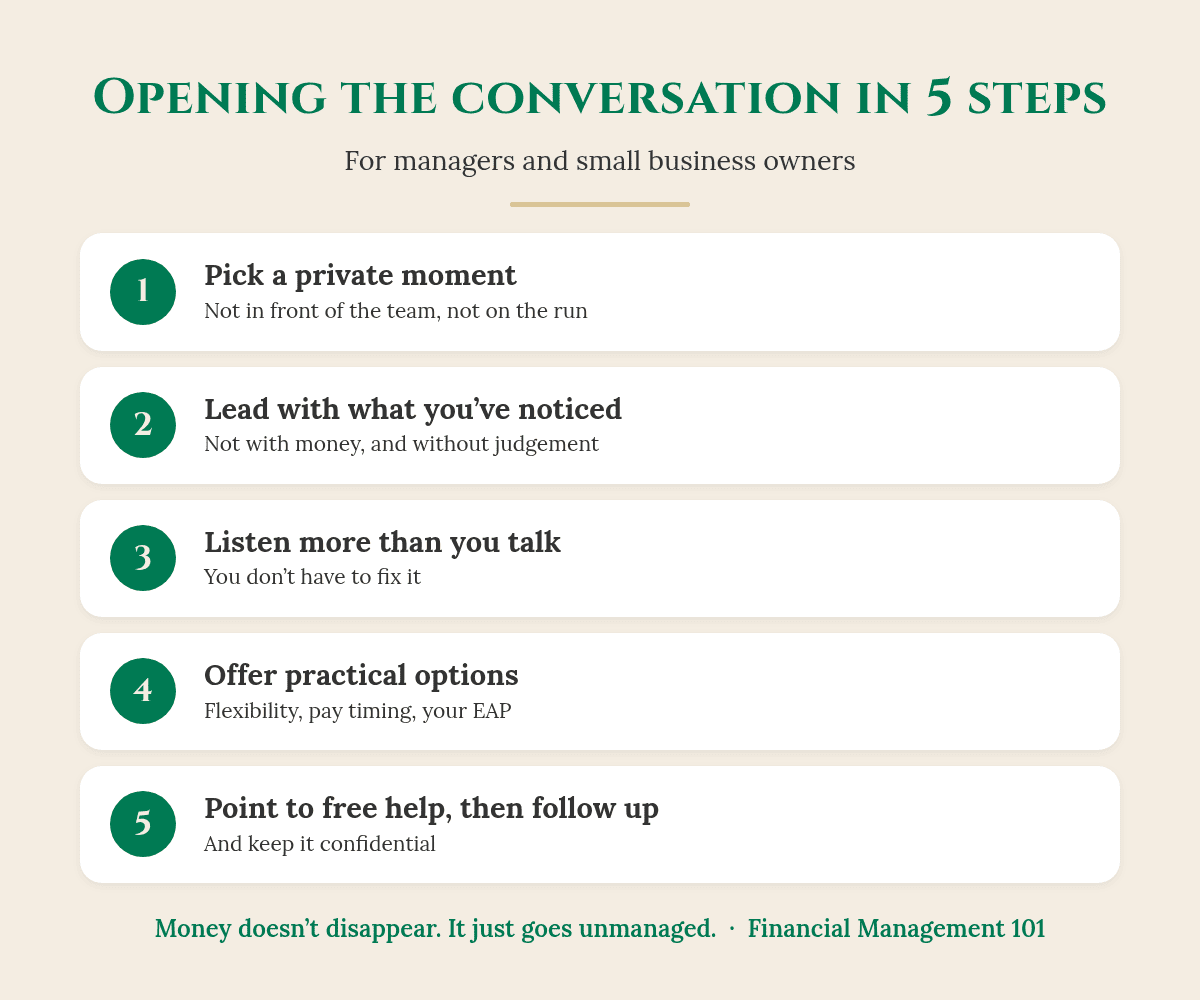
You don’t need a script, but a little preparation helps. Here’s a simple way in.
- Pick a private moment. A quiet room or a walk, not in the middle of a busy shift. Give it time.
- Lead with what you’ve noticed, not with money. “I’ve noticed you’ve seemed a bit flat lately. How are you going?”
- Listen more than you talk. Let silences sit. You don’t have to fix anything or ask for details.
- Offer practical options. Can you be flexible with hours or leave? Could pay timing help? Do you have an Employee Assistance Program (EAP)?
- Point to free, confidential help, then follow up. Check in a week or two later, and keep what they shared confidential.
What to look for: Words that keep the door open. “Is there anything at work that would make things easier right now?” works better than “Are you in debt?” Let them share as much or as little as they want.
So what does this actually look like?
Here’s an illustrative example (not a real person). Sam, a team leader at a small Perth business, notices one of his crew has asked for two pay advances in a month and seems exhausted. He asks for a coffee away from the site and says: “You’ve seemed under pressure lately and I wanted to check in. No need to go into anything you don’t want to.” His team member mentions bills piling up. Sam doesn’t offer advice. He says the business can move a couple of shifts to help, shares the National Debt Helpline number, and mentions the free counselling through their EAP. A fortnight later he checks in again, privately.
What shouldn’t I say?
- Don’t give financial advice. Suggesting loans, investments or which debts to pay first isn’t your role, and it may not suit their situation.
- Don’t judge. Comments like “You just need a budget” shut the conversation down.
- Don’t lend money personally. It blurs the working relationship. If you want to help with pay, use a clear, documented business process.
- Don’t share it. Beyond Blue notes that privacy laws protect people at work (Beyond Blue). Keep what they tell you on a need-to-know basis, with their agreement.
Money doesn’t disappear. It just goes unmanaged. And the people managing it are often doing it alone.
Where can I refer them for help?
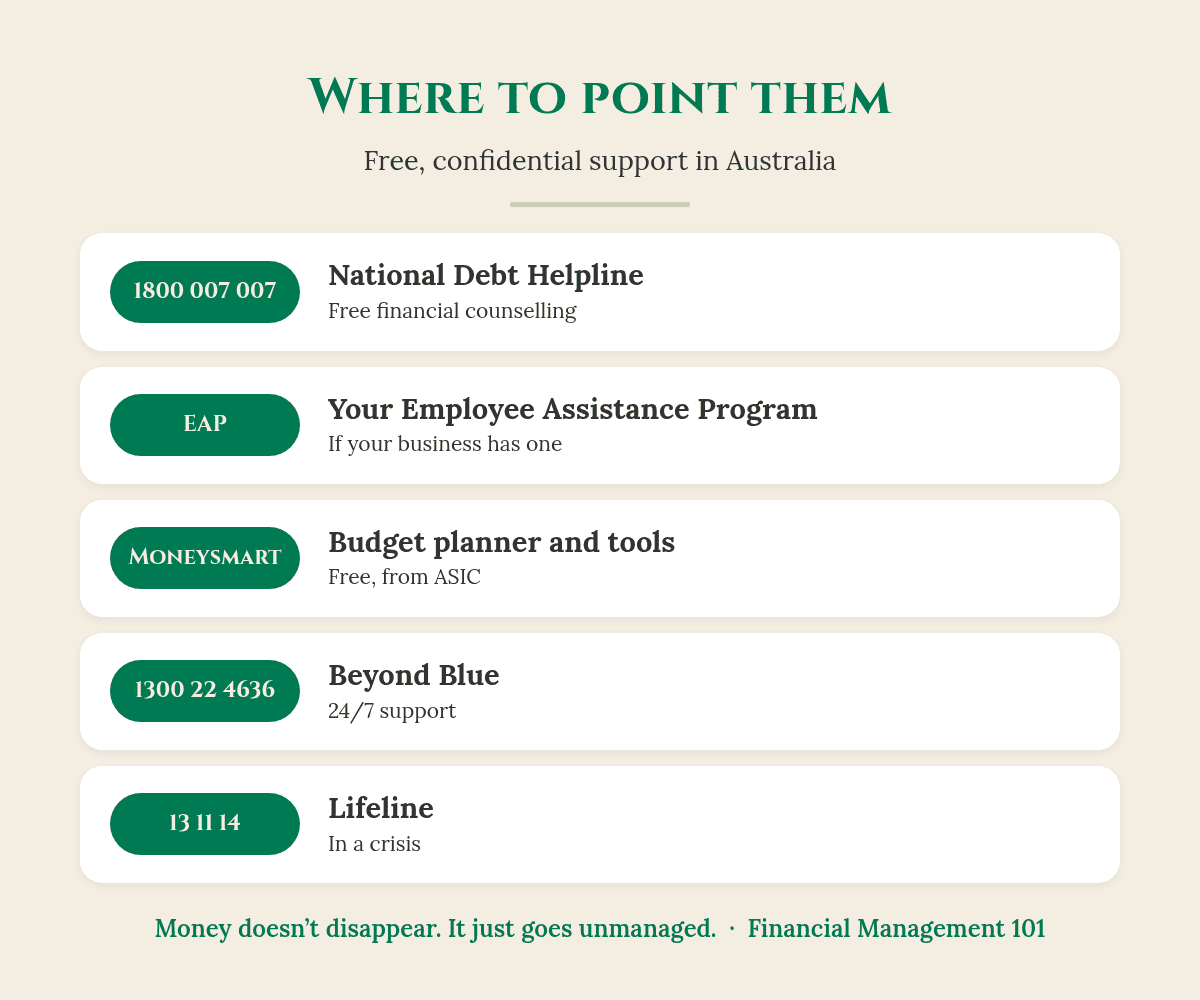
You’re not their financial counsellor, and you don’t need to be. Australia has excellent free services.
- National Debt Helpline: 1800 007 007. Free, confidential financial counselling from not-for-profit services. Phone weekdays 9:30 am to 4:30 pm, or live chat weekdays 9:00 am to 8:00 pm (National Debt Helpline).
- Moneysmart. ASIC’s free website has a budget planner and other tools. Moneysmart also warns that businesses charging fees to fix debt aren’t financial counsellors (Moneysmart).
- Your EAP. If your business has an Employee Assistance Program, remind them it’s there and how to contact it.
- Beyond Blue: 1300 22 4636. Free, confidential support, 24 hours a day, 7 days a week (Beyond Blue).
- Lifeline: 13 11 14. If someone is in crisis, or you’re worried about their safety (Lifeline).
Check this first: Put this list somewhere your managers can find it, like your intranet, staff handbook or the lunchroom noticeboard. It means the next conversation is easier for everyone.
What can my business do beyond one conversation?
One conversation helps one person. A culture where money stress can be talked about helps everyone. My earlier posts on how employers can support staff through uncertain times and why financial stress could be costing more than you think go deeper, and Is Money Stress the Missing Piece in Your Wellbeing Strategy? looks at where it fits in your wellbeing plans.
- Train your managers to notice and open the door, not to give advice.
- Review workload and rosters. Safe Work Australia lists high job demands and low job control as psychosocial hazards (Safe Work Australia).
- Offer practical financial education that’s general, judgement-free and open to everyone, so nobody is singled out.
Your takeaway
- Notice, then talk privately. Lead with what you’ve seen, not with money.
- Listen. You don’t need to fix it, and you shouldn’t give financial advice.
- Offer practical workplace options, and keep what’s shared confidential.
- Point them to free help: the National Debt Helpline (1800 007 007), your EAP, Moneysmart, Beyond Blue or Lifeline.
Your HR adviser and your agent/accountant are great partners in this too, especially when it comes to pay advances, leave and payroll processes.
Want help supporting your team?
I run practical, judgement-free financial wellbeing sessions for workplaces, so your people get real tools and your managers feel confident having these conversations. If you’d like to explore what that could look like for your team, book a call with me.
Frequently asked questions
Is it appropriate to ask an employee about their finances?
Don’t ask about their finances directly. Talk about what you’ve noticed at work, ask how they’re going, and let them choose what to share. Then point them to free, confidential help.
What if they say everything is fine?
Respect that. Let them know the door is open, mention your EAP or the National Debt Helpline in general terms, and check in again later.
Can I give an employee a pay advance?
Some businesses do, but it should be a clear, documented process that follows your payroll and workplace obligations. Talk to your HR adviser and your agent/accountant before you offer one.
Is financial counselling really free?
Yes. The National Debt Helpline says financial counselling through its not-for-profit services is always free and confidential. Moneysmart warns that businesses charging fees aren’t financial counsellors.
Is financial stress a work health and safety issue?
Personal money worries aren’t listed as a workplace hazard by Safe Work Australia, but stress can cause harm, and poor support is a listed psychosocial hazard. How you respond matters.
Your people are your business. Looking after them starts with one conversation.
Karen G. Adams
Small Business Performance Strategist, Financial Management 101
This article is general education only. It isn’t financial, legal or mental health advice. Sam is an illustrative example, not a real person. For advice about your workplace obligations, speak to your HR or WHS adviser. If someone is in immediate danger, call 000.