

July, August, September – done and dusted, more or less. So how’s the new financial year actually going? Not “how busy have you been.” How’s it going?
Most business owners can rattle off exactly how flat out they’ve been since July; the jobs, the clients, the late nights. Fewer can tell you how profitable they’ve been over the same stretch. And that gap between “flat out” and “actually ahead”, is exactly where a quick quarter check-in earns its keep. It’s the difference between a business that feels busy and a business you can actually prove is moving forward.
Nobody waits for the end-of-year school report to find out how a kid’s tracking. You check in along the way – a note home, a parent-teacher chat, a quiet word, and adjust before it becomes a bigger conversation. Your business deserves the same courtesy. Not a full audit, not a forensic dive into every transaction, just an honest look at the first three months of the new financial year, before you’re four quarters deep wondering where it all went and why the number at tax time doesn’t match the effort you know you put in.
Why most business owners skip this
It’s not laziness. It’s usually one of two things, either it feels like it’ll take hours you don’t have, or there’s a quiet fear of what it might show. Both of those assumptions tend to be wrong. This exercise takes less time than a coffee catch-up, and more often than not, the number is somewhere between “not as bad as I feared” and “better than I gave myself credit for.” The dread is almost always worse than the discovery.
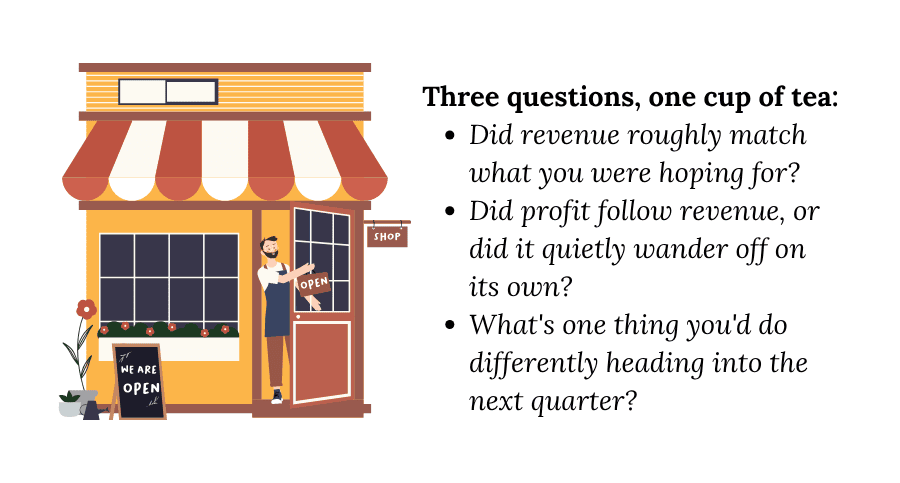
Three questions, one cup of tea
Did revenue roughly match what you were hoping for? Doesn’t need to be precise; ahead, on track, or behind is enough of an answer for now. And if you realise you never actually set a target for the quarter, that’s not a failure, it’s just a perfectly good place to start next time. You can’t be ahead or behind a target that doesn’t exist.
Did profit follow revenue, or did it quietly wander off on its own? This is the one that catches people out most often, and it’s the one I see most in this line of work. Revenue climbs, everyone’s thrilled, the calendar’s fuller than ever and then the bank balance doesn’t quite reflect it, because costs crept up right alongside the growth without anyone clocking it. Materials went up. A subcontractor’s rate went up. You took on a bit more admin help. None of it felt like a big decision at the time, but added together it’s eaten the extra revenue and then some. If you’ve felt busier than ever this quarter but the numbers don’t quite match the feeling, this is usually why.
What’s one thing you’d do differently heading into the next quarter? Not five things, just one! Trying to fix everything at once is how good intentions turn into nothing changing at all. Maybe it’s pricing, which almost every business owner I meet is quietly undercharging on. Maybe it’s chasing invoices a little sooner instead of letting them drift. Maybe it’s finally looking at where the money’s actually going instead of guessing based on vibes and a general sense of dread. Pick the lever that would move things most, and leave the rest for next quarter’s version of this exercise.
What to do with what you find
If the quarter came in ahead, resist the urge to immediately spend the difference on something exciting. Sit with it for a bit. Ask whether it’s a genuine trend or a one-off good stretch before you build plans around it. If it came in behind, resist the opposite urge, the spiral into “the whole business is failing.” One quarter is one quarter. It’s a data point, not a verdict. The value isn’t in the number itself, it’s in what the number tells you to look at next.
Why quarterly, specifically
A quarter is a genuinely good length of time to check in on; long enough to see a real pattern rather than a one-off blip, short enough to actually change course while it still matters. Check monthly and you risk reacting to noise, a slow week that means nothing, a good week that means nothing either. Check yearly and you find out too late to do much about it. Quarterly sits right in the sweet spot, giving you enough information to trust it, and enough time left in the year to actually act on it.
The business owners I see making calmer, more confident decisions are almost always the ones checking in quarterly, not just at tax time when the accountant delivers the number and there’s nothing left to do but accept it. Checking quarterly puts you back in the driver’s seat of your own financial year, rather than a passenger finding out where you ended up after the fact.
If you’d like a proper look under the bonnet, the CEO Dashboard gives you full visibility on exactly how the quarter really went not the guessed version, the real one.
Turning it into a rhythm
The businesses that get the most out of this aren’t doing anything clever, they’ve just made it a rhythm rather than a rescue mission. Same week each quarter. Same three questions. Same short list of actions afterwards. It stops being a big, dreaded event and becomes something closer to a habit, the business equivalent of a regular check-up rather than an emergency room visit.
If this is the first time you’ve done a proper quarter check-in, don’t worry about making it perfect. The value isn’t in precision, it’s in the act of actually stopping to look, on a schedule, instead of only looking when something’s gone wrong enough to force your hand.
Setting yourself up for next quarter
Before you close the laptop on this exercise, write down one number you’ll check again in three months. Just one. Revenue, profit margin, average invoice value, whatever feels most relevant to where you are right now. Having that one number in mind gives the next quarter’s check-in a head start, because you’ll already know what you’re comparing against instead of starting from scratch each time.
Small, consistent check-ins beat big, occasional audits every time. That’s true of your car, your health, and it’s absolutely true of your business.

#HowToResetMyMoneyMindset #NewYearFinancialMindset #HowToStartFreshWithMoney emergency fund australia, money management, family savings #SmallBusinessOwner #BusinessGrowth #CashflowManagement #BusinessSuccess
#EntrepreneurMindset