Investing in your child’s future is often a top priority for parents in their 35s to 50s. While the traditional piggy bank is an excellent way to teach children to save, there are more substantial ways to ensure their financial security and educational future.
1. START WITH A PLAN
Begin by outlining your goals for your child’s future. Is it a college fund, seed money for a business venture, or financial support for a creative pursuit? Having clear goals aids in selecting the best investment strategy.
2. EDUCATION SAVINGS ACCOUNT
Consider opening an education savings account; there are many options depending on where you live. These accounts, which are specifically designed for educational expenses, frequently offer tax advantages.
3. DIVERSIFY WITH MUTUAL FUNDS
Mutual funds can be a great way for parents to diversify their portfolio without having to pick individual stocks. They allow you to invest small amounts on a regular basis.
4. BONDS: A SAFER BET
Government and municipal bonds can be safer investment options. They can be a good choice if you prefer a low-risk path to grow your child’s future fund.
5. TEACH FINANCIAL LITERACY
Involving your children in age-appropriate financial discussions is invaluable. Teach them about money management, saving, and investing. This education is just as important as the financial investment you are making in their future.
6. CONSIDER REAL ESTATE INVESTMENTS
Real estate investing can provide long-term returns for those who are financially capable. This could be through purchasing a rental property or investing in a real estate investment trust. Ensure that you first seek financial advice if you are not experienced in property investing.
7. THE POWER OF A TRUST FUND
Setting up a trust fund for your child can provide financial security and is particularly useful for larger estates or specific family circumstances. It can also assist with tax planning. Seek financial and tax advice before setting up any trust to ensure it is suitable for your financial circumstances.
8. LIFE INSURANCE AS A FINANCIAL TOOL
A life insurance policy can be used to secure your child’s financial future in addition to providing protection. Some policies accumulate cash value over time, which can be used to fund your child’s education.
9. REGULAR REVIEWS AND ADJUSTMENTS
As with any investment, it is critical to review and adjust your strategies on a regular basis. This ensures that your investments are in sync with changing market conditions and educational costs.
10. INSTILLING THE VALUE OF MONEY
Encourage your child to save for the future, whether through part-time work or saving gifts. This instills a sense of responsibility and an appreciation for money.
Investing in your child’s future requires more than just financial commitment; it’s about making informed decisions, taking a diversified approach, and instilling in them the value of financial responsibility. It’s a journey that goes well beyond the piggy bank, setting the stage for a brighter, more secure future for your children.
For any of the above strategies, I would encourage you to seek out professional advice first to ensure it aligns with your values, goals, and financial position.
Remember, it starts with you. Learning about money can give you the power to make smart financial decisions and reduce money-related stress over time. That’s where the LEARNING HUB helps you gain more financial knowledge, while providing you with the support and help you need.
Let’s talk about how stress maybe shortening your life.
And, how you can become better equipped to deal with stress related symptoms whenever you start to feel them come up.
Are you aware what stress is doing to your body?
You may think you do. But I’m here to share with you that some of the symptoms are not as obvious as you may think.
Here in Australia, The Australian Psychology Society produce a stress and wellbeing report.
The area that always catches my attention is how anxiety and depression levels have risen over the years.
The report also shows that financial issues continue to be the top stress over the last few years followed closely by the second top stress being family issues.
I’ve said this before that whenever there are financial issues and stress in a person’s life, their loved ones suffer immensely.
So what effect is this then having on our emotional side and physical body?
Well, stress affects a whole range of areas within our body when we feel pressured or overwhelmed.
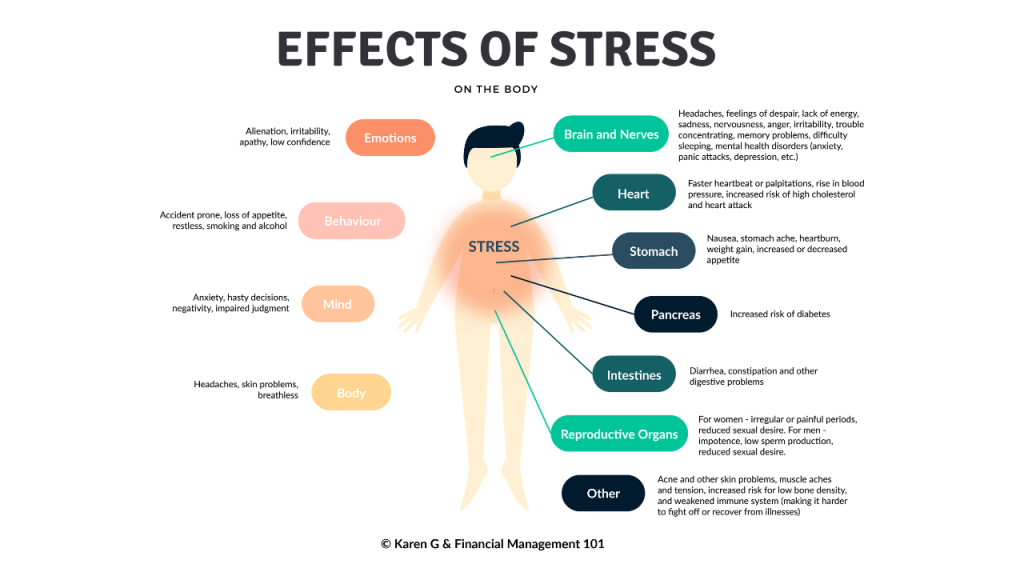
If you take a look at this illustration you’ll see that it’s affecting many areas within your body, some are obvious while others may surprise you.
I want you to look at the left hand side of this diagram to see how first hand it’s affecting your emotions.
When your emotions are overloaded by stress, you become irritable, you may alienate yourself from others and your confidence drops.
When you’re under stress, your behaviour changes and you may become accident-prone, lose appetite, take up recreational drugs or alcohol, and/or start smoking.
And no surprise here that stress greatly affects your mind and mental well-being, where you may experience more anxiety, become negative or make impaired decisions and judgments where you otherwise wouldn’t have done.
The area that I see common with stressed out people is when they experience headaches, skin problems and become breathless.
But did you know that stress can have a detrimental affect on other areas within your body like, complaints either in the form of diarrhoea or heartburn.
In more severe cases, stress can also affect your heart. You may experience heart palpitations or even worse, a heart attack.
In some cases stress has know to be the start of more serious issues like cancer and diabetes.
So you can see it’s more important than ever to take care of yourself and look at what’s stressing you out.
For a lot of people money is the biggest stress as I’ve outlined early in findings by the Australian Psychology Well Being Survey.
While I don’t have a cure for how stress affects the body – I do have a solution that anyone can adopt where financial issues are part of their stress and that’s getting more information and knowledge about how money works.
Obtaining financial education to improve your money position is critical to living a healthy stress free life.
Getting the right financial education, support and coaching will alleviate financial stress if you are serious about improving the quality of your life.
What I offer is a full coaching service that’s affordable while you get the support, knowledge and help you require to make better and healthy financial decisions.
So if money stress is causing you problems then check out how you can work with me in the resources below.
When life suddenly throws you a curveball whether the signs were there or not and you haven’t prepared yourself for what’s about to come, it can send you into a spin and see you experience massive stress and anxiety.
Financial & Relationship stress go hand in hand and it’s still the number one trigger point for most.
When a relationship breaks down and you’re left to sort out where to go and what to do – money stress is ever-present.
Not only are you dealing with the emotional stress of the relationship breakdown, but you’re now having to deal with where to live, how to survive and then there’s the issue about money which is about to get very messy.
Then if children are involved a whole other issue about custody arrangements and financial support start coming into play.
It’s like you’re in the middle of a soap opera and left emotionally drained.
When an event like this is triggered a person will feel a whole bunch of overwhelming feelings like sadness, anxiety, or even experience panic attacks.
What happens next is that our body goes into one of the “fight, flight or freeze modes” and our heart beats faster and our senses go on high alert. Also our brain stops some of its normal functions to deal with the threat we may be feeling or experiencing.
If this has happened to you or you can see life is about to dramatically change then get some help.
Firstly, find someone who is unbiased and independent and someone who doesn’t know you or the situation that you’re about to experience.
When people are feeling overwhelmed and stressed out they sometimes don’t make decisions that are in their best interests or health.
If you know of someone or you yourself, are feeling any form of stress then get some help. You don’t have to do this alone. There are people and organisations that can help.
Be on the lookout for the SYMPTOMS that stress can produce:
PHYSICALLY
Tiredness, headaches, accidents, tightness in neck and shoulders, restlessness, ulcers, hypertension, respiratory problems, diarrhoea or constipation, chest pain, back pain, upset stomach, skin problems, weight loss or gain.
If stress is experienced for long periods of time it can result in physical, mental and emotional exhaustion or ‘burnout’.
STAY CONNECTED
We need to look out for one another, stay connected and ask if we’re ok.
If your gut is telling you that you’re not ok or that someone close to you is not, then make sure you’re there for them. More often than not they’ll say they’re ok and will remain silent while living with their pain.
SUPPORT
Here in Australia, we have an organisation called Lifeline which is a national charity that has been providing assistance to Australians experiencing difficulties for over 55 years.
If you’re reading this and not in Australia then seek out your country’s support network to ensure you get help and are not dealing with this alone.
In Australia, you can call Lifeline on 13 11 14 anytime as they’re available 24 hours a day.
WHAT TO DO NEXT
I have created a tool kit to help you identify when you’re feeling overwhelmed about what to do.
Other resources I have available is my monthly coaching program which is a fraction of the cost than other coaching programs at $37 per month and with no lock-in contracts. You can exit whenever you choose.
Also, courses teaching you money management skills and how you can build financial muscle. You can check out what’s available HERE.
In the meantime, here’s to your financial health, wealth & happiness.