Breaking the Chains: How to Escape the Cycle of Living Paycheck to Paycheck

Breaking the Chains: How to Escape the Cycle of Living Paycheck to Paycheck

Do you feel like your money disappears as soon as you get paid? Are you constantly counting the days until your next paycheck? If so, you’re not alone – millions of people find themselves trapped in the cycle of living paycheck to paycheck. But here’s the good news: escaping this cycle isn’t just possible, it’s within your control.

Let’s break the chains and create a life where money works for you, not the other way around.

Step 1: Shift from Survival Mode to Financial Strategy

Most people stuck in the paycheck-to-paycheck cycle don’t have a spending problem, they have a strategy problem. Instead of reacting to financial emergencies, it’s time to start planning proactively.

Ask yourself:

  • What would financial stability look like for me?
  • How much money do I need to feel secure between paychecks?
  • What’s stopping me from breaking free?

By shifting your focus from surviving to strategising, you take back control of your finances.

Shift from Survival Mode to Financial Strategy

Step 2: Find Your Financial Leaks (and Plug Them!)

Ever wonder where all your money goes? It’s time to find out. Track your spending for a month and identify the small, sneaky expenses draining your bank account. These could be:

  • Subscription services you forgot about
  • Daily coffee runs that add up to hundreds a month
  • Unused gym memberships
  • Frequent food delivery orders

Plugging these leaks doesn’t mean cutting out all enjoyment – it means being intentional about where your money goes.

Small, sneaky expenses might be draining your bank account

Step 3: Pay Yourself First – Even If It’s Just $10

The key to breaking the cycle is creating a buffer between you and financial stress. Start by setting aside a small amount from every paycheck – yes, even if it’s just $10. The act of saving builds momentum and rewires your brain for financial growth.

Open a separate savings account and automate deposits. Over time, you’ll build a financial cushion that prevents you from relying on the next paycheck.

Step 4: Increase Your Income Without Working More Hours

If your expenses leave you with nothing to save, it’s time to boost your income. But before you assume that means working more hours, consider these options:

  • Ask for a raise – most employees don’t, and employers often have room to negotiate.
  • Sell unused items – your clutter could be someone else’s treasure.
  • Offer freelance or side gigs – platforms like Fiverr, Upwork, and Etsy offer ways to monetise your skills.
  • Rent out assets – if you have an extra room, parking space, or equipment, consider renting it out.

Small income boosts can create big shifts in your financial freedom.

Step 5: Use Your Credit Wisely (Not Recklessly)

Credit can be a tool or a trap – it all depends on how you use it. Instead of relying on credit cards to cover gaps, use them strategically:

  • Pay off balances in full to avoid high-interest debt.
  • Use credit card rewards for cash back or travel perks.
  • Build your credit score to access lower rates on future loans.

Mastering your credit is key to long-term wealth-building.

Step 6: Create a 3-Month Escape Plan

Breaking free isn’t about overnight miracles, it’s about consistent steps in the right direction. Create a 3-month plan with small, achievable goals:

  • Month 1: Cut financial leaks and save at least $50.
  • Month 2: Increase income by $200 through side gigs or negotiations.
  • Month 3: Use extra income to build a financial cushion and pay off high-interest debt.

By the end of 90 days, you’ll have proof that escaping the paycheck-to-paycheck cycle is possible.

FINAL THOUGHTS

Financial freedom isn’t just for the lucky, it’s for those who take action. You have the power to rewrite your financial story and create a life where money works for you.

If you’re ready for a deeper transformation and a complete guide to managing your money, my Master Your Money Program will provide the step-by-step tools to take control once and for all.

You deserve financial peace – start your escape plan today!

The Big Picture: Why Net Position Matters More Than Budgeting

The Big Picture: Why Net Position Matters More Than Budgeting

When people think about managing their finances, budgeting is often the first thing that comes to mind. While budgeting is an essential tool, it’s only one piece of the puzzle. To truly take control of your financial life, you need to understand your net position. This bigger-picture view is the cornerstone of long-term financial success. In this blog, we’ll dive into what net position is, why it matters, and how it can transform your approach to money management.

What is Net Position?

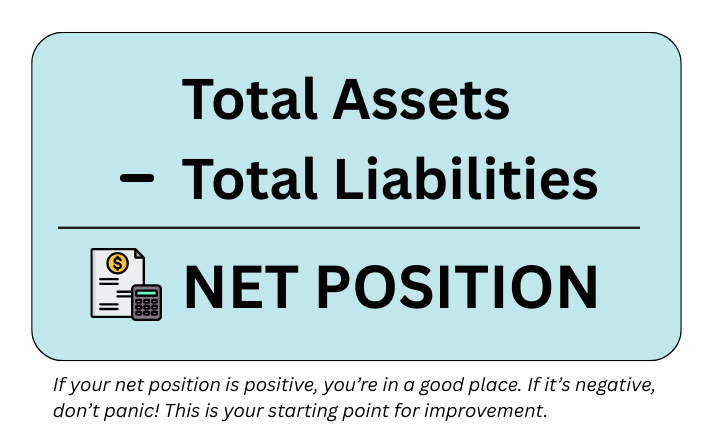
Your net position is the difference between what you own (your assets) and what you owe (your liabilities). It’s essentially your financial scorecard, giving you a snapshot of your overall financial health. Here’s a simple formula:

Net Position

Assets include things like your home, car, savings, and investments. Liabilities include mortgages, credit card debt, personal loans, and other financial obligations. Knowing your net position helps you understand whether you’re building wealth or accumulating debt.

Why Net Position Matters More Than Budgeting

Budgeting is about managing your monthly cash flow, how much money comes in and goes out. While this is important, it doesn’t give you a complete picture of your financial health. Here’s why focusing on your net position is a game-changer:

1. PROVIDES A HOLISTIC VIEW

      • Budgeting focuses on short-term goals, like paying bills or saving for a vacation. Net position shows your long-term financial standing, including the value of your assets and the weight of your debts.

2. HELPS SET REALISTIC GOALS

      • Understanding your net position allows you to set achievable financial goals, whether it’s buying a home, retiring early, or becoming debt-free.

3. REVEALS FINANCIAL TRENDS

      • Tracking your net position over time helps you see whether your financial health is improving or deteriorating.

4. GUIDES BETTER DECISION-MAKING

      • Knowing your net position helps you make informed decisions about spending, saving, and investing.

Common Misconceptions About Net Position

Budgeting is about managing your monthly cash flow, how much money comes in and goes out. While this is important, it doesn’t give you a complete picture of your financial health. Here’s why focusing on your net position is a game-changer:

1. “Only Wealthy People Need to Track Their Net Position”

      • False! Everyone, regardless of income level, can benefit from understanding their net position. It’s about knowing where you stand and where you’re headed.

2. “Budgeting Alone is Enough”

      • While budgeting is crucial for managing day-to-day expenses, it doesn’t address your overall financial health.

3. “It’s Too Complicated”

      • Tracking your net position can be as simple as listing your assets and liabilities in a spreadsheet or using a financial app.

Steps to Improve Your Net Position

1. ELIMINATE HIGH-INTEREST DEBT

      • Focus on paying off credit cards and personal loans first. These often carry the highest interest rates and can significantly impact your financial health.

2. INCREASE YOUR SAVINGS

      • Build an emergency fund with at least three to six months’ worth of living expenses. This provides a financial safety net and reduces the need for high-interest debt during emergencies.

3. INVEST WISELY

      • Grow your assets by investing in a diversified portfolio. Consider long-term investments like retirement accounts or real estate.

4. REDUCE LIABILITIES

      • Pay down loans and avoid taking on new debt unless it’s for a strategic purpose, like buying a home.

5. TRACK YOUR PROGRESS

      • Revisit your net position quarterly or annually to measure your progress and adjust your financial plan as needed.

How Our “Know Your Numbers” Course Can Help

Our “Know Your Numbers” course is designed to take the guesswork out of understanding your net position. Here’s what you’ll learn:

1. HOW TO CALCULATE YOUR NET POSITION 

      • Step-by-step guidance on listing your assets and liabilities.

2. TOOLS AND TEMPLATES

      • Access user-friendly calculators and spreadsheets to track your progress.

3. STRATEGIES FOR IMPROVEMENT

      • Learn actionable steps to grow your assets, reduce your liabilities, and increase your net worth.

4. REAL-LIFE EXAMPLES 

      • See how others have transformed their financial health by focusing on their net position.

Success Stories

1. JOAN’S TRANSFORMATION

Joan discovered her net position was negative due to high credit card debt. Using strategies from the course, she paid off her debt in two years and now has a positive net worth of $20,000.

2. PETER’S JOURNEY

Peter thought he was doing well because he had a high income. After calculating his net position, he realised his debt outweighed his assets. He’s since restructured his finances and is on track to achieve financial independence.

Know Your Numbers

Conclusion

Understanding your net position is the key to unlocking financial freedom. It’s not just about how much you earn or spend; it’s about the bigger picture of what you own versus what you owe. By focusing on your net position, you can make smarter financial decisions, set realistic goals, and build a secure future. Ready to take control? Join our “Know Your Numbers” course today and start your journey toward financial clarity and success.

The Vault
The Financial Confidence Formula: How to Trust Yourself with Money Again

The Financial Confidence Formula: How to Trust Yourself with Money Again

We’ve all had those moments standing at the checkout, second-guessing a purchase, or staring at a bank statement, feeling a wave of regret. Maybe you’ve told yourself, “I’m just bad with money,” or, “I can’t trust myself to make good financial decisions.” If this sounds familiar, you’re not alone. But here’s the truth: you are not inherently bad with money. You just need to rebuild your financial confidence.

Financial confidence isn’t about knowing every investment strategy or becoming a budgeting master overnight. It’s about trusting yourself to make empowered, intentional choices with your money without fear, guilt, or self-doubt.

So how do you start trusting yourself with money again? Let’s dive into the formula that can help you regain control and move forward with confidence.

STEP 1: Reframe Your Money Story

The beliefs you have about money shape how you handle it. If you’ve experienced financial struggles in the past, it’s easy to assume that you’ll always struggle. But that’s not true you are constantly evolving, and your financial reality can evolve with you.

Take a moment to reflect: What are the money stories you’ve been telling yourself? Do you believe money is hard to earn? Do you think you’re destined to be in debt? Once you identify these limiting beliefs, challenge them. Instead of saying, “I’m terrible with money,” try, “I am learning to manage my money with confidence.” Words matter, and so does your mindset.

What are the money stories you’ve been telling yourself? Do you believe money is hard to earn?

STEP 2: Small Wins Lead to Big Confidence

Trust isn’t built overnight it’s created through consistent actions. If you’ve been avoiding your finances out of fear, start small. Set up a weekly “money date” with yourself to review your finances, even if it’s just for 15 minutes. Celebrate the small victories, like paying a bill on time or choosing to cook at home instead of eating out. These small wins add up, reinforcing the belief that you are capable of managing your money wisely.

STEP 3: Shift from Fear to Curiosity

Many people feel anxious when they look at their bank account, but what if you approached your finances with curiosity instead of fear? Instead of saying, “I don’t even want to look at my balance,” try asking yourself, “I wonder what I can learn from my spending habits this month?” By shifting your mindset, you turn financial management into a tool for empowerment rather than a source of stress.

Align Your Spending with Your Values<br />

STEP 4: Align Your Spending with Your Values

One of the fastest ways to feel good about your money is to ensure your spending reflects what truly matters to you. If financial guilt is a recurring theme, it may be because you’re spending in ways that don’t align with your priorities.

Ask yourself: What do I value most in life? If it’s family, are you investing in quality time with loved ones? If it’s health, are you prioritising your well-being over impulse purchases? When your spending aligns with your values, financial confidence follows naturally.

STEP 5: Give Yourself Permission to Learn

No one is born knowing how to manage money perfectly. Mistakes will happen, but they don’t define you. What matters is how you respond. Instead of beating yourself up over a financial misstep, treat it as a learning experience.

Ask: “What can I do differently next time?” This shift in perspective turns every challenge into an opportunity for growth, reinforcing your ability to trust yourself.

STEP 5: Give Yourself Permission to Learn

Confidence grows in the right environment. If you’ve been struggling alone, it may be time to seek out support whether that’s a financial coach, a community of like-minded individuals, or access to the right financial education.

That’s why I created my Monthly Coaching program, giving you access to The Vault a treasure trove of financial resources, courses, and guidance to help you build the skills and mindset necessary for long-term success. And if you’re ready to take full control of your finances, my Master Your Money program will guide you through everything you need to know to transform your financial future.

Master Your Money Program

Final Thoughts

Rebuilding financial confidence isn’t about perfection it’s about progress. Every positive step you take strengthens your trust in yourself. You are fully capable of making empowered financial choices, and your journey starts today.

Take the first step, celebrate your wins, and remember: you are not alone in this. With the right mindset, tools, and support, you can rewrite your financial story and step into a future filled with confidence and abundance.

Are you ready to take control? Let’s do this together!

The 90 Day Money Makeover