I talk a lot about building financial muscle and for good reason.
Why? Because some people today still don’t have their money working for them and they’re making dumb decisions when it comes to managing it effectively.
My concern is that when these people decide around 65 – 70 years of age that they would like to retire – they’re going to struggle!
Why, because they’re going to have nothing to enjoy their retirement years with, as they’ve spent everything they’ve earned along the way.
Financial muscle as I bang on about constantly, is making sure firstly that you’re hard earned money is working for you and not your bank’s.
And secondly, it’s about having something put away for “just in case” which “just in case” comes up a fair bit during our lifetime.
So how nice would it be to know that you’ve got money and it’s working to your advantage when you need it.
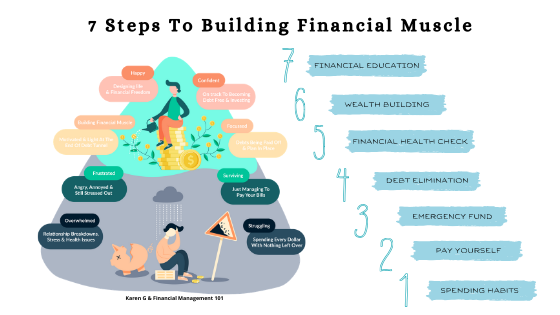
Here are 7 steps you need to know when it comes to building financial muscle and they are:
1 Looking at your spending habits. What are you spending your money on each and every payday? Are you spending it on things that are worthless and while short term makes you feel good initially but then when it comes to paying your bills you haven’t anything left to pay for them?
My guess is, this is when you start to feel stressed out and your life becomes very overwhelming.
The quickest and easiest way to get a handle on what you’re spending is to look at doing a budget. For the first month, you write down everything you spend and then deduct what you earn by what you’ve spent for the month.
More often than not, you’ve used credit to help get you out of a bind, but it’s not working and you’re getting further and further into debt.
2 Next, once you’ve worked out if there’s any surplus, you’ll want to make some adjustments in your spending to put away a small percentage around 10% of what you earn into a savings account.
Now 10% is not a lot of money, but you’ll need to do this first at payday before you pay any bills or use some of your income on other expenditure.
Once you’ve put away 10% or even $20 or $30 into a savings account then put on autopilot, where every payday money goes from your pay into this account. I guarantee you’ll start to think about your money a little differently.
Something magical happens when you know you have some money saved and you start to feel a little more confident and less stressed and it gives you a greater sense of security.
3 Ok the third area where you’ve got to be strict with yourself is to open another savings account, one that is too hard to get access to and start building on your emergency fund.
You’ll need to get your emergency fund up to at least $2000 as quickly as possible.
There are many ways to get this account up to $2000 and the first is to look around your home. What could you sell online that’s sitting around in your garage or shed that’s gathering dust?
The emergency fund is the 3rd most critical aspect to building financial muscle because it takes the pressure off you and your money when those unexpected things arise like your hot water goes on the blink or your fridge packs up.
The emergency fund is for exactly that emergencies that make life very difficult if they’re not fixed or replaced.
Ideally, the emergency fund needs to be at a balance where if you lost your job or you couldn’t work for 6 months, you would have enough money to be able to pay your bills until you get back to working again.
4 The major stress for most people is their ever-increasing debt, whether it be from overspending on credit or the mortgage on your home.
I can’t stress enough that when you finally become debt-free life is going to be a whole lot more fun. Things that used to stress you out are suddenly gone and all the pressure of working at a job that you probably don’t like now gives you the power and choice to look at whether you continue working there.
If you’re not working to pay down all your debts as fast as you can – you’re just throwing away good money to the banking institutions that are funding your poor money habits and making them richer while you become poorer.
Map out who you owe, how much you owe and then start with one debt at a time and pay that down until it’s gone. Once the first debt has been eliminated, then use the money that you paid the debt down with to double up on the next debt.
5 Ok, so the next step in building financial muscle is to stop and do a quick financial health check.
A financial health check will look at quite simply if there are any areas within your money that you need to work on, or get more information on, to get you back on track and retiring comfortably.
I have a 5 min financial health check that you can download HERE to get you started.
6 Now you’ve got money being saved, your debts are being paid off, it’s now time to look at your wealth-building strategies.
Your wealth-building will consist of two parts:
Investing and
Protecting
Let’s talk about investing first.
Investing is about growing your money through facilities like superannuation and other investment options.
Superannuation is a way of saving for retirement.
Essentially your employer in Australia is putting away a percentage of your salary into a fund of your choice that invests the money until you retire.
It’s a forced type of saving but brilliant to help those in particular that are not good at saving and will see you have some money at the end of your working life.
This is a big topic that’s too big to cover off in this post, so I will write a post on this and explain in more detail shortly, so keep an eye out for it.
Other investment options for wealth building during your working years could consist of investing in shares, managed funds or property to name a few.
I would encourage anyone looking into wealth building to seek a financial adviser who is qualified to provide advice on what assets or which investment vehicle is best for you and your personal circumstances.
There are many out there so be careful and take the time to ensure they have your best interest at the forefront of their advice giving.
Next, I want to talk about protecting your money. This is a very important topic. Today, I’ll give you a brief summary but like the topic on superannuation, I’ll be writing more about this in another post.
But for now, let me explain why it’s important to have a Will or good Estate Plan.
A Will and Estate Plan are there to make sure your wishes at the end of your life are carried out and distributed properly.
A Will is a legal document that states what you would like to happen with your assets when you die and forms part of your Estate Plan.
An Estate Plan, on the other hand, records exactly what you would like to happen with your assets upon death and includes documents such as your Will, a testamentary trust, superannuation assets and may contain powers of attorney or other such documents that in the event of you being unable to make decisions, someone appointed by you will act on your behalf.
So as you can see from the brief descriptions above it is extremely important to make sure you are protecting what you’ve worked long and hard to build.
If you die without making a Will it means you die intestate and this causes a lot of heartache and headache for your loved ones left behind.
What actually happens here is that your estate is left to deal with either from the Supreme or Highest Court, depending on which state you live in Australia, who will appoint an administrator.
The administrator’s job is to arrange the funeral and distribute any leftover assets after paying any debts and taxes. Sometimes there are fees associated with an administrator taking care of your details which means your loved ones may not receive the full inheritance you had planned on leaving them.
So make sure you have a current Will your priority today because nobody knows when our time is up.
7 And lastly, the 7th step to building financial muscle is to get yourself ongoing financial education and support.
Just like a sporting team, they all use coaches to help them and guide them to their sporting greatness.
Financial coaching is much the same, an experienced coach who knows sound financial education can make the difference between living with financial stress or living your life the way you’ve always desired – happy and stress-free.
If you’ve read to the bottom of this and you’ve followed the steps outlined above then congratulations as you are one who is committed to living a financially comfortable life.
Why not continue with your financial education by working with me on a monthly basis.
I offer several options, but the first is the most preferred as it’s inexpensive and extremely supportive towards you achieving awesome financial health.
Overwhelm is on the rise and it’s happening more and more to us good folks.
It’s not just because we’re approaching the end of the year but emotions are high with more of us feeling increasingly stressed out for various reasons.
The months leading up to Christmas can be a very stressful time as you may know, with so many things put into high speed to finish off before we break for the holidays.
The feeling of overwhelm is so stressful that at times feels like your head is about to explode.
Overwhelm can come from many areas. It can come from how you’re feeling about your money, your relationships, your work environment and overall the expectations you put on yourself. Yes, it can come from a whole variety of areas.
A little while ago, I was feeling very overwhelmed and it came from a place of sheer exhaustion from work and what I had expected to happen. I had put myself under enormous pressure and because I hadn’t hit my goal of being at a certain place in my business I just broke down.
My husband David I don’t think has ever seen me like this. Normally I’m the one that keeps things ticking along, I’m also the upbeat, happy and positive person in our family, but this wasn’t the case that day.
I just broke down from tiredness, doing too many long hours and trying to figure out how I can get everything done before we break for the Christmas school holidays that was fast approaching.
Having a feeling of overwhelm can bring on anxiety or panic attacks and issues like anxiety can have a detrimental effect on our health.
It’s where everything just feels like it’s on top of you and there is no way out.
One of the ways to identify if you are feeling overwhelmed is to look at what you’ve got going on in your life.
You see we are often pulled in so many directions whether this is in our personal, family, work-life, or even with maintaining our friendships.
Let’s not forget about the pressure to fit in exercise and healthy eating choices so that our bodies are nourished and looked after to ensure we live a long and healthy life.
I know part of my overwhelm is the constant pressure I put on myself to eat healthily and fit in some form of exercise so I can feel better about myself.
One of the major areas for overwhelm is when it comes to our money and it tends to be the number one stress for a lot of people.
For some, it’s the feeling of overwhelm or helplessness on how to improve their financial position that gets extremely overwhelming.
Part of my overwhelm was not only putting myself under work pressure but feeling frustrated that I have pulled much out of our savings account to start a business and get it to the stage today where I am able to become self-sufficient from coaching gorgeous clients.
That for most business owners is a major stress – managing cash flow and ensuring their business is making a profit at the end of the day.
By not dealing or identifying when we are feeling overwhelmed – it can quickly escalate and take its toll on us not only emotionally but physically.
We may sometimes lack confidence in the ability to achieve what we’ve set out to do.
And we become very irritable and unhappy when this occurs.
Like I mentioned before there is the potential for our health to suffer in the process, whether stomach complaints or the onset of anxiety and depression.
The very first thing to do is understand why you’re feeling overwhelmed?
Are you trying to be everything to everyone?
Could you be trying to focus on too many things at once? or
Possibly you’re being too optimistic about how much time it will take to do a particular task.
Maybe you’re just not saying “NO” to people who may be taking up more time from you than you have to give at the moment.
For me, it is trying to do everything and be everything in my business.
So take a look at what’s causing you to feel overwhelmed and see where you can make life a little easier for you.
After you’re clearer what’s causing you to feel overwhelmed start with these 5 simple tips to get things back under control and in balance.
1 First and foremost take a deep breath.
2 write down every task, project or event whether for work or family and get it down on paper. Then look to see if you can delegate any of the areas that you feel you just can not handle anymore. If you’re a working parent or stay at home parent and just can’t seem to get on top of things around the house – maybe you could consider hiring a cleaner once a week or fortnight to help. This is one area that doesn’t cost a fortune and will take enormous pressure off with the many other tasks busy people & parents have on their plate.
3 Next focus on what’s important to you and what priorities you need to get done. Most importantly look to decide what your priorities are any learn to say NO without any guilt associated to any colleague, family or friend you feel maybe encroaching on the limited time you have to get your stuff done.
4 Ask for help when you feel those overwhelming feelings come up. Never be too proud to ask someone to help you when you start to feel overwhelmed. You will be surprised at how many people will offer to help out when you’re feeling under the pump.
AND then…
5 Be kind to yourself and remember you only one person and can only do so much.
To help when those feelings of overwhelm come up, I have a worksheet you can download that will get you thinking where your time is being spent and how certain areas within your life may be overloading your brain and the ability to achieve more in your life.
With Christmas and the holidays just around the corner, it’s important to understand how to use your credit card wisely.
For some, the best way to use it is to not use it all.
Especially for a lot of you who get yourselves in financial trouble because you spend more than you earn.
Understanding how your card works is key to managing it effectively.
Some have up to a 55 day interest-free period. Which means from day 1 of your credit card cycle you could have 55 days of so-called free money & spending without costing you a cent.
This is where some of you may get into trouble because when your statement arrives you’ve realised you’ve overspent and have no way of paying the amount racked up back to the zero balance.
So here’s where the bank loves you because now they’re going to slog you anywhere from 19 – 22% interest.
Here are 6 tips that will make you more mindful for when using your credit card:
1. Keep track of your spending. If you’re not good at this then go get yourself a visa debit card which uses your money not the banks and stops you getting into financial trouble.
2. Pay your card on time. This may seem obvious but for a lot of people they forget to pay the balance or minimum payment by the due date and this ends up costing them more. This is where the bank slogs you around $15 for not paying on time.
3. Pay off your outstanding balance as quickly as possible. Banks love when you don’t pay the balance owing in full off because they can then start charging you interest on the amount racked up anywhere from 19 – 22%.
By getting into the habit of sweeping off what you’ve spent on your credit card every month – will save you thousands of dollars. You see every year you don’t pay off your balance sees you going further into debt.
For example; here’s a really frightening statistic that I got one client to read on the back of their credit card statement to shock them into how NOT paying the balance off in full is costing them. In this example, the balance owed was $5000 and the client was paying just the minimum monthly repayment around $95. This client if they didn’t get their butt into gear and pay the card off in full they would be paying it off in 72 years and owing over $25k in interest charges!
4. Check your statement monthly to make ensure there are no transactions that you didn’t authorise. Today there is too much internet fraud with online purchasing that starts with a $5 or $10 amount then next you know someone has swiped you for a couple of thousand dollars. This is how they do it small and slowly and go unsuspecting. So check your card statement regularly to ensure there are no unsuspecting amounts on there.
5. If you’re buying on the internet be aware of a fee called the “foreign transaction fee” which is a fee that occurs when you buy something from the internet and it’s in a different currency like US because your bank will convert this cost back into your currency for example; Aussie dollars and you’ll be slogged a foreign transaction fee.
This doesn’t seem like a lot but today the trend is to buy online and these amounts add up if they’re not in your country’s currency. So an option to get around this is to look at a credit card that has “no foreign transaction fees” attached to the card. For me, a lot of the monthly operating expenses in my business are from the US and because of this, I have a credit card that doesn’t charge the additional foreign transaction fee which saves me hundreds of dollars per month. Look at your bank or financial institution to see whether they offer this type of credit card, and lastly
6. Don’t buy items you really can’t afford with no way in hell of paying them back by the end of the month. This is not good money management and is seeing your hard-earned dollars going to others and not you. You work hard for every dollar you get so make it count and if you really want that particular item save up for it – because it makes it all the worthwhile knowing you actually own it not the bank!
That’s it for my 6 tips on how to better manage your credit card. If you’re looking for more training and education in how to work money to your advantage then check out a money program that’s super affordable and will get you back in the black.
How To Keto Your Money is a 21-day kick start program designed to get your money back in shape. Find out more HERE
Any questions leave me a comment and if you enjoyed this please also let me know.
Until next time here’s to your financial health, wealth and happiness.
Loneliness is not just for the elderly either sitting at home or in nursing care waiting to die.
It’s a very real feeling for a lot of people today for all ages, with or without family.
In fact, a study done by an American health insurance provider Cigna showed that younger people Gen Z have the highest loneliness score, followed by millennials and then Gen X.
Today we are feeling more isolated and lonely than ever before and we are more disconnected in part because of technology.
While technology has helped many of us connect with loved ones and friends who we haven’t seen or kept in touch with for some time, we are more alone than ever before.
Studies have found that despite being more connected, more people feel more alone than ever.
So it seems that because technology makes it easier to stay in touch more and more people find themselves feeling distant and never having any human contact.
We human beings crave intimacy and human contact We crave that connectivity where we can talk face to face.
From my own experience, I’m busier than ever however, at times it feels that having loads to do doesn’t always fill up my happy cup.
I was thinking back to when we use to just go out with friends and have a good time without having to worry about posing for that perfect snap to share on social media and to tell the world yeah we’re having a good time!
What’s wrong with just enjoying the moment with the special people that we’re out with and keeping those snaps for our own memories or for sharing later after the event?
Loneliness might not seem like a medical problem but it can impact your overall health and wellbeing.
I remember watching a show where they brought kindergarten kids into a nursing care centre to help brighten up the residents day.
One older man remarked before the kids came in that he felt he was just waiting to die. He was so grateful for the kids who showed him some kindness, laughter and fun and it reminded him that there’s still more life in him yet.
This situation is not just limited to the elderly in nursing care.
Loneliness can come about when people have partners, whether married or not.
The study from Cigna asked about relationships and 43% of respondents said that they sometimes or always feel that their relationships are not “meaningful.”
The same percentage of participants said they sometimes or always felt isolated from others, even those closest to them.
How many times have we seen people on their phones out for dinner and are not communicating but looking at their device instead.
Couples are not talking as much as they use to and I often laugh when I see couples talking to each via their social media posts.
I’ve heard from friends and seen it for myself that while hanging out to engage and talk with our partners – the other is on their phone appearing to be more interested in other people’s lives than their own.
Maybe that’s why there are more relationship breakdowns?
I use to think a lot had to do with money but I’m wondering whether it’s a 50/50 between no communication and no money?
So it seems that because technology makes it easier to stay in touch, more and more people find themselves feeling distant and never having that true connection. Or at least not enough to avoid the feelings of being alone.
Loneliness can be overcome, but it does require a conscious effort on your part to make a change. Making a change, in the long run, can make you happier, healthier, and enable you to impact others around you in a positive way.
Here are ways to prevent and overcome loneliness:
1.Identify that when those feelings of loneliness and unhappiness come about to look at ways you can change by doing something, whether it be volunteering, going for a walk, meeting a friend, finding groups in your community that offer activities that you’re interested in and go do them.
2. Talk to your partner or friends and suggest some real conversation by putting down the devices.
3. Understand the effects that loneliness has on your life, both physically and mentally.
4. Look at ways to cultivate new friendships by joining a club or join a “meetup group” that offers something you’re interested in and gets you meeting new people.
5. Focus on developing quality relationships with people who share similar attitudes, interests, and values with you.
6. Lonely people often expect rejection, so instead focus on positive thoughts and attitudes in your social relationships.
Loneliness can have an overall effect on your health, so be sure to look at including some of the suggestions I’ve shared above, so it doesn’t affect your health and wellbeing.
If you’re looking for more financial or emotional support then join either my FB Group or Monthly Coachingto get inspire and live a happier, healthier life.
Until next time, here’s to your health, wealth and happiness.
You may have noticed or “may not” that I’ve been off the air and haven’t posted or shared anything for a while.
There’s a couple of reasons for that and I’ll share with you ONE now and the other I’ll save for another time in a more intimate group via a live training call on how to move forward when you’re feeling emotionally, mentally and financially stuck.. soon.
So make sure you keep an eye out and join me for this special live training.
So one of the reasons I’ve been a little quiet is because I’ve felt there’s been so much noise on social media loads of talk, new stuff coming on our feed – some good and some I feel not so good.
So I decided to stop and just think about what are people looking for?
What am I looking for?
The answers were obvious.
Firstly. we all want the same things in life to live free from stress and worry, whether it be about money, relationships, work or other stuff.
A life that when we come to the end of our days we can say YES we had a good time and we lived the best possible life for us, one with loads of fun and a life with meaning.
And secondly, what I discovered was that 80% of life is about the stuff that’s going on between our ears the constant conversation we’re having in our head, where the 20% is about the doing – the know-how.
You see I use to think it was the other way round.
80% – knowledge, know-how and just doing it, while the
20% – is about mindset and getting that right.
I realised that in order for my clients to be truly successful in all areas of life I have to help them unravel what’s going on upstairs. What thoughts, beliefs and misconceptions they were constantly thinking about themselves and their life.
You see most of my clients were sabotaging their long term happiness because of the beliefs they were carrying around about themselves – self-sabotaging thoughts.
As I started to work more closely with them I discovered their limiting beliefs were holding them back from living the life they truly desired.
So I had to change things up and flip things on their head “so to speak” by focussing on breaking down these limiting beliefs and re-building new thoughts about themselves to create a realistic transformation.
Because what I discovered was that it wasn’t as easy as I thought to just to get their money in order, I had to get their mind thinking different thoughts, because most didn’t feel good about themselves or even like who they are.
So I’ve decided to change things up a bit and spend time equally talking about mindset and financial, with more emphasis on looking to improve some of the crappy beliefs we carry around about ourselves.
For example; when you truly love yourself and are at peace with who you are and how your life is you find that you don’t talk about people, bitch about them or compare yourself to them.
You also find you have less interest in gossiping and spend more on what makes you happy.
If you don’t believe me then I challenge you to stop and listen to the thoughts you have in your head and hear the words you’re speaking.
Are you talking about someone all the time, sticking your nose in where it’s not wanted or are you an active listener and participating in conversations without judgement and criticism?
When we take our focus off others and focus on our own life – we’re able to help not only ourself live a better life but others around us, because we’re not getting involved in their dramas.
What we’re doing is freeing the often negative, exhaustive thoughts that are constantly swirling around in our head when we’re not involved in gossip, criticism or judgement.
So it’s all about the 80/20.
80% – Mindset, thoughts, beliefs & how we feel.
20% – Know-how, knowledge & education.
In order to build both financial and emotional muscle, learn to let go and focus on yourself and your happiness first.
For more support and help to do this join my monthly coaching or access, any of my ONLINE PROGRAMS to live the life you’ve always dreamed.
Until next time…….here’s to your financial health, wealth & happiness.