Budgeting Without the Boring: The Money Map Method That Actually Works

Budgeting Without the Boring: The Money Map Method That Actually Works

Let’s be honest for a second. The word “budget” has the same vibe as:

  • “We need to talk…”
  • “Your call is being transferred…”
  • “Please see the attached invoice…”

It makes people tense. Defensive. Slightly sweaty. 😅

And here’s the irony: most people don’t hate having a plan. They hate the way budgeting has been sold to them – like it’s punishment for daring to enjoy life.

So today, I’m giving you a different approach.

Not a strict budget.
Not a spreadsheet that needs a PhD to operate.
Not a system that makes you feel like you have to track every piece of gum you’ve ever purchased.

This is Money Mapping – the method I use with clients who want to feel in control, not controlled.

Because your money doesn’t need a prison.

It needs a plan. A plan that fits your actual life. Not the version of you who meal preps on Sundays and never impulse buys at Kmart.

(If that version of you exists, I’d like to meet her. She sounds organised and slightly intimidating.)

Why Traditional Budgets Fail (and why it’s not your fault)

Most budgets fail for three reasons:

1) They’re too restrictive

People try to cut everything at once: coffees, fun, birthdays, little treats, takeaway, holidays… and then wonder why they rebound like a rubber band.

If a budget feels like suffering, you won’t stick to it.
Your brain will treat it like a threat.
And humans don’t do “threat” long-term.

2) They’re too complicated

Forty-seven categories. Daily tracking. Constant adjustments.
You miss one thing and suddenly you feel like you’ve “failed.”

A budget that requires constant maintenance becomes another job.
And nobody needs a second job that doesn’t pay.

3) They’re built on guilt, not goals

Many budgets are basically: “Stop spending money on things that make you happy.”

No thanks.

Money mapping works because it’s:

  • simple
  • flexible
  • based on priorities
  • designed for consistency, not perfection

What is a Money Map?

A Money Map is a simple plan that tells your money where to go before life grabs it.

It answers these questions:

  1. What must be paid? (essentials + bills)
  2. What matters to you? (your priorities)
  3. What are we building? (savings, emergency fund, investing, debt reduction)
  4. How do we keep your life enjoyable while still making progress? (yes, fun stays)

A money map is not about tracking every dollar.
It’s about creating a flow.

And when your money flows with intention, financial stress drops fast

A Money Map is a simple plan that tells your money where to go before life grabs it.

The Big Mindset Shift: A Budget Isn’t Restriction – It’s Permission

I want you to reframe this:

A budget isn’t a list of things you can’t do.
It’s a permission slip that says:

✅ “Yes, you can spend money on what you love.”
✅ “Yes, you can have fun.”
✅ “Yes, you can enjoy your life.”
… and also
✅ “Yes, you can build wealth and feel safe.”

That’s the goal: enjoying today while protecting tomorrow.

The Money Map Framework (Simple, Powerful, Real-Life Friendly)

Here’s the structure I recommend. It’s clean and easy:

Category 1: Essentials (Must Pays)

These are the costs of keeping your life running:

  • mortgage/rent
  • utilities
  • groceries
  • fuel/transport
  • insurance
  • minimum debt repayments
  • childcare/school essentials
  • basic medical

These are your “keep the lights on” expenses.

Category 2: Future You (Your Financial Muscle)

This is where you build safety and wealth:

  • emergency fund
  • sinking funds (car rego, Christmas, school costs, rates, holidays)
  • extra debt repayments
  • investing/super top-ups (where appropriate)

Future You deserves funding. Not “whatever’s left.”

Rainy Day Fund or Emergency Fund

Category 3: Fun & Freedom (Guilt-Free Spending)

This is the category that keeps you sane:

  • coffees
  • dinners out
  • entertainment
  • hobbies
  • shopping (within reason, Karen… within reason 😄)
  • little treats

The reason most budgets fail is because this category is either missing or unrealistically small.

We’re not doing that here.

Step-by-Step: How to Build Your Money Map in Under an Hour

Grab a pen, notes app, or whatever you use when you’re feeling productive for five minutes.

Step 1: Find your baseline numbers

Look at the last 4–8 weeks of spending (not because we love pain, but because data helps).

Write down:

  • total income (after tax)
  • total essentials
  • average weekly spending (groceries, fuel, eating out, shopping)
  • debt minimums
  • any annual bills that sneak up (rego, insurance, school, rates)

You’re not judging. You’re observing.

Step 2: Choose your “Money Map style”

There are two main styles:

  1. A) Weekly Flow Map (best for people paid weekly/fortnightly)
  • Allocate money each pay into Essentials / Future You / Fun
  1. B) Monthly Map (best for salaried monthly pay)
  • Set amounts for each category and automate them

If you’ve tried budgeting before and it didn’t stick, weekly is usually easier because it gives faster feedback.

Step 3: Set up separate accounts (this is where the magic happens)

I’m going to say this lovingly:

If all your money sits in one account, your brain will treat it like it’s all available.
That’s not a discipline problem. That’s a human brain problem.

A simple setup is:

  1. Bills account (Essentials)
  2. Spending account (groceries/fuel/fun)
  3. Future You account (emergency + sinking funds)

Automation is your best friend. Because you’re busy.
And your money system should run even when you’re tired.

Step 4: Decide your “non-negotiables”

These are your priorities — the things you want your money to reflect.

Examples:

  • “I want to stop feeling anxious about bills.”
  • “I want an emergency fund.”
  • “I want to pay off this debt.”
  • “I want to travel without putting it on a credit card.”
  • “I want to stop fighting with my partner about money.”

Your money map should support your real goals — not someone else’s idea of financial success.

Step 5: Allocate your numbers (start simple)

Here’s a starting point many people can relate to:

  • Essentials: 60–75%
  • Future You: 10–20% (even 5% is a start if money is tight)
  • Fun & Freedom: 10–20%

If your essentials are currently higher than 75% — you’re not alone. Cost of living has been doing the most.

This is where strategy matters: we might need to reduce leaks, renegotiate bills, or adjust the debt plan to create breathing room.

Step 6: Create one weekly “Money Date” (10 minutes)

Once a week:

  • check what’s coming out
  • check what’s coming in
  • make sure bills are covered
  • adjust your spending category if needed

No drama. No self-lectures. Just a quick check-in.

Think of it like brushing your teeth. You don’t do it once and call it done forever.

The “I Hate Tracking” Version: The 3-Number Method

If you’re someone who rebels against tracking (I see you), do this instead:

Pick three numbers each week:

  1. Your weekly spending limit (food + fuel + fun)
  2. Your weekly Future You transfer
  3. Your “buffer amount” you want to keep in your spending account

Then the rule is simple:
When spending hits the limit… you stop spending until next week.
No guilt. Just boundaries.

This is the system many of my clients love because it’s:

  • quick
  • clear
  • low-maintenance
  • effective

Money Map in Real Life: What This Looks Like (Example)

Let’s say your household brings in $2,500 a week after tax.

You might map it like this:

  • $1,700 Essentials (bills, groceries, fuel, minimum debt)
  • $400 Future You (emergency fund + sinking funds + extra debt)
  • $400 Fun & Freedom (eating out, treats, spending money)

Then you automate:

  • $1,700 goes straight into Bills account
  • $400 into Future You account
  • $400 stays in Spending account

Now you’re not trying to “budget” daily.
You’re simply spending from the right place.

And when your Spending account runs low, it gives you a clear signal:
“That’s it for this week.”

No spreadsheet required.

What If There’s Not Enough Money to Map?

This is the part where I get very real with you:

If you feel like there’s never enough, it doesn’t mean you’re failing.
It means your map needs to include leak-plugging and breathing space first.

Here’s what I do with clients when money is tight:

  1. tighten obvious leaks (subscriptions, lazy renewals, bank fees)
  2. build a tiny emergency buffer (even $500 can change your stress levels)
  3. stabilise bills and reduce panic spending
  4. create sinking funds for predictable expenses
  5. then build momentum

You don’t jump from stressed to thriving in one week.
But you can absolutely move from chaos to calm with the right steps.

The Most Important Part: Your Money Map Must Match Your Personality

Some people need structure.
Some need flexibility.
Some need boundaries.
Some need permission.

So here are a few personality-based tweaks:

If you’re an overspender:

  • reduce “available money” in your spending account
  • use separate “fun” cash or a dedicated card
  • increase automation

If you’re an underspender/anxious saver:

  • allocate guilt-free fun money and actually spend it
  • focus on safety targets (emergency fund)
  • build confidence with small consistent steps

If you’re a “set and forget” person:

  • automate everything
  • schedule the weekly money check-in
  • keep categories very simple

If you’re a couple/family:

  • do a shared Money Map + personal spending allowances
  • agree on the weekly “household number”
  • remove judgement from the conversation

Money mapping isn’t one-size-fits-all.
It’s “your life, your values, your plan.”

If You Want This to Stick, Join the Membership

Now, if you’re reading this thinking:

“Okay… this makes sense. But I need help setting it up properly.” or “I’ve tried before and I fall off the wagon.” or “I want a system that actually fits my life.”

That’s exactly what my Membership is for.

Because here’s the truth:

Most people don’t need more information. They need support, structure, and someone to keep them consistent.

Inside the Membership, we don’t just talk about budgeting. We:
✅ build your personal Money Map (based on your real numbers)
✅ set up accounts and automation so it runs without willpower
✅ create sinking funds so life stops surprising you
✅ learn how to manage spending without guilt
✅ build financial muscle with ongoing guidance and community

You’re not meant to do this alone.

If you’re ready to stop winging it and start feeling calm and in control, join the Membership.
Let’s build your Money Map together — and get your financial house in order the smart way.
budgeting without spreadsheets, simple budget method, cash flow planning, how to budget in Australia, reduce financial stress, personal finance tips, money management system, budgeting for beginners, weekly money check-in, sinking funds, financial management 101, Karen G Adams, financial coaching

 

How Can I Rebuild My Confidence After Making a Financial Mistake or Falling Behind on My Budget?

How Can I Rebuild My Confidence After Making a Financial Mistake or Falling Behind on My Budget?

We’ve all had that moment.

You check your bank account… and it’s lower than you thought.
You open your credit card bill… and it’s higher than you expected.
You look at your budget… and realse you haven’t followed it for two weeks.

Cue the shame spiral.

If you’ve recently made a money mistake – or you just feel behind – I want you to know this:

You are not alone.
You are not a failure.
And you are absolutely capable of bouncing back stronger.

This blog will walk you through how to move from guilt to growth, and rebuild your confidence one step at a time.

1. Separate Your Self-Worth from Your Net Worth

First and foremost: you are not your bank balance.

Your financial missteps don’t make you “bad with money.” They make you human.

Whether you overspent, ignored your budget, or slipped back into old habits, it doesn’t define who you are. It’s a moment – not a life sentence.

Start here:

  • Remind yourself: “I am capable of change.”
  • Reflect on a past financial win, no matter how small

Say out loud: “I forgive myself. I’m ready to move forward.”

2. Get Honest (Without the Shame)

Let’s name what happened – not to beat yourself up, but to take your power back.

Ask yourself:

  • What did I spend that I hadn’t planned for?
  • Did I avoid tracking or checking in with my money?
  • Did I say “yes” to things I couldn’t afford?

Write it all down. You’re not here to judge yourself – just to gain clarity so you can move forward with purpose.

3. Understand What Triggered the Slip-Up

There’s always a “why” behind every money misstep mand understanding it is key to change.

Common triggers:

  • Emotional spending (boredom, stress, celebration)
  • People-pleasing (saying yes to things out of guilt)
  • Lack of planning (unexpected expenses you didn’t prep for)
  • Old money stories (like “I’ll never get ahead anyway”)

Identifying the trigger gives you a new layer of awareness and that’s when real change begins.

4. Reset with a Micro-Goal

When your confidence is shaken, the best thing you can do is create a tiny win that rebuilds momentum.

Here are some examples:

  • Track your spending for the next 3 days
  • Create a mini budget just for this week
  • Make one extra payment toward your credit card
  • Pause one subscription and save the money instead

Success is a series of small, intentional steps. Start with one.

Create a mini budget for this week

5. Watch Your Words (They Matter More Than You Think)

Your internal dialogue becomes your financial reality.

Let’s flip the script:

❌ “I’m terrible with money.”
✅ “I’m learning how to manage my money better every day.”
❌ “I’ll never get out of debt.”
✅ “Every payment I make moves me closer to freedom.”
❌ “I can’t stick to a budget.”
✅ “I’m figuring out a system that works for me.”

Language matters. Speak like someone who’s growing because you are.

6. Track Progress, Not Perfection

You don’t have to get everything right to be making progress. Celebrate the fact that:

  • You noticed the slip-up
  • You chose to stop and reflect
  • You’re taking action now

That’s what winning with money actually looks like.

Make a habit of reflecting each month:

  • What went well?
  • Where did I struggle?

  • What can I adjust?

And remember: even showing up for your finances when it’s hard is worth celebrating.

7. Lean Into Support – Don’t Do This Alone

Shame thrives in isolation. Confidence grows in community.

Find a space where:

  • You can ask questions without feeling judged
  • You can share your wins and struggles
  • You can be held accountable to your goals

That’s exactly what Financial Muscle Coaching is a coaching and accountability space, where we normalise setbacks and celebrate bounce-backs.

Inside the membership, you’ll find structure, strategy, and support – all in one place.

8. Build Your Financial Muscle, One Rep at a Time

Rebuilding financial confidence is like building physical strength – it happens one rep at a time.

One decision to check your balance.
One habit of tracking your spending.
One conversation where you ask for help instead of hiding.
One payment that moves you forward.

You don’t need to leap – you just need to lift. And every lift makes you stronger.

Final Thoughts

Mistakes are part of the journey – not the end of it.

You are not behind. You are not bad with money. And you don’t have to do this perfectly to make progress.

Every time you choose to come back – to review, reflect, and reset – you’re rebuilding your confidence.

You’re showing yourself what you’re made of.
And you’re writing a new money story that’s rooted in self-trust, resilience, and growth.

You’ve got this. And I’m right here cheering you on.

? Join Financial Muscle Coaching

If you’re tired of navigating your money alone – or beating yourself up every time you slip – Financial Muscle Coaching is the place for you.

In this weekly coaching space, you’ll get:
✅ Encouragement instead of criticism
✅ Clear, doable action plans that meet you where you are
✅ Real accountability to build habits and confidence that last

No more shame. No more silence. Just strength, strategy, and steady growth.

Join Financial Muscle Coaching Now

#HowToChangeMoneyMindset #ResetMyMoneyBeliefs #BuildFinancialConfidence #MoneyMindsetHelp #FinancialMindsetCoaching #HowToFeelBetterAboutMoney #WhyDoIFeelStressedAboutMoney #NewYearMoneyMindset #MoneyMindsetReset2025 #PositiveMoneyBeliefs #MoneyMindset #FinancialFreedomJourney #MoneyCoach #BudgetMindset #AbundanceMindset

How Can I Reset My Money Mindset This Year and Finally Feel in Control of My Finances?

How Can I Reset My Money Mindset This Year and Finally Feel in Control of My Finances?

It’s Not Just About the Numbers – It’s About Your Mindset

Look, you can have the best spreadsheet in the world…

You can download all the budget apps, cut back on coffee, and cancel every subscription.

But if your money mindset hasn’t shifted? You’ll still feel stuck, overwhelmed, or like “you’re just not good with money.”

Let’s fix that because 2026 is the year we stop dragging last year’s money baggage into our future.

This blog is your ultimate guide to resetting your mindset, clearing out old financial beliefs, and building a powerful, positive relationship with money.

And yes – it’s fun, it’s doable, and it’s way more effective than another boring budget.

Let’s go.

What Even Is a Money Mindset?

Your money mindset is the collection of beliefs, emotions, and thoughts you have about money. It’s your personal “money story” – the internal script you repeat (often subconsciously) about earning, saving, spending, and wealth.

Some of it comes from your childhood, your past experiences, or society’s weird money rules. And here’s the wild part: It influences every single money decision you make.

Your mindset determines whether you:

  • Save confidently or hoard out of fear
  • Ask for more money or shrink your value
  • Budget with ease or avoid your bank balance like it’s haunted

Signs You Might Need a Money Mindset Reset

?‍♀️ You feel anxious or guilty every time you spend money
? You avoid looking at your bank account or credit card
?‍♂️ You say things like “I’m just bad with money” or “I’ll never get ahead”
?‍♀️ You feel stuck in a paycheck-to-paycheck cycle, even when your income grows

If that sounds like you, it doesn’t mean you’re broken – it means it’s time to reprogram your financial brain.

Step 1: Identify the Old Money Stories Holding You Back

Before you can shift your mindset, you need to see what you’re working with.

Ask yourself:

  • What did I learn about money growing up?
  • What do I believe about wealthy people?
  • When I think about money, do I feel free or fearful?

Some common limiting beliefs:

  • “There’s never enough money.”
  • “Money is hard to manage.”
  • “I’m not good with numbers.”
  • “More money means more stress.”

? None of these are facts. They’re just beliefs. And beliefs can change.

Step 2: Choose Empowering New Money Beliefs

You get to write a new story this year. Start by replacing the old thoughts with intentional, positive ones:

Instead of: “I’m bad with money” → Say: “I’m learning how to manage my money powerfully.”
Instead of: “I’ll never get ahead” → Say: “Every dollar I manage well moves me forward.”
Instead of: “Money is stressful” → Say: “Money is a tool I’m learning to use with confidence.”

✨ Tip: Write your new beliefs down. Post them on your mirror. Make them your phone wallpaper. Say them out loud. Train your brain to believe better.

Step 3: Connect Your Money to What You Actually Value

Ask yourself:

  • What do I want money to do for me this year?
  • What do I value most – freedom? stability? generosity? joy?
  • How can I align my spending and saving with those values?

Example: 

If you value peace of mind, create a savings plan.
If you value freedom, reduce debt.
If you value fun, build in guilt-free spending money.

Money doesn’t just serve numbers – it should serve your life.

Money doesn’t just serve numbers - it should serve your life.

Step 4: Make Mindset Work Part of Your Routine

You don’t go to the gym once and expect abs, right?
Same with your mindset. It takes repetition.

Here’s a weekly reset routine you can follow:

? Money Mindset Reset (10 Minutes):

  • Review your thoughts from the week – what came up around money?
  • Journal one thing you’re proud of financially
  • Write or say one new belief out loud
  • Visualise yourself succeeding with money

? Do this every Sunday before your weekly budget check-in and you’ll be unstoppable.

Step 5: Surround Yourself With New Financial Energy

If you want to upgrade your mindset, you need to upgrade your environment.

That might look like:

  • Listening to empowering money podcasts
  • Following financial educators who speak your language (hello ? yes me ?)
  • Talking about money with friends who are also growing
  • Hiring a coach who helps you reframe, reset, and rise (hello ? yes me again ?)

You can’t change your money mindset in isolation. That’s why I created my Financial Muscle Coaching Membership.  It’s where financial growth meets real community and support.

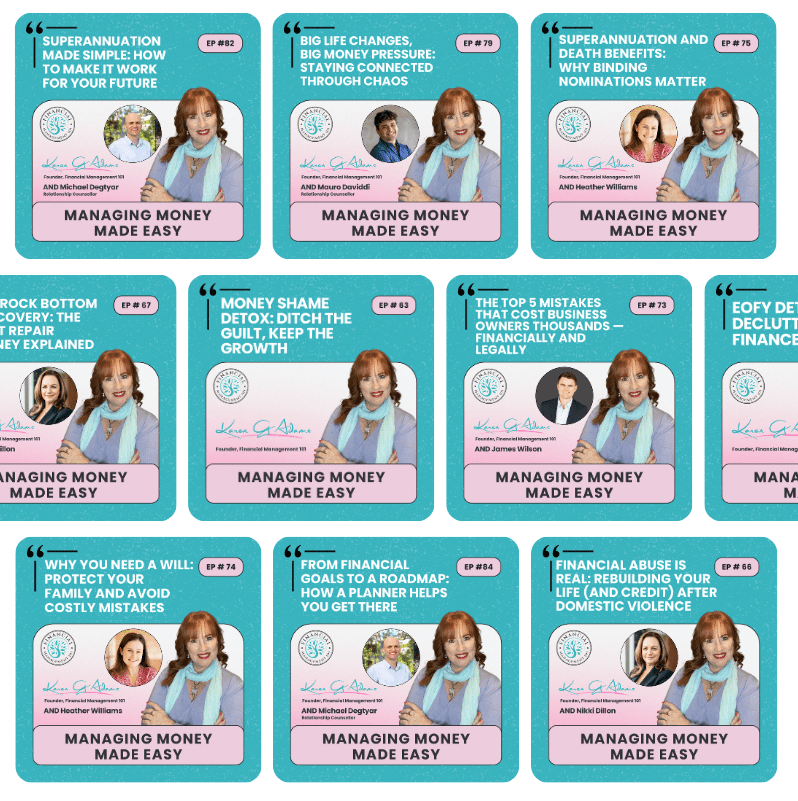
Listen to empowering money podcasts like Managing Money Made Easy

Step 6: Replace Shame With Curiosity

When things go “wrong”  you overspend, forget a bill, or avoid a budget – don’t spiral into shame. Instead, ask:

  • What triggered this?
  • What do I need right now – support, structure, or space?
  • What can I do differently next time?

Every financial hiccup is just data. Don’t let one moment of messiness define your entire money story.

You’re allowed to be a work in progress and a success story at the same time.

Step 7: Set Mindset-Based Goals for the Year

Let’s skip the boring “save more, spend less” vibe.

Try these instead:

  • “This year, I’m building my financial self-trust.”
  • “This year, I’m proving I can stick to one habit consistently.”
  • “This year, I’m learning to enjoy managing my money.”

Then break that into monthly goals:
✅ January: Track every dollar
✅ February: Create a spending plan aligned to my values
✅ March: Build an emergency fund of $300

Momentum creates confidence and mindset fuels momentum.

Final Thoughts: You Can’t Budget Your Way Out of a Scarcity Mindset

If you’re stuck in fear, guilt, or shame around money, no spreadsheet will save you. You have to go deeper. And you have to believe that a new relationship with money is possible for you.

Because it is.

You are not bad with money.
You are not too far behind.
You are not stuck – you’re just getting started.

And when you build a strong, positive money mindset? Everything else gets easier.

Let’s build that mindset muscle together.

? Join Financial Muscle Coaching

If you’re ready to change your money mindset, build real financial confidence, and create a life that feels good – not just looks good on paper – I’ve got you.

Join Financial Muscle Coaching – my coaching community where we:
✅ Rewrite limiting money stories
✅ Build strong, sustainable habits
✅ Create aligned goals you actually want to follow

This isn’t just budgeting. This is mindset, motivation, and muscle – built week by week, with me in your corner.

Your money mindset reset starts here. Let’s go. ?

Join Financial Muscle Coaching Now

#HowToResetMyMoneyMindset #WhyDoIFeelOutOfControlWithMoney #HowToFeelInControlOfFinances #ResetMoneyMindset2025 #NewYearFinancialMindset #HowToStartFreshWithMoney #MindsetShiftForMoney #RebuildMoneyConfidence #WhatIsMoneyMindset #MoneyMindsetTransformation #MoneyMindset #MoneyConfidence #FinancialReset #MoneyHealing #FinancialEmpowerment #AbundanceMindset #WealthMindset #MoneyCoach #MoneyGoals2025 #FinancialMuscle

Money Isn’t the Problem – Your Brain Might Be!

Money Isn’t the Problem – Your Brain Might Be!

Feeling Stuck with Money? You’re Not Alone

Ever feel like no matter how hard you work, money keeps slipping through your fingers?

You track your spending, download another budgeting app, maybe even try a no-spend challenge (ugh)…
But nothing sticks. You’re still stressed, still overspending, and still wondering why money feels so hard.

Here’s a radical idea that might blow your mind:

Your financial struggle isn’t just about money. It’s about your mindset.

If you’ve ever told yourself:

  • “I’m just not good with money.”


  • “I’ll never get ahead.”


  • “I’m terrible with numbers.”


  • “There’s never enough to go around.”

…then guess what? You’re not bad with money.
You’re just running an outdated mental program and it’s time to upgrade your system.

? Your Mindset Is the Missing Link in Money Management

Let’s get one thing straight: You weren’t born with your current money habits.

They were learned, shaped, and reinforced over years often by:

  • What you saw growing up
  • What society tells you about money
  • Your past financial “mistakes”
  • Deep, often unconscious beliefs about what’s possible for you

Most of us were never taught how to actually think about money in a healthy, empowering way.

Instead, we internalise things like:

  • “Money doesn’t grow on trees.”
  • “Rich people are greedy.”
  • “You have to work hard to make money.”

These beliefs shape our thoughts.
Our thoughts drive our behaviours.
Our behaviours determine our results.

?  “Change your thoughts, and you change your world.” – Norman Vincent Peale

? Meet the RAS: The Tiny Brain Filter That Shapes Your Reality

One of the most powerful (yet overlooked) players in your financial journey is your Reticular Activating System (RAS).

It’s a tiny bundle of nerves in your brainstem that acts like a filter, allowing in information that matches your beliefs and blocking out everything else.

In short:

  • If you believe money is hard to come by, your RAS will filter out opportunities and highlight obstacles.
  • If you believe you’ll never get ahead, your RAS will literally make it harder to see paths to progress.

It’s not woo-woo. It’s neuroscience. ?⚡

But here’s the good news: You can train your RAS to focus on abundance, opportunity, and growth. That’s the work we do in my Master Your Money program – and it works.

Create a monthly payment plan that includes money for fun and savings.

? 5 Limiting Beliefs That Keep You Financially Stuck

Let’s get real for a moment. Most people are walking around with a money mindset full of invisible roadblocks.

Here are 5 common ones that might be running in the background of your brain:

  1. “I’m just not good with money.”
    → Translation: I’ve made mistakes, and now I believe they define me.


  2. “There’s never enough.”
    → Leads to hoarding, fear-based spending, or total avoidance.


  3. “I always mess it up.”
    → Creates shame, procrastination, and financial self-sabotage.


  4. “If I make more, I’ll lose it anyway.”
    → Keeps you stuck at your current income level (or worse).


  5. “Wanting wealth is greedy or selfish.”
    → Prevents you from receiving more, even when you’ve earned it.

Sound familiar?

The first step to changing your results is changing these beliefs. But how? Let’s walk through a simple reframe technique that works fast.

? Flip the Script: How to Rewire a Limiting Money Belief

Step 1: Identify the belief

Example: “I’ll never be debt-free.”

Step 2: Ask yourself, “Where did I learn this?”

Maybe from watching your parents struggle, or after repeated financial setbacks.

Step 3: Write the empowering opposite

✅ “I am taking steps every day toward financial freedom.”
✅ “My past doesn’t define my financial future.”
✅ “I am capable, committed, and in control.”

Now, speak that new belief out loud every morning.
Yes – out loud. You’re rewiring your brain. It needs to hear the new code.

?‍♀️ Practice Mindful Money: A Daily 5-Minute Ritual

You don’t need hours of meditation or 12-tab spreadsheets to take control of your finances.
You just need five intentional minutes a day.

Here’s a powerful money mindfulness ritual to try:

? Each morning or evening:

  1. Check in with your emotions around money.
    • Am I feeling anxious? Grateful? Avoidant?
  2. Review your spending from the past 24 hours.
    • One win + one lesson.
  3. Name your money goal for the week.
    • Keep it small and actionable: “Track all spending” or “Bring lunch from home 3x.”
  4. Say your top 3 affirmations out loud.
    • Examples: “I am aligned with abundance.” “Money flows to me with ease.” “I am in control of my financial future.”

      Repeat for 30 days and watch how much more confident, clear, and calm you feel around money.

Create a monthly payment plan that includes money for fun and savings.

? Why This Work Matters More Than Spreadsheets

I’ve been in the financial industry since 1986.
I’ve seen people transform their finances not because they suddenly won the lotto or got a huge raise…
…but because they shifted how they think about money.

They rewired their brains for:

  • Financial confidence
  • Resilience
  • Peace of mind
  • And yes – wealtH

And that’s why I created the Master Your Money program.

It’s not just another budgeting course. It’s a 30-day, mindset-first reset that helps you finally stop the cycle of stress, sabotage, and shame around money and start creating real momentum towards financial freedom.

? What Happens When You Rewire Your Money Mindset?

✨ You stop panic-spending and start making calm, intentional choices.
✨ You forgive your past mistakes and take empowered action today.
✨ You feel in control – even if your income hasn’t changed yet.
✨ You start attracting new opportunities, support, and even more money.

This is the magic of mindset.
It works. It’s real. And it’s within your reach.

? Try This: Your 7-Day Money Mindset Challenge

Want to get a taste of what mindset work can do for you?

Here’s a simple challenge to try this week:

Day 1: Write your 3 biggest money fears

Day 2: Flip each into an empowering belief

Day 3: Create a 5-minute money ritual

Day 4: Track one spending habit with curiosity (not judgment)

Day 5: Visualise your ideal financial future

Day 6: Celebrate one money win

Day 7: Journal what’s shifted emotionally, mentally, or financially

You’ll be amazed what starts to change in just one week.

? Ready to Go Deeper? Join Master Your Money!

If you’re tired of feeling:

  • Confused about where your money goes
  • Anxious every time a bill lands
  • Guilty when you spend (or don’t)
  • Stuck in a financial Groundhog Day…

Then you’re ready for a reset.
Not just in your bank account – but in your brain.

My Master Your Money 30-day program walks you step-by-step through:
✅ Rewiring limiting beliefs
✅ Creating daily habits that stick
✅ Building emotional clarity around money
✅ Using mindset tools like visualisation, affirmations, and gratitude
✅ Becoming the CEO of your financial life (finally)

No judgment. No jargon. Just powerful, practical transformation.

? Final Thought: It Was Never About the Money

It was always about:

  • The story you believed.
  • The patterns you repeated.
  • The mindset you inherited.

But here’s the best part:

You have the power to rewrite the story.

Let today be the day you stop blaming money and start mastering your mindset.

Because once your brain gets on board? Your bank account will follow.

Your Financial Freedom Breakthrough™
Think Rich, Stay Rich: Building Wealth + Protecting It with Wills, Insurance & Estate Planning

Think Rich, Stay Rich: Building Wealth + Protecting It with Wills, Insurance & Estate Planning

Wealth isn’t just about having money.

It’s about building it strategically and protecting it wisely.

And let’s be honest:

Most people focus so hard on making money that they forget to plan for what happens once they have it.

In this blog, we’re unpacking:

  • The mindset shift from making money to keeping money
  • What wealth-building really looks like (even if you’re starting small)
  • Why insurance and estate planning matter at every stage
  • How to future-proof your finances for yourself and your family

Let’s get into it.

? First: Shift from Earning to Building

When you’re in survival mode, your focus is on earning and paying bills. But true financial freedom comes when you start thinking long-term.

Here’s what wealthy people understand:

It’s not just what you make that matters. It’s what you keep, grow, and protect.

That shift in thinking is powerful. It means you’re no longer reacting to money problems – you’re planning for prosperity.

? What Does Wealth-Building Look Like?

Wealth-building isn’t about flashy cars or seven-figure salaries. It’s about consistent, values-aligned habits over time.

Here are some key wealth-building actions:

1. Investing Early & Often

You don’t need thousands to start. With micro-investing apps and superannuation (or retirement accounts), you can begin small and grow big.

2. Multiple Income Streams

Wealth builders don’t rely on just one source. Think side hustles, passive income, rental properties, or dividend stocks.

3. Automated Saving

Treat savings like a non-negotiable bill. Automation makes it effortless and consistent.

4. Asset Growth

Buy appreciating assets (like property or shares), not just liabilities (cars, gadgets, etc.).

5. Financial Literacy

Wealthy people are constantly learning. They read books, hire coaches, and surround themselves with financial wisdom.

? Why Protecting Your Wealth Matters

Building wealth is only one part of the equation.

Protecting it is just as important.

This is where too many people drop the ball. Without protection, all your hard work could be undone by:

  • Illness or injury
  • Legal disputes
  • Death without a plan

Let’s talk about the tools that safeguard your legacy.

? Wills, Insurance & Estate Planning: The Wealth Protectors

1. Life Insurance

If anyone depends on your income, you need life insurance. It’s about protecting your loved ones from financial stress in the worst-case scenario.

2. Income Protection Insurance

What happens if you’re too sick or injured to work for months? Income protection can cover up to 75% of your income to keep you afloat.

3. Wills & Power of Attorney

Wills ensure your assets go where you want them to. Power of Attorney gives someone legal authority to act on your behalf if you become incapacitated.

No one wants to think about worst-case scenarios. But planning now means your family won’t be left scrambling later.

4. Advance Care Directives

These outline your medical wishes if you can’t speak for yourself. It brings peace of mind for you and your family.

5. Trusts (for those further ahead)

If you have significant assets or dependents, trusts can help manage, protect, and distribute wealth according to your wishes.

Working on your money mindset while paying off debt is so important.

? Estate Planning Is an Act of Love

Let’s be real. Avoiding your numbers can lead to:

  • Overspending without realising it
  • Paying late fees or higher interest
  • Never knowing where your money is going
  • Constant financial anxiety

This creates the cycle of financial fog:

Avoid → Panic → Overspend → Avoid again

You deserve better.

? How This Fits Into the Financial Freedom Diagram

At the top of the Financial Management 101 Diagram are people who are:

  • Confident
  • Happy
  • Focused
  • Designing a life of freedom and purpose

That includes growing their wealth and protecting their assets.

This is the final layer of your financial muscle. It’s where you move from “doing okay” to building a legacy.

⚡ Ready to Build and Protect Your Future?

Here are 3 steps to take today:

  1. Schedule a review of your current insurances and will (or start one if you haven’t yet!)
  2. Join our Financial Freedom Breakthrough Program to get tools, templates, and expert support
  3. Have a money conversation with your family – start talking about future plans

? Final Thoughts

You work hard for your money. Now it’s time to make sure your money works hard for you.

Wealth is not just about what you earn. It’s about what you grow. What you protect. And what you pass on.

Think rich. Stay rich. And build a life and legacy – you’re proud of.

Your Financial Freedom Breakthrough™