When you hear “small business”, what do you picture?
For most people it’s a corner shop. A mum-and-dad operation. One van, one phone, a kitchen-table office.
So when you’re running a trades or service business with eight staff, three utes and a seven-figure turnover, “small business” can feel like the wrong label. Like it’s talking about someone else.
Here’s the thing… by every official Australian measure, it’s talking about you.
By the end of this article you’ll know what “small business” actually means in Australia, why the definitions don’t agree, and three numbers to check in your own business this week.
What is a small business in Australia? The short answer
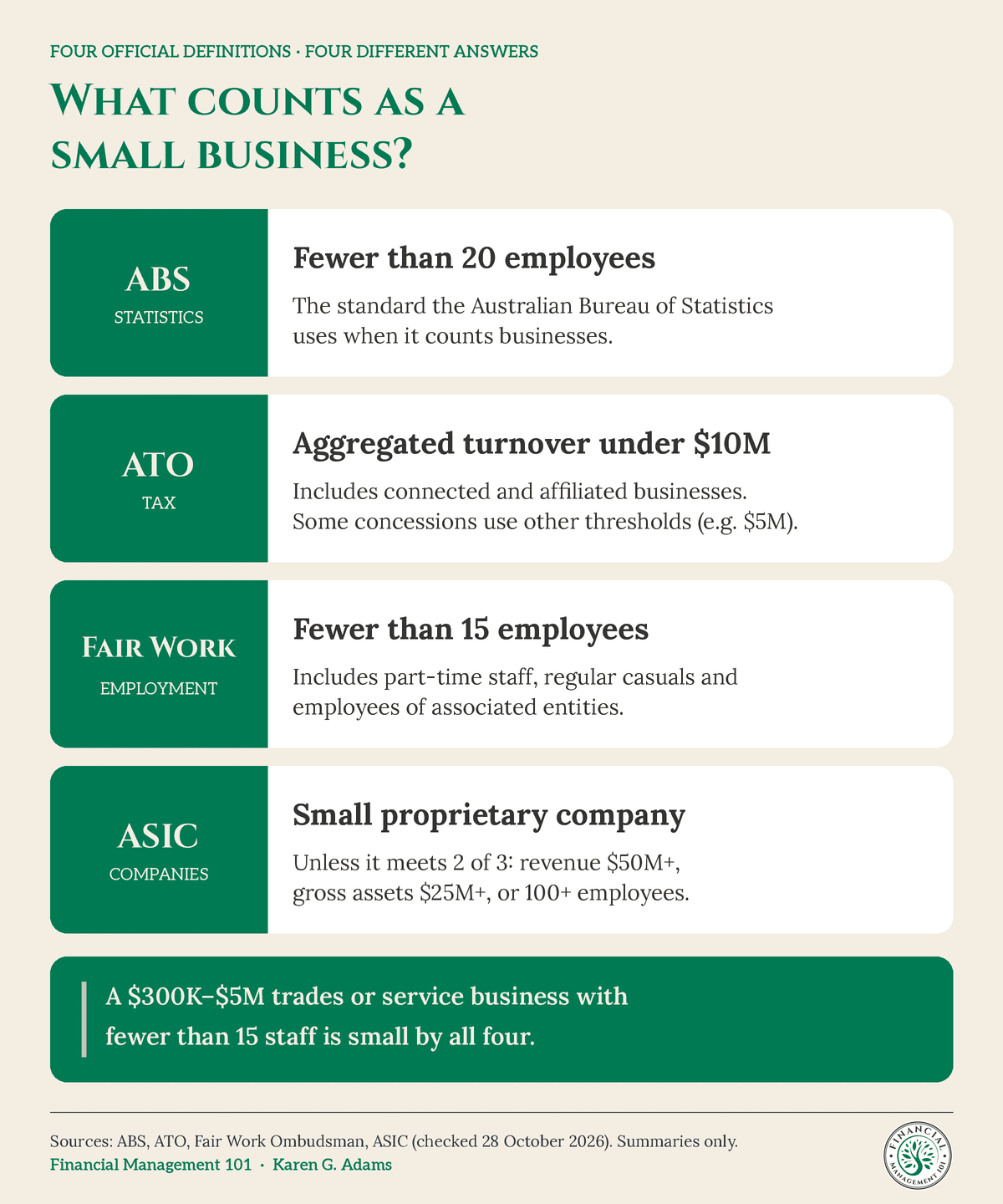
There’s no single definition. The ABS counts a small business as one with fewer than 20 employees. The ATO uses aggregated turnover of less than $10 million. Fair Work uses fewer than 15 employees. And ASIC treats a proprietary company as small unless it meets two of three “large” tests on revenue, assets and employees.
Four official definitions, four different answers
There’s no single definition of a small business in Australia. Each government body draws the line for its own purpose.
The ABS (statistics): a small business has fewer than 20 employees. That’s the standard the Australian Bureau of Statistics uses when it counts businesses.
The ATO (tax): you’re a small business entity if you carry on a business and your aggregated turnover is less than $10 million. That turnover includes connected and affiliated businesses. (A few concessions use other thresholds, like $5 million for the small business income tax offset.)
Fair Work (employment): under the Fair Work Act, a small business employer has fewer than 15 employees. That headcount includes part-time staff, regular casuals and employees of associated entities. It matters for things like unfair dismissal rules.
ASIC (companies): a proprietary company is “large” if it meets at least two of these three tests: consolidated revenue of $50 million or more, consolidated gross assets of $25 million or more, or 100 or more employees. If it doesn’t, it’s a small proprietary company. (The Government has proposed lifting the revenue and assets tests to $100 million and $50 million, but ASIC says those changes aren’t in effect yet.)
Notice the range. “Small” can mean fewer than 15 people, fewer than 20, under $10 million in turnover, or under $50 million in revenue. Same label, very different businesses.
What the numbers say about who’s really out there
The ABS counted 2,814,778 actively trading businesses in Australia at 30 June 2026. About 97 per cent of them had fewer than 20 employees.
Yes, plenty are tiny. Around 65 per cent don’t employ anyone at all.
But look at turnover. At 30 June 2025, the latest turnover figures available, 35.4 per cent of Australian businesses turned over between $200,000 and $2 million. Another 4.8 per cent turned over between $2 million and $5 million.
That’s about 1.1 million businesses in the $200K to $5M range. Real operations, with wages, vehicles, suppliers, tax obligations and families relying on them.
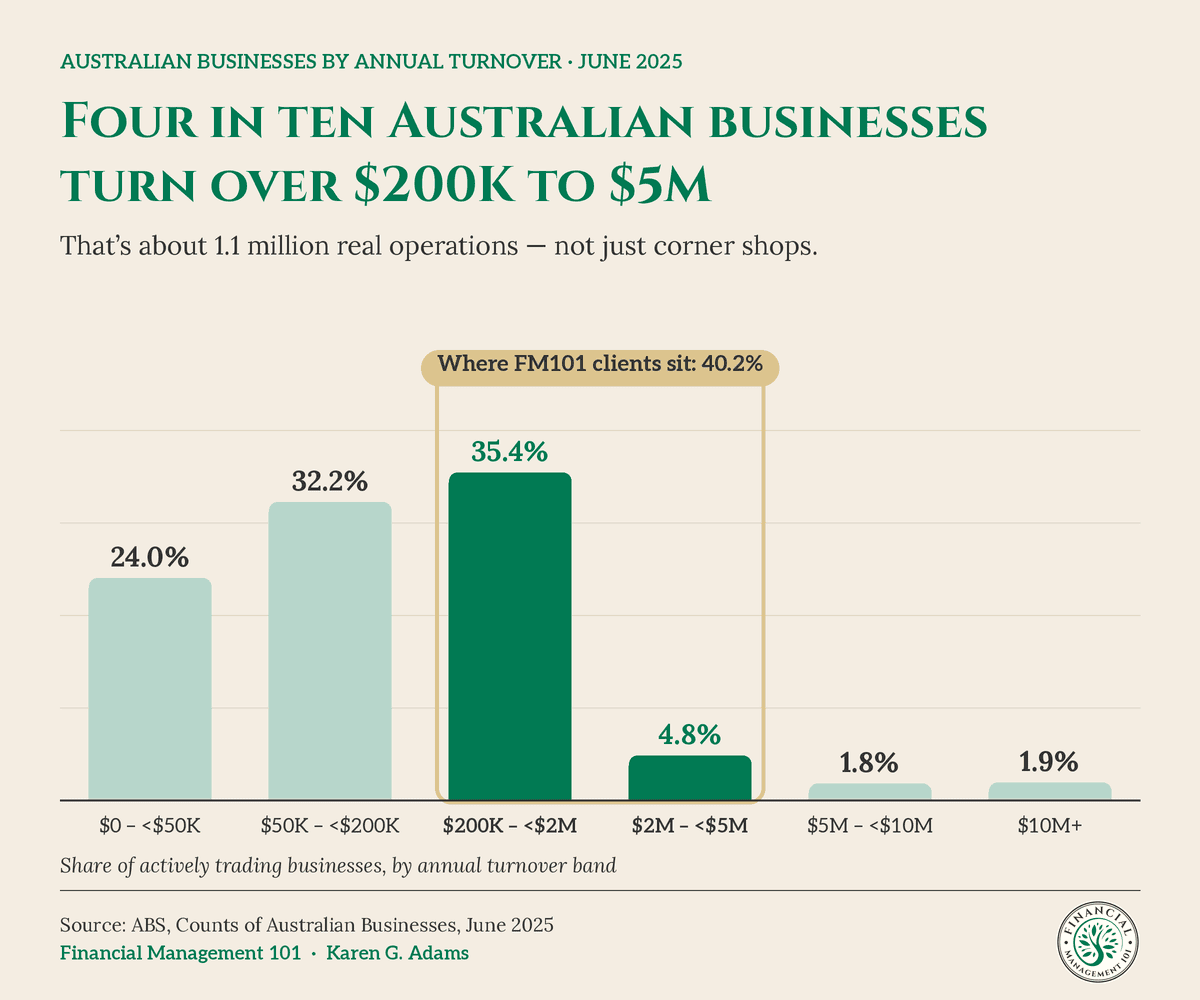
So if your trades or service business turns over $300,000 to $5 million with fewer than 15 staff, you’re a small business by every official measure. With up to 19 staff, you still are for the ABS, the ATO and ASIC. And either way, you’re running something substantial.
I call it Too Big to Wing It. Too Small to Need a CFO.
Why the label matters more than you’d think
When we picture “small business” as tiny, we tend to run it like it’s tiny.
We check the bank balance and call it financial management. We look at the numbers at tax time. We assume that if the phone’s ringing and the team’s busy, the money must be fine.
At $1.5 million in turnover, that approach gets expensive. Let me show you exactly what I mean.
A worked example: a fictional electrical business with 10 staff
- Turnover: $1,500,000
- Direct costs (materials, subcontractors, on-the-tools wages): $900,000
- Gross profit: $600,000, or 40 cents in every dollar
- Overheads (rent, vehicles, insurance, software, admin): $380,000
- A fair wage for the owner: $120,000
- What’s actually left: $100,000
That’s under 7 cents in every dollar of turnover.
And the break-even point? Overheads plus the owner’s wage, divided by the gross profit margin: $500,000 ÷ 40% = $1,250,000. This business is only $250,000 above break-even.
A few underquoted jobs, one slow-paying builder or an uncosted variation or two, and that 7 cents disappears fast. On a $1.5 million turnover, the room for guesswork is small.
This example is fictional and for illustration only. Your figures will be different.
Your accountant and bookkeeper make sure the numbers are right. That’s essential. The next step is you knowing how to run the business with them, week to week.
Your action this week: check your three gauges
Block out 30 minutes this week with your latest monthly reports. Think of them as the three gauges on your dashboard.
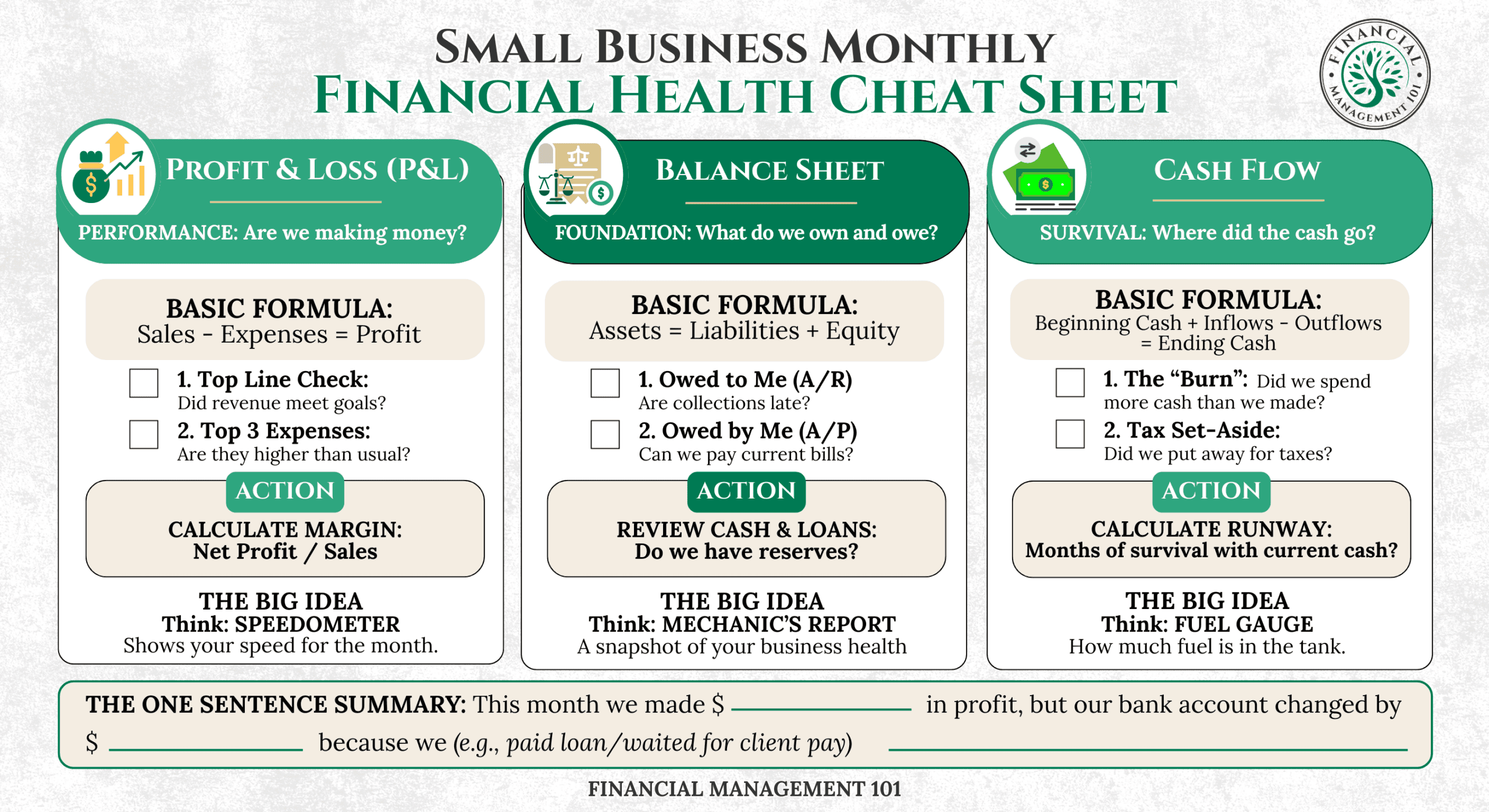
1. The speedometer: your Profit & Loss
It shows how fast you’re going this month. Are we making money?
Calculate your net profit margin: net profit ÷ sales. In our example, $100,000 ÷ $1,500,000 = 6.7%. Then ask: did revenue meet the goal, and are the top three expenses higher than usual?
2. The mechanic’s report: your Balance Sheet
It’s a snapshot of what you own and what you owe.
Check what customers owe you. Are collections running late? Then check what you owe. Can you pay current bills, and do you have reserves?
3. The fuel gauge: your cash flow
It tells you how much is in the tank.
Calculate your runway: cash on hand ÷ average monthly outgoings. In our example, monthly outgoings are about $116,700. If there’s $90,000 in the bank, that’s under three weeks of fuel. Also check: did we spend more cash than we made, and have we set aside enough for tax?
Related reading: Why Is Cashflow Always Tight?
Then write one sentence
“This month we made $_____ in profit, but our bank account changed by $_____ because we _____.”
That one sentence connects your profit to your cash. When you can read the story, you can change the ending.
Related reading: What Numbers Should A Small Business Owner Track?
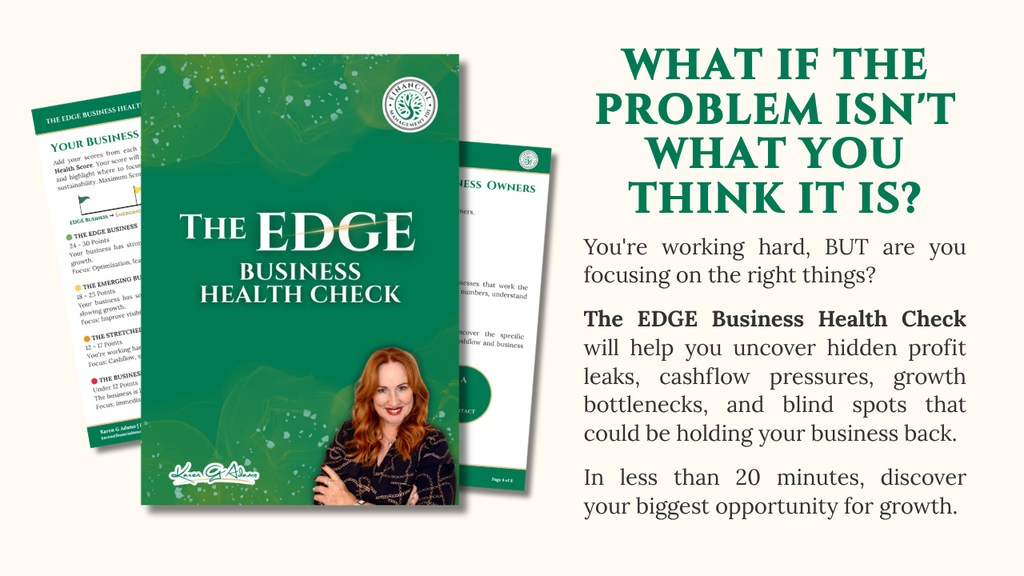
Your next step: The EDGE Business Health Check
If doing those three checks raised more questions than answers, you’re not alone in this.
The EDGE Business Health Check is the next step. It takes about 20 minutes with your last 12 months’ Profit & Loss, and it gives you:
- Your EDGE Score across 30 statements in five areas: Profit & Pricing, Cashflow, CEO Visibility, Systems & Freedom, and Growth
- Your Profit Leak Calculator results: your break-even, your true net profit once you’re paid fairly, what a 5% price rise would add, what your unbilled time is worth, and how much cash is tied up in slow payers
- Your lowest area, so you know the one thing to fix first
- A 7-Day Reset you can start on Monday, around 20 minutes a day
It’s $47, and it’s designed for established business owners like you.
Rather talk it through first? Get in touch and book a call with me.
Frequently asked questions
What is the ATO definition of a small business?
For tax, you’re a small business entity if you carry on a business and your aggregated turnover is less than $10 million. That turnover includes connected and affiliated businesses. A few concessions use other thresholds, like $5 million for the small business income tax offset.
How many employees can a small business have in Australia?
It depends who’s asking. The ABS counts a small business as one with fewer than 20 employees. Under the Fair Work Act, a small business employer has fewer than 15 employees, including part-time staff, regular casuals and employees of associated entities.
Is a business turning over $300,000 to $5 million still a small business?
Yes. If your trades or service business turns over $300,000 to $5 million with fewer than 15 staff, you’re a small business by every official measure. With up to 19 staff, you still are for the ABS, the ATO and ASIC.
How many small businesses are there in Australia?
The ABS counted 2,814,778 actively trading businesses in Australia at 30 June 2026. About 97 per cent of them had fewer than 20 employees, and around 65 per cent don’t employ anyone at all.
When is a company “small” under ASIC’s rules?
A proprietary company is “large” if it meets at least two of three tests: consolidated revenue of $50 million or more, consolidated gross assets of $25 million or more, or 100 or more employees. If it doesn’t, it’s a small proprietary company. The Government has proposed lifting the revenue and assets tests, but ASIC says those changes aren’t in effect yet.
You’ve built something real. Financial confidence starts with clarity.
Karen G. Adams
Small Business Performance Strategist, Financial Management 101
Business education only, not financial, tax or legal advice. The official definitions above are summaries; check with your accountant or adviser how each one applies to your business.