

Maybe you’re a year or two in, turnover is creeping up, and someone at a barbecue told you to “just register for GST”. Or maybe your business is growing fast, a big contract has landed, and you’re not sure if you’ve just crossed a line you didn’t see coming. Both lead to the same question: when do I need to register for GST?
Either way, GST registration is one of those decisions that feels simple until you’re in it. Let me walk you through it in plain English, for both situations.
THE SHORT ANSWER
When do I need to register for GST?
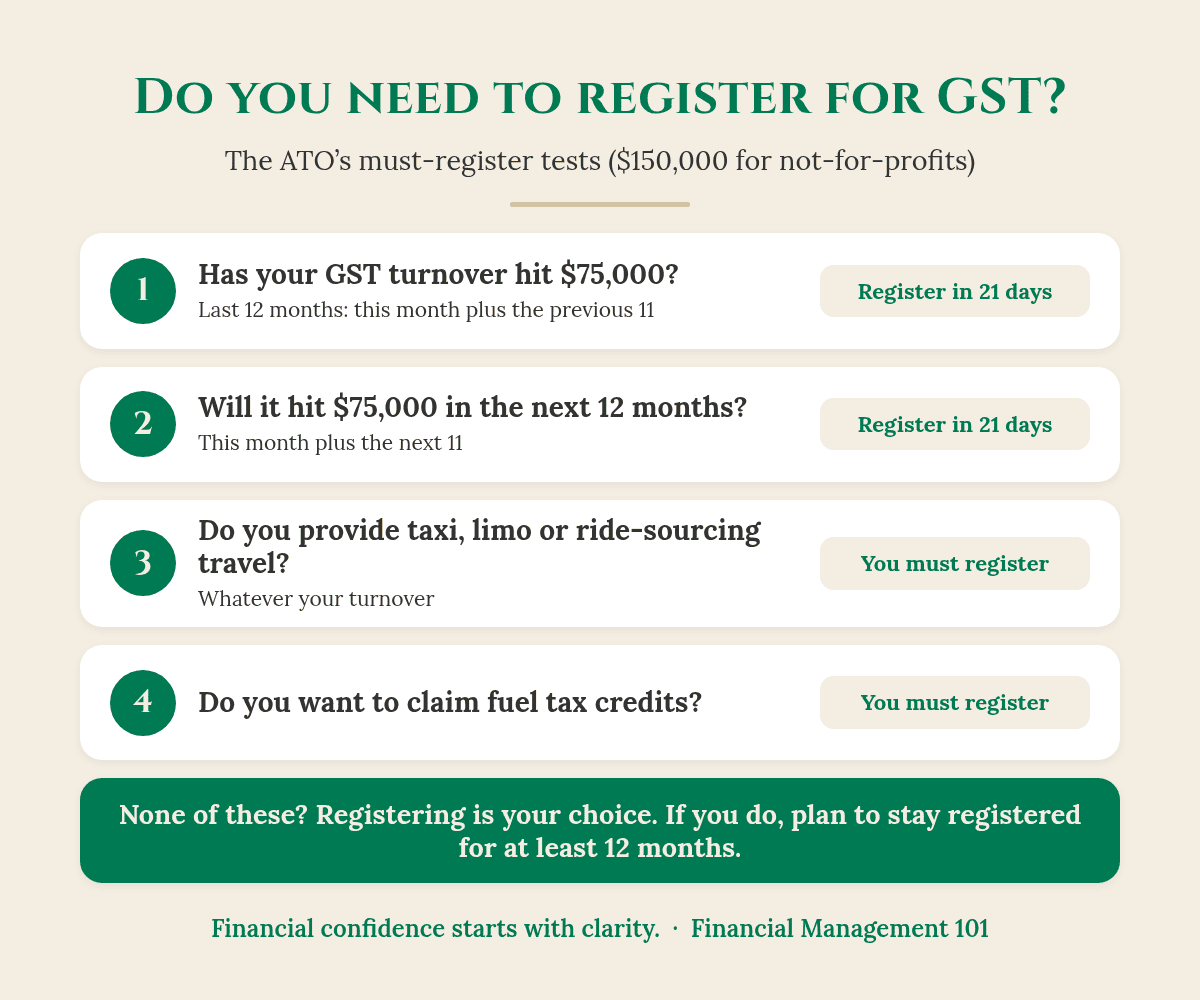
You must register for GST within 21 days of your GST turnover reaching $75,000 or more, or when you expect it to reach $75,000 in the next 12 months (or $150,000 for not-for-profits). Some businesses, like taxi and ride-sourcing drivers, must register whatever their turnover. Otherwise, under the threshold, it’s your choice.
That comes straight from the ATO’s Registering for GST page. Now let’s look at what it means for you.
What counts towards the $75,000 GST threshold?
Your GST turnover is broadly your total business income, not your profit, less any GST you’ve charged. Some types of sales aren’t counted, so ask your accountant if you’re unsure. If you run more than one business, the income from all of them counts.
There are two tests, and you need to check both regularly:
- Current GST turnover: this month plus the previous 11 months.
- Projected GST turnover: this month plus the next 11 months.
Check this first: Most owners only look backwards. But if a new contract, a new staff member or a price rise means you’ll pass $75,000 in the next 12 months, the projected test applies now. Make it part of your monthly numbers check. My post What Numbers Should a Small Business Owner Track? shows where it fits.
I’m under $75K. Should I register for GST anyway?
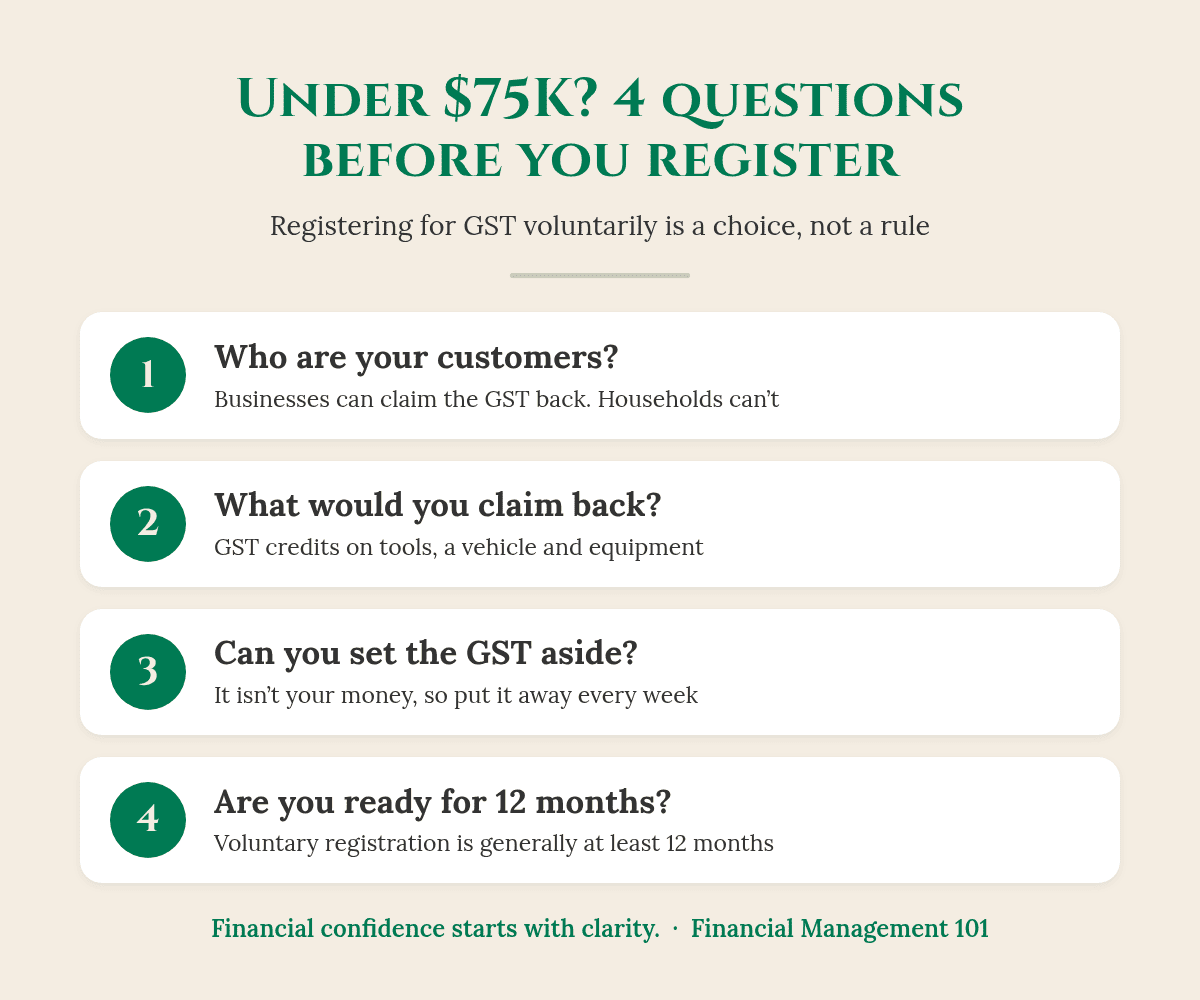
I totally get why this is confusing. There’s no single right answer. It depends on who your customers are and what you spend to run the business. If you register voluntarily, the ATO expects you to stay registered for at least 12 months (ATO). Here’s how I’d weigh it up.
The pros of registering early
- You can claim GST credits on business purchases like tools, a vehicle, equipment or a fit-out, as long as you have valid tax invoices.
- Business customers often expect it. Builders, head contractors and commercial clients can claim the GST back, so it doesn’t cost them more.
- No scramble at the threshold. Your pricing, invoices and systems are set up properly from day one.
- Good habits early. Setting aside GST and lodging a BAS builds the discipline a growing business needs.
The cons of registering early
- Household customers pay more. If you sell mostly to the public, you either add 10% to your prices or absorb it and earn less.
- More admin. You’ll need to issue tax invoices, keep records and lodge a BAS.
- Cash flow discipline. The GST you collect isn’t yours, so you need to set it aside every week.
- You’re committed for 12 months. You can’t easily switch back off if it doesn’t suit you.
So what does this actually look like?
Here’s an illustrative example (made up to show the thinking, not a real client). A mobile garden maintenance business turns over about $58,000 a year, almost all from households. Its biggest costs are fuel and small equipment.
Registering would mean adding 10% to every job for customers who can’t claim it back, in exchange for a modest amount of GST credits. For now, staying unregistered is a reasonable choice. But the owner is also pitching to a strata company. If that contract lands and projected turnover passes $75,000, the decision gets made for them, and they’ll have 21 days to register.
Compare that with a new electrician who mostly subcontracts to builders and has just bought a ute and $15,000 of tools. Registering early could make sense, because the builders expect it and the GST credits on that equipment help. (If you’re still working out what kind of business you are, start with What Is a Small Business in Australia?)
Not registered yet? What should I do while I’m under $75K?
If you’ve decided not to register for now, that’s a perfectly sound choice. The trick is staying in control, so the threshold never sneaks up on you. Here’s what I’d put in place this month:
- Get your ABN sorted. You need an Australian Business Number before you can register for GST, so have it ready (ATO).
- Check your rolling 12 months every month. Look back (this month plus the previous 11) and look forward (this month plus the next 11). Pick an early-warning figure, say $65,000, so registering becomes a planned decision, not a scramble.
- Don’t add GST to your quotes or invoices. Until you’re registered, you don’t charge GST. Your invoice total is simply your price.
- Quote big jobs with GST in mind. If one contract could push you over $75,000, make sure the price still works if you need to register and account for GST on it.
- Check the must-register exceptions. Taxi, limousine and ride-sourcing travel, and claiming fuel tax credits, mean you must register whatever your turnover (ATO).
Good to know: If you register voluntarily and your GST turnover stays under $75,000, you may be able to report GST once a year instead of quarterly. The annual GST return is due on 31 October (ATO). Ask your BAS agent whether that suits you.
What happens when my business grows past $75,000?
Here’s the thing… if you run a growing trades or service business, the answer to “when do I need to register for GST?” rarely lands on a neat date. It arrives with a big job, a busy season or a new hire. That’s why the projected test matters so much.
The 21-day rule
Once your current or projected GST turnover reaches $75,000, you have 21 days to register (ATO). You’ll need an ABN. Your accountant or BAS agent can register for you, or you can do it yourself.
What if I’ve already passed it and didn’t register?
In my 40 years in financial services, I’ve seen this more often than you’d think, and it’s fixable. But don’t wait. The ATO says that if you were required to register and didn’t, you may have to pay GST on your sales from the date you should have been registered, even if you didn’t charge your customers GST. Penalties and interest may also apply (ATO).
The ATO can backdate your registration, generally up to four years. Here’s an illustrative example of how that adds up. A carpenter’s projected turnover passed $75,000 when a big deck contract was signed, but he didn’t register. Since then he’s invoiced $71,500 without adding GST. The ATO will generally treat one-eleventh of that, about $6,500, as GST he owes, and he can’t easily go back to customers for it.
What to look for: If you think you’ve missed it, talk to your accountant or BAS agent this week. Getting it sorted early usually costs less than waiting.
What changes once I’m registered for GST?
- Your prices: you’ll need to include GST in your prices, or add it on top. Decide which before you send your next quote.
- Your invoices: you’ll issue tax invoices, and if a customer asks for one you generally have to provide it within 28 days (ATO).
- Your BAS: you’ll lodge a business activity statement, usually quarterly for a small business, reporting the GST you’ve collected and the GST credits you’re claiming.
- GST credits: you can claim credits for the GST in your business purchases, generally within four years, as long as you hold a tax invoice (not needed for purchases of $82.50 or less including GST).
- Your cash flow: the GST you collect sits in your account until the BAS is due. Put it aside weekly in a separate account, or it will feel like your money. Why Is Cashflow Always Tight? explains why this catches so many owners out.
Should I choose cash or accrual for GST?
When you register, you choose how to account for GST. If your aggregated turnover is under $10 million, you can generally choose either (ATO).
- Cash basis: you report GST when you’re paid and claim credits when you pay your bills. For a trades or service business with 30-day terms, slow payers or retentions, it usually keeps cash flow easier, because you’re not paying GST on money you haven’t received.
- Non-cash (accrual) basis: you report GST on a sale when you issue the invoice or receive any payment, whichever comes first, and claim credits when you receive a supplier’s invoice or pay it, whichever comes first. It can suit a business that’s paid upfront or wants its BAS to match its invoices.
Talk to your accountant or bookkeeper before you choose. They’re your partners in this, and they know how your books are set up.
Financial confidence starts with clarity.
Your takeaway
- You must register within 21 days once your current or projected GST turnover reaches $75,000.
- Check both tests every month, especially when a big job or contract is on the way.
- Under $75K, registering is a choice. Weigh up who your customers are and what GST credits you’d claim, and remember it’s at least 12 months.
- Once registered, set your prices, invoices, cash or accrual choice and a weekly GST set-aside before your first BAS.
- If you’ve missed the threshold, act now. Your accountant can help you get it sorted.
Want to know if your business is ready for the next stage?
Start with The EDGE Business Health Check. It’s a $47 workbook that takes about 20 minutes. You score 30 quick statements across five areas: Profit & Pricing, Cashflow, CEO Visibility, Systems & Freedom, and Growth. Then the Profit Leak Calculator shows where money may be slipping away, and the 7-Day Reset gives you clear next steps.
Rather talk it through first? Get in touch and book a call with me.
Frequently asked questions
Do I have to register for GST if I earn under $75,000?
Generally no. Registration is optional under $75,000, unless you provide taxi, limousine or ride-sourcing travel, or you want to claim fuel tax credits (ATO). If you choose to register, you’ll generally need to stay registered for at least 12 months.
Is the $75,000 GST threshold based on income or profit?
It’s based on your GST turnover, which is broadly your business income, not your profit, excluding GST. Both your current turnover (the past 12 months) and your projected turnover (the next 12 months) count.
How long do I have to register for GST?
You have 21 days from when your current or projected GST turnover reaches $75,000 to register.
Can I backdate my GST registration?
Yes. The ATO can generally backdate registration up to four years. If you should have registered earlier, you may owe GST on past sales even if you didn’t charge it, plus penalties and interest. Talk to your accountant first.
Is it better to register for GST on a cash or accrual basis?
If your aggregated turnover is under $10 million, you can generally choose. Many trades and service businesses find the cash basis easier on cash flow, because GST is reported when customers actually pay. Your accountant can confirm what suits you.
Run the business by the numbers, not the bank balance.
Karen G. Adams
Small Business Performance Strategist, Financial Management 101
This article is general education only. It isn’t financial, tax or legal advice, and it doesn’t take your personal circumstances into account. The garden maintenance, electrician and carpenter examples are illustrative, not real clients. GST rules have exceptions, so check your situation with your accountant, BAS agent or the ATO before you register or change how you account for GST.